C2 - Circles, chords and tangents
Use a circle's centre and radius to write its equation, recover them by completing squares, and solve coordinate problems involving chords, right angles and tangents. You will see how one distance condition explains all these geometric relationships.
Circle equations and radius
Can a single equation tell you whether a point is on a circle, whether an angle is right and which way a tangent runs? Begin with the circle centred at with radius . The point is across and up from the centre, so Pythagoras puts it exactly units away.
You already know
The squared distance between two points is the sum of the squared horizontal and vertical changes. A midpoint averages the two coordinates. Finite gradients of perpendicular lines multiply to ; horizontal and vertical lines form the boundary case.
A circle contains every point at one fixed distance from its centre, not the whole region inside it.
Circle
A circle is the locus of points at a fixed positive distance , the radius, from a fixed point , the centre. For example, a radius of gives a circle. Radius zero gives a single point, not a nondegenerate circle.
Pythagoras translates that definition into coordinates. Squared distances also distinguish points inside and outside the circle.
Circle equation and mensuration
For centre and radius ,
A point is inside, on or outside according as its squared distance from the centre is less than, equal to or greater than .
The circumference is , and the enclosed area is .
Not in the formula booklet: learn it.
Compare the brackets carefully: means , so the corresponding centre coordinate is . The right-hand side is the squared radius.
Worked example 1: forming a circle
Question. A circle has centre and radius . Find its equation, circumference and enclosed area, and check whether lies on it.
Plan. Substitute the centre and squared radius into the standard form, then test the point's squared distance.
Why this step? A point lies on the circle exactly when its squared distance equals ; being nearby on a sketch does not establish this.
Answer. The equation is . The point lies on it. Circumference is length units and area is square units.
Check. The greatest horizontal coordinate is ; substituting gives .
The next example changes how the radius is supplied: you know a point on the circle instead of the radius itself.
Worked example 2: finding the radius from a point
Question. A circle has centre and passes through . Find its equation and determine whether lies inside it.
Plan. Calculate the squared radius from the known point, then compare the second squared distance with it.
Why this step? The centre-to-point distance is a radius; a distance between two arbitrary circumference points would instead be a chord.
Answer. , and is inside.
Check. The point gives ; the centre itself gives zero, correctly placing it inside.
The bracket signs and the square on the radius each carry geometric information.
Watch out
Wrong: the number on the right of the circle equation is its radius. Right: it is ; take the positive square root to find , and read centre signs from and .
Use the same radius-from-a-point method with a different centre in the next question.
Completing squares for circles
Completing squares turns an expanded equation into a form that displays its centre and radius.
For example, : expanding the bracket gives an extra , so subtract to compensate. Do this separately for the and terms.
Completing a coordinate square
For a real constant ,
After completing both squares, a positive squared radius gives a circle, zero gives one point, and a negative value gives no real points.
Not in the formula booklet: learn it.
An expanded circle has equal coefficients of and and no term. If both squared terms have the same nonzero coefficient, first divide the whole equation by it. Unequal squared coefficients do not give the circle form by this method.
Worked example 3: recovering a centre and radius
Question. Find the centre and radius of by completing the square.
Plan. Complete the two coordinate squares, then collect all constants on the right.
Why this step? The compensating constants keep the equation equivalent; they must be moved as well as the squared brackets.
Answer. Centre , radius .
Check. Expanding gives , which recovers the original equation.
Now change the resulting squared radius from positive to negative. The algebra still works, but there is no real circle to report.
Worked example 4: an empty locus
Question. Determine whether represents a real circle. Justify your answer.
Plan. Complete the squares and check the sign of the right-hand side.
Why this step? Recognising the bracket pattern is insufficient: the supposed squared radius must be positive for a circle.
Answer. There are no real points satisfying the equation, so it does not represent a real circle.
Check. Even at , where both squares are smallest, their sum is zero rather than .
A zero right-hand side is a different boundary case: both squares must then vanish. It gives one point, rather than an empty set.
Watch out
Wrong: has centre and radius . Right: the centre is , and the radius is .
The next equation changes only the constant from Worked example 4. Decide which boundary case it gives.
Chords and perpendicular bisectors
A perpendicular from the centre to a chord makes two right triangles with equal hypotenuses, so it divides the chord into equal halves.
Chord
A chord is the line segment joining two distinct points on a circle. A diameter is a chord through the centre. A tangent touches the circle at one point and is not a chord.
Let be the perpendicular foot from centre to chord . The triangles and share , and . Pythagoras gives , hence . This proves the bisection property. Conversely, the line from the centre to the midpoint of a non-diameter chord is perpendicular to the chord.
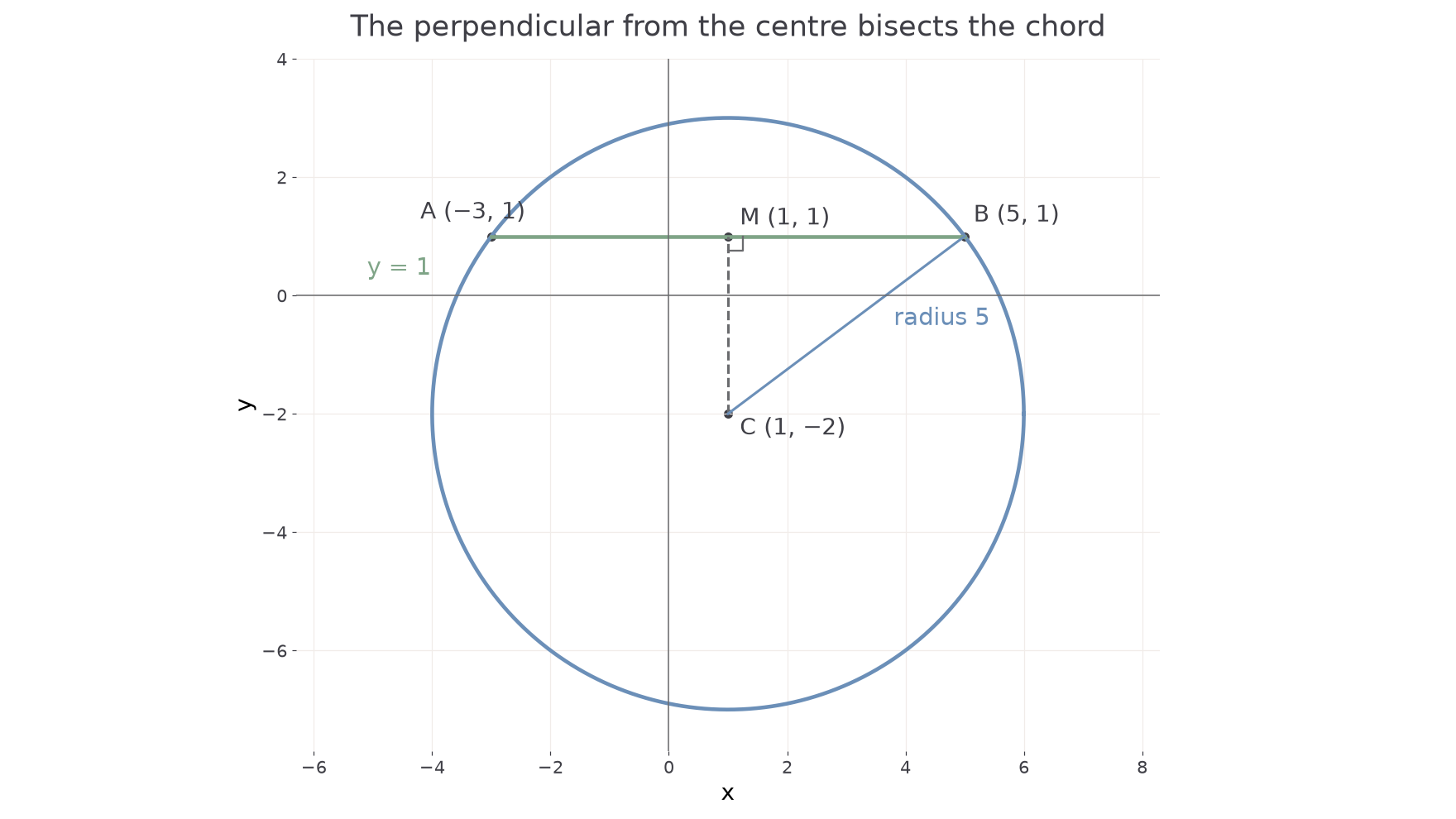
The right triangle gives a convenient length result. It is derived from Pythagoras rather than supplied separately.
Length of a chord
If is the perpendicular distance from the centre to a chord line in a circle of radius ,
At , the chord is a diameter. At , the line is tangent and there are no two distinct chord endpoints.
Not in the formula booklet: learn it.
The midpoint of a diameter is the centre. In that case the zero-length segment from centre to midpoint has no direction; choose the line through the centre perpendicular to the diameter instead.
Worked example 5: a horizontal chord
Question. A circle has centre , radius , and a chord on . Find the chord's length and endpoints.
Plan. Locate the perpendicular foot, find half the chord by Pythagoras, then move left and right from the midpoint.
Why this step? The perpendicular foot is the chord's midpoint, so one right triangle determines the whole chord.
Answer. Length , endpoints and .
Check. At either endpoint, .
Change only the chord's orientation. For an oblique chord, find the perpendicular foot by intersecting two lines before using the same right triangle.
Worked example 6: an oblique chord
Question. Find the length of the chord where meets .
Plan. Intersect the chord line with its perpendicular through the origin, then use the perpendicular distance.
Why this step? Distance to an arbitrary point on the chord is not the shortest distance; the right triangle needs the perpendicular foot.
Answer. The chord length is .
Check. The endpoints and satisfy both equations and have squared separation .
The same procedure works for a translated centre: the perpendicular line must pass through that centre, not automatically through the origin.
Watch out
Wrong: report as the full chord length. Right: that is half the chord, because the perpendicular bisects it; double the result.
The next chord changes the radius and direction, but its half-chord still belongs to the same right triangle.
Angle in a semicircle
A diameter and a third point on the circumference form a right-angled triangle, with the right angle opposite the diameter.
For diameter endpoints and , the point gives gradients and , so the angle at the third point is right. The result remains true when that point moves anywhere else on the circle, apart from the endpoints themselves.
Angle in a semicircle
If is a diameter and is a different point on the circle, then
Conversely, a point forming a right angle with fixed endpoints lies on the circle with diameter .
Not in the formula booklet: learn it.
You can slide the third point around the circle, changing both triangle side lengths, yet the angle stays exactly right. A short coordinate proof explains this. Put the diameter endpoints at and . A different circle point satisfies , so
The denominators are nonzero: a circle point with would be an excluded endpoint. Thus the two joining lines are perpendicular. This explains why the theorem works for every allowed third point.
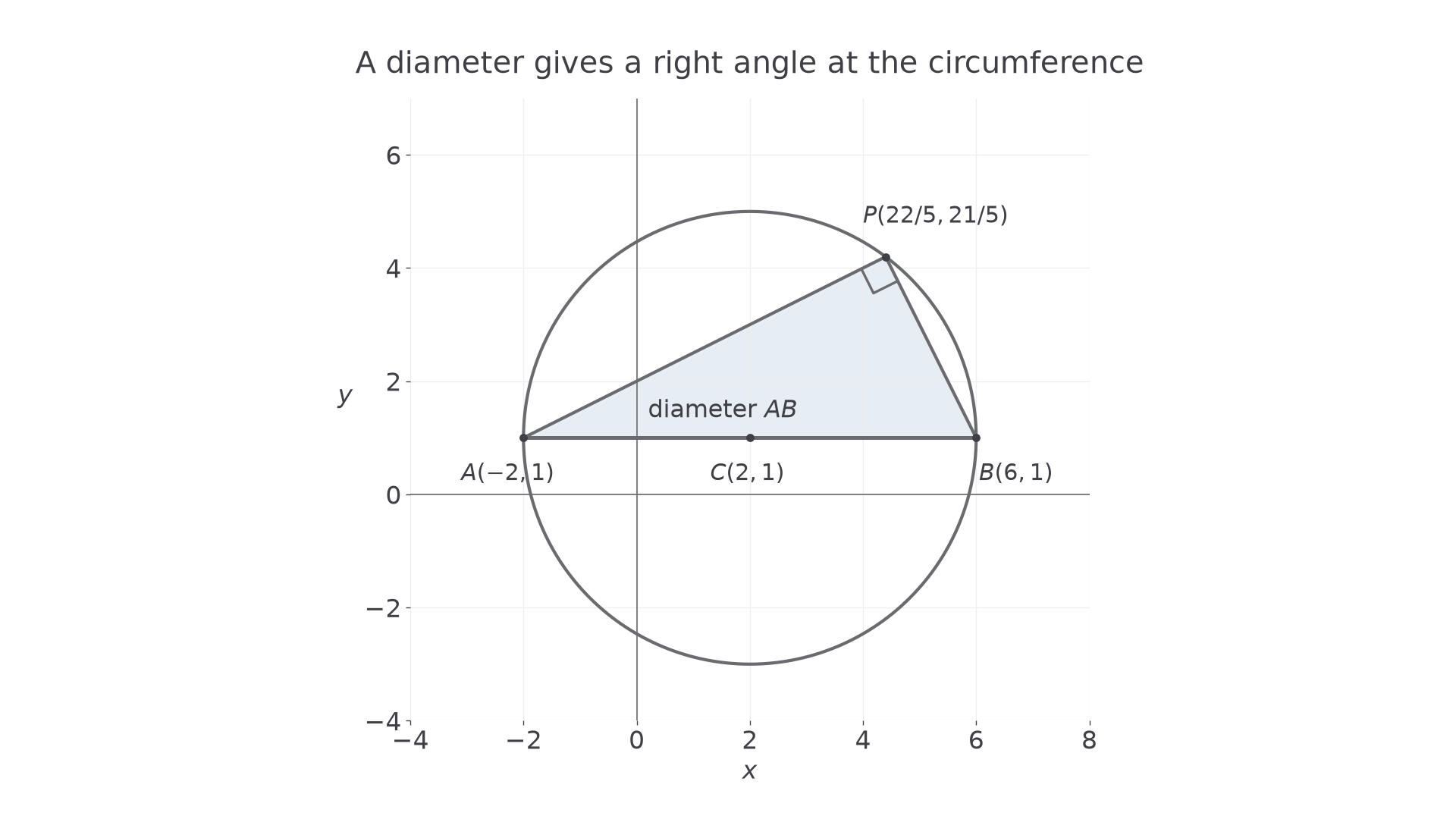
Use the theorem only after establishing that the opposite side is a diameter and the third point is on the circle.
Worked example 7: verifying the right angle
Question. A diameter has endpoints and . Show that is on the circle, and deduce .
Plan. Find the diameter midpoint and half-length, test , then apply the theorem.
Why this step? A triangle merely being inside a circle does not establish a right angle; the diameter condition does.
Answer. is on the circle, and .
Check. The gradients of and are and , with product .
The next example changes only the third point's position. The triangle is no longer symmetric, but the diameter still forces the right angle.
Worked example 8: an asymmetric triangle
Question. For the same diameter endpoints , show that gives .
Plan. Check the point against the circle with centre and radius .
Why this step? The equal-radius condition is what matters; the two sides meeting at need not have equal length.
Answer. is a distinct circumference point, so the angle at is right.
Check. and , again giving product .
The diameter is the hypotenuse, never one of the two sides meeting at the right angle.
Watch out
Wrong: any triangle inside a circle has a right angle. Right: the side opposite the proposed right angle must be a diameter, and the third point must be a distinct point on the circumference.
Keep the point names in your conclusion clear when applying the theorem to the next diameter.
Tangents and normals to circles
A tangent's direction is fixed by the radius at its contact point; the normal follows the radius through the centre.
Tangent and normal
A tangent to a circle touches it at one point and is perpendicular to the radius there. The normal at that point is the line perpendicular to the tangent, so it passes through the centre. A line crossing the circle at two distinct points is not a tangent.
Why does the perpendicular radius give a tangent? From any other point on that perpendicular line, Pythagoras gives . Thus every other line point is outside the circle: there is exactly one contact point. This perpendicular-radius property is not in the formula booklet: learn it.
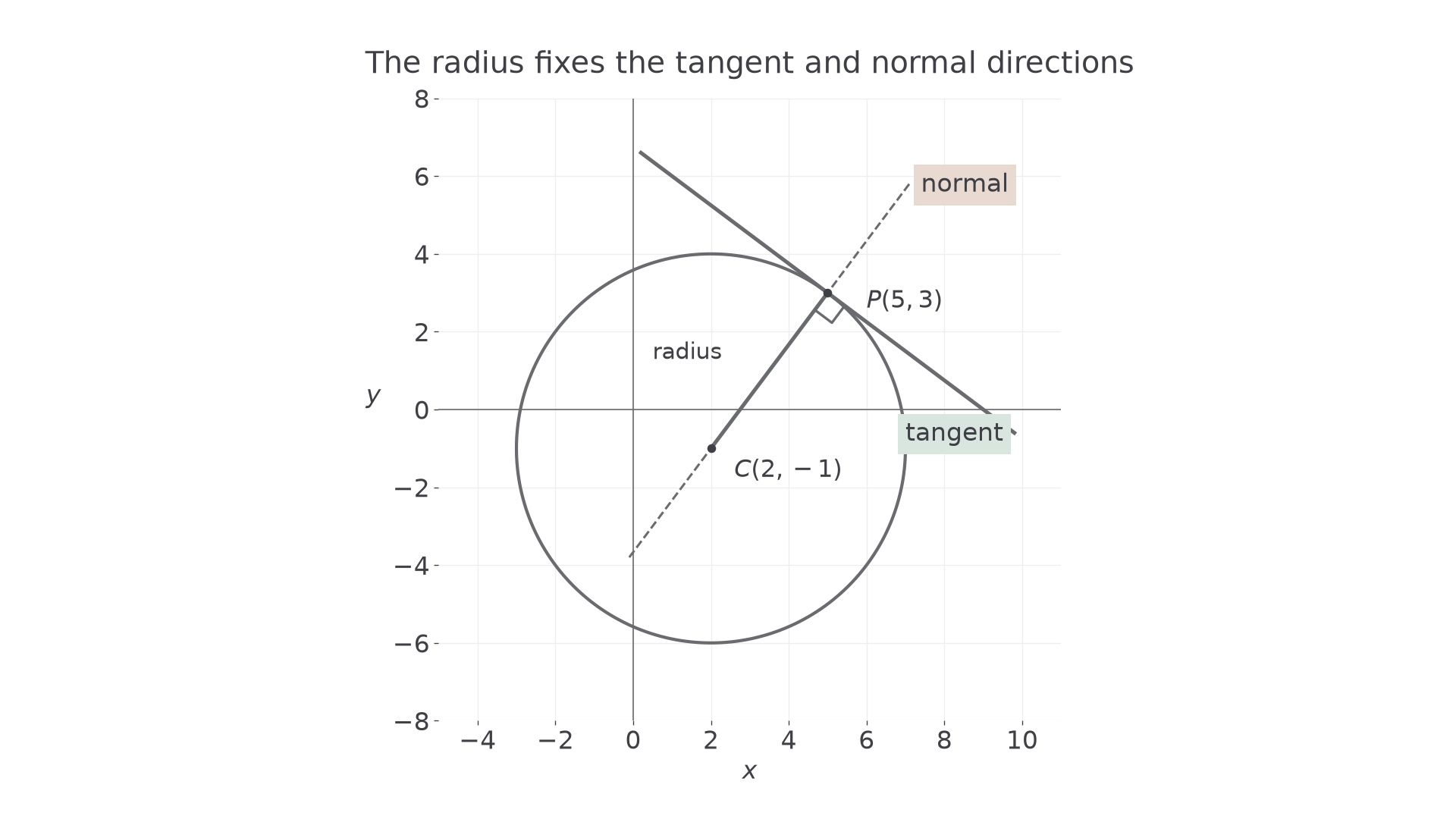
First check that the given point is on the circle. Then find the radius gradient, turn it through a right angle for the tangent, and anchor each line at the contact point.
Worked example 9: tangent and normal
Question. Find the tangent and normal to at .
Plan. Use the centre to find the radius direction and its perpendicular.
Why this step? The normal has the radius gradient; using that gradient for the tangent would give the wrong line.
Answer. Tangent: . Normal: .
Check. Both contain . The normal also contains , since .
Now change only the contact point to the circle's rightmost point. The radius becomes horizontal, so the tangent equation is vertical.
Worked example 10: a vertical tangent
Question. Find the tangent and normal to at .
Plan. Recognise the horizontal radius and write the vertical and horizontal line equations directly.
Why this step? A negative-reciprocal calculation would divide by zero; the geometric direction is already clear.
Answer. Tangent , normal .
Check. Putting into the circle gives , so is its only contact point.
The opening question now has an answer. The circle equation tests distance; the diameter theorem gives a right angle; the radius gives the tangent's direction. One fixed-distance definition ties the geometry together.
Watch out
Wrong: use a tangent at a point before checking membership. Right: verify the point is on the circle first. A tangent through an outside point is a different problem and may have two contact points.
For a new circle, change the centre and contact point, then follow the same direction-and-position method.
Quick Recap
- A circle is the set of points with , where .
- Complete both squares to find the centre and squared radius; check whether that squared radius is positive.
- A perpendicular from the centre bisects a chord, producing a right triangle with half the chord.
- The angle opposite a diameter at a distinct circumference point is right.
- The tangent is perpendicular to the radius; the normal passes through the centre.
Yes: one circle equation supplies the distance test that supports the right-angle and tangent arguments in the opening question.