R1, R3 - Forces, weight and Newton's first law
Identify the interactions acting on one body and turn them into a clear force diagram (R1). You will distinguish mass from gravitational weight (R3), then use Newton's first law to find unknown forces when a body rests or moves with constant velocity.
Forces on one body
Can a crate move to the right while four nonzero forces on it add to zero? Imagine a crate pulled along a floor: the pull is rightwards, friction is leftwards, the floor supports it upwards and gravity pulls it downwards. The question is what these forces do together.
You already know
A vector has magnitude and direction. Opposite signed components cancel: a rightward force of and a leftward force of have zero resultant. Velocity includes direction as well as speed.
First choose one body. For each force, ask what other object or medium exerts it. A force arrow describes an interaction, not the direction in which the chosen body happens to travel.
Force and free-body diagram
A force is an interaction that can change a body's velocity. It is a vector measured in newtons, . A free-body diagram shows the forces acting on one chosen body. When the body is modelled as a particle, draw those arrows from a single point.
The direction follows from the interaction. These are the forces you will meet most often.
| Force on the chosen body | Direction |
|---|---|
| Weight | Vertically downwards locally |
| Normal reaction from a surface | Perpendicular to the surface, away from it |
| Tension in a taut string or stretched rod | Along the string or rod, pulling the body |
| Thrust in a compressed rod | Along the rod, pushing the body |
| Friction | Along the contact, opposing sliding or the tendency to slide |
| Resistance of a medium | Opposing motion through that medium |
A string can pull but cannot push. A rod can transmit tension or thrust. A smooth contact is modelled as frictionless; it can still exert a normal reaction. Treating an object as a particle ignores its size and rotation, but does not by itself remove resistance. You must state that assumption separately when you need it.
Worked example 1: forces on a moving crate
Question. A crate moves right along a horizontal floor. Its weight is , its normal reaction is , a horizontal pull is right and friction is left. Represent the forces and find their resultant.
Plan. Put all four interactions on the crate, then add signed horizontal and vertical components.
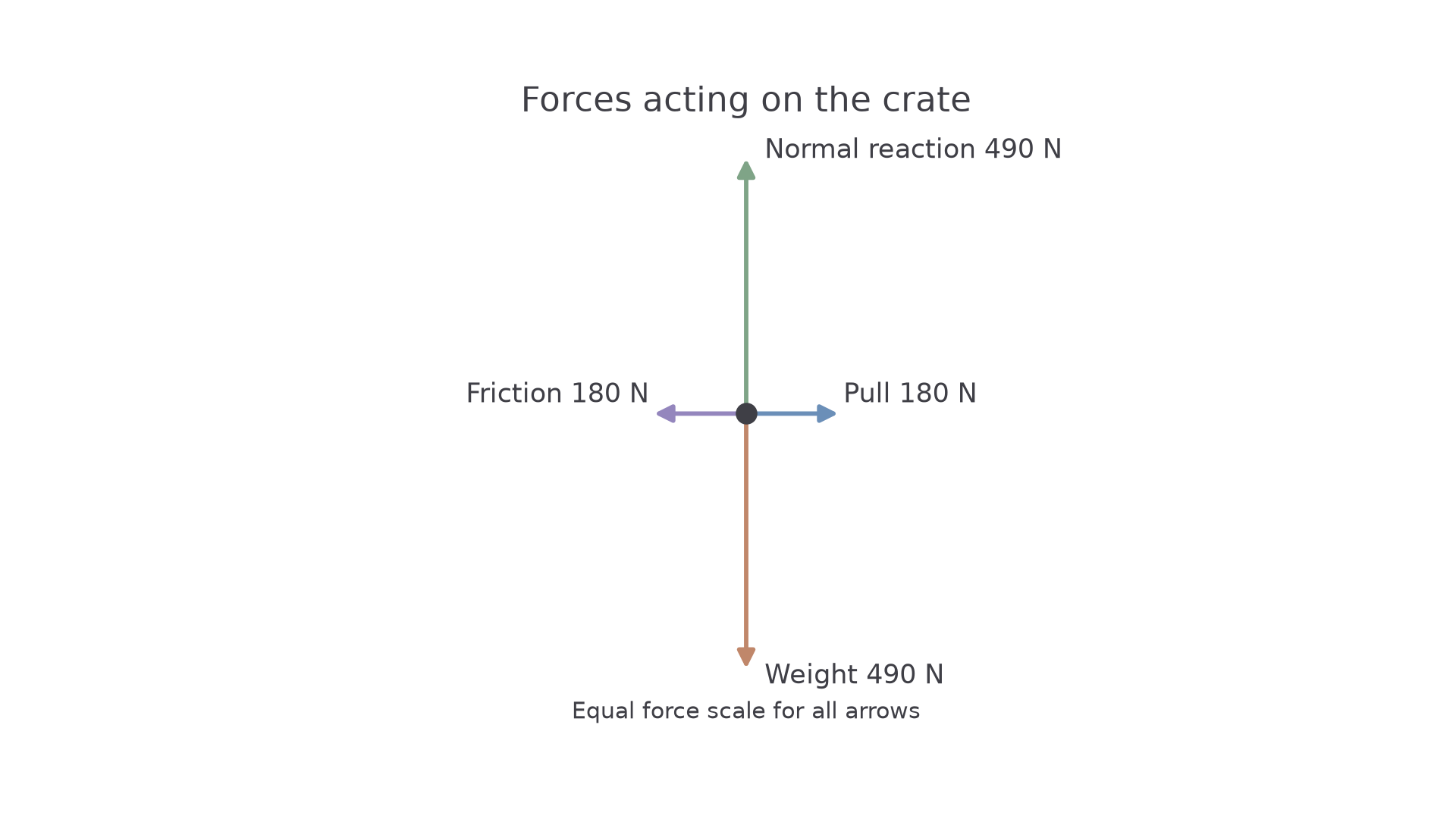
Why this step? The forces act in two independent directions, so both component sums must be included.
Answer. The resultant is the zero vector. The floor exerts the normal reaction and friction; the pull and weight come from other interactions.
Check. Each direction has equal opposing forces. The arrows use one common force scale; ordinary free-body sketches need correct directions and labels, but need not be to scale unless asked.
Worked example 2 adds one interaction: an upward pull from a vertical string. The floor's reaction is smaller, so there are now three vertical arrows to account for.
Worked example 2: adding a supporting string
Question. The moving crate still has weight , pull right and friction left. A taut vertical string now pulls upwards with tension , and the floor's normal reaction is . Represent the forces and find their resultant.
Plan. Include the string as a separate interaction, then sum all the vertical forces as well as the horizontal pair.
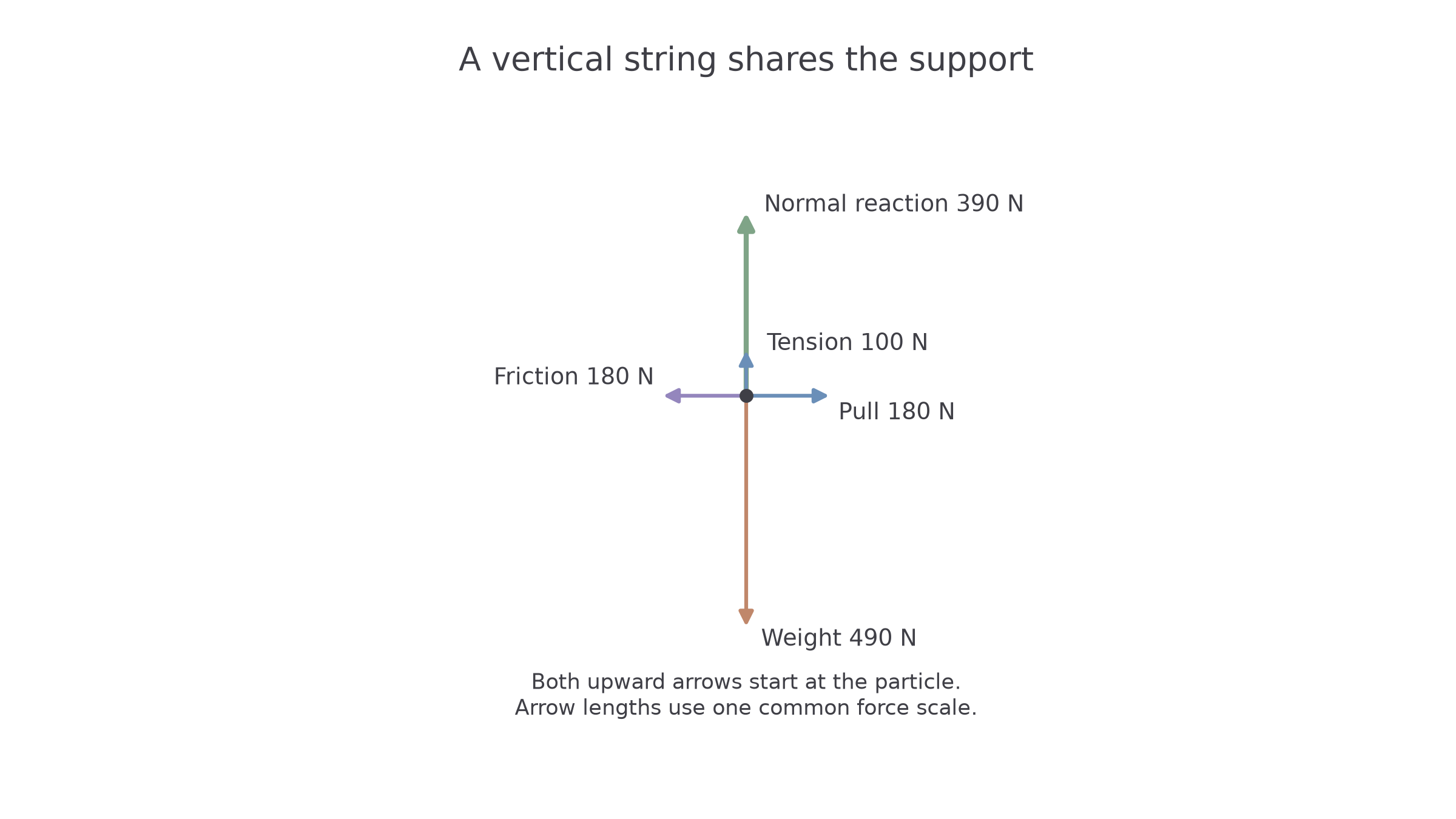
Why this step? Tension and normal reaction are different interactions on the crate, even when they point in the same direction.
Answer. Five forces act and the resultant is still zero. The floor supplies of the upward support and the string supplies the remaining .
Check. The upward total is , equal to the weight. No force called “motion” is needed.
Force identification and vector addition are not supplied as rules in the formula booklet: learn them. Keep the list of physical interactions separate from later calculations with their components. Equal weight and reaction on this crate are not a Newton's third-law pair: such a pair acts on two different bodies, as you will study later.
Watch out
Wrong: “Smooth means the normal reaction is zero.” Smooth removes friction, which acts along the contact. A normal reaction acts perpendicular to the contact and may still be nonzero. Include it whenever the surface supports or constrains the body.
Try the same interaction check with a smooth surface. All the force data are given, so you do not need to know the mass.
Mass, weight and local gravity
Moving a parcel to a place with weaker gravity changes its weight without removing any of its mass. A parcel weighs where , but only where . The same parcel can therefore need a very different supporting force.
Mass and weight
Mass measures a body's inertia and is measured in kilograms, . Weight is the gravitational force acting on that mass and is measured in newtons. Changing location changes weight through the local gravitational acceleration , while the mass remains unchanged.
The gravitational force acts vertically downwards locally. Over an ordinary small region we treat as constant, but it is not a universal constant: it depends on location.
Weight
Here is the magnitude of weight in , is mass in , and is gravitational acceleration in .
Not in the formula booklet: learn it.
Use the value of stated in the question. Keep unrounded working, then give final gravity answers to the corresponding accuracy: gives one significant figure, two and three. If a question explicitly gives a different accuracy instruction, follow it.
Continue this lesson.
You’re previewing NovaLearn without an account. Create a free account to read the rest.
Create free account