R2, R5 - Resultant forces and Newton's second law
Add forces as vectors and use their resultant to determine acceleration (R2, R5). You will connect constant forces to familiar motion equations, then use calculus and differential equations when a constant-mass particle experiences a force that varies with time or speed.
Adding force components
Can the same driving force and resistance law speed one particle up while slowing another down? Suppose a drive is right and resistance has magnitude left, where is rightward speed. At the drive wins; at resistance wins. To predict either motion, first find the resultant rather than choosing one force.
You already know
A force is a vector. Add like signed components, and use Pythagoras for a vector's magnitude. Zero resultant gives constant velocity; a nonzero resultant changes velocity.
For a simple horizontal pair, right and left give right, not . With two perpendicular directions, carry out that signed addition separately in each direction.
Resultant force
The resultant force is the vector sum of all forces acting on the chosen body. It has the same effect on the particle's acceleration as those forces combined.
A vector-addition diagram may translate arrows head-to-tail. Its resultant joins the first tail to the last head. This is different from a free-body diagram, where the arrows identify actual interactions on one body.
Resultant in components
For perpendicular unit vectors and ,
Find and by adding the signed components of all the forces. Direction needs a reference axis and the correct quadrant; for a nonzero resultant, use the component triangle.
Not in the formula booklet: learn it.
If both components are zero, the resultant has zero magnitude and no direction. Otherwise, a calculator's alone may select the wrong quadrant.
Worked example 1: head-to-tail addition
Question. Forces and act on a particle. Find their resultant, its magnitude and its direction anticlockwise from , to one decimal place.
Plan. Add components, use Pythagoras, then choose the angle from the signs.
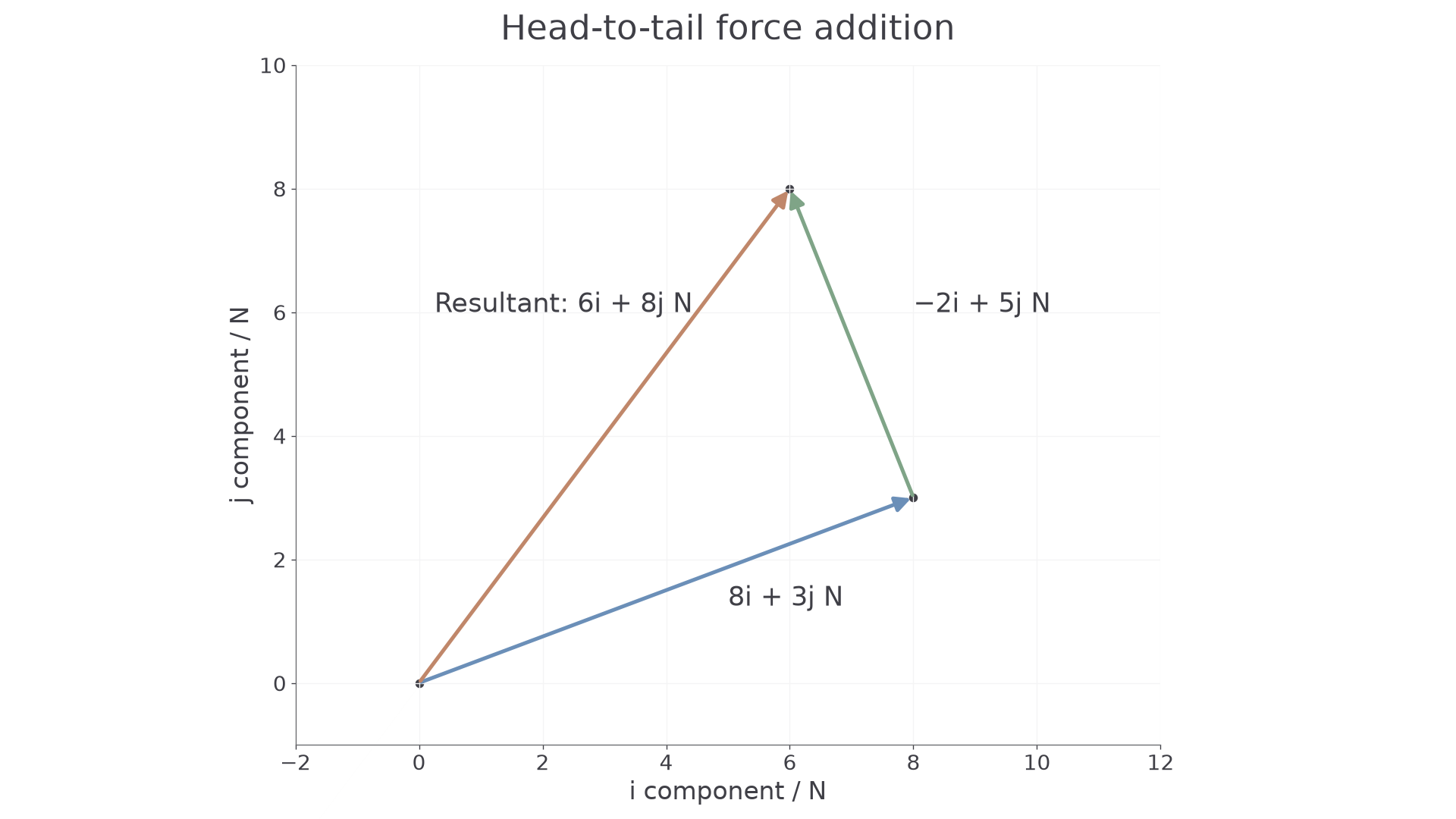
Why this step? The positive components place the resultant above and to the right, so the acute angle is measured from the positive direction.
Answer. The resultant is , with magnitude and direction anticlockwise from .
Check. and . The head-to-tail endpoint is .
Worked example 2 reflects the force arrangement in the vertical axis: only the signs of horizontal components change. The magnitude stays the same, but the direction needs a quadrant correction.
Worked example 2: a resultant in quadrant II
Question. Forces and act on a particle. Find their resultant, magnitude and direction anticlockwise from , to one decimal place.
Plan. Add signed components, then measure the quadrant-II angle from the positive horizontal axis.
Why this step? The horizontal component is negative and the vertical component positive. The resultant points up-left, not down-right.
Answer. The resultant is , with magnitude and direction .
Check. , while . Reflection changed the horizontal sign and preserved the length.
The addition method works for any number of forces, not just two. Equal and opposite vectors such as and cancel even though each has magnitude .
Watch out
Wrong: for every pair. Adding magnitudes discards direction. Right: add signed components first, then find the magnitude of their sum. Opposite forces have zero resultant, not .
Change the force components once more and check the quadrant before reporting the angle.
Second law in components
The resultant determines acceleration, not velocity. A rightward-moving particle can have a leftward resultant and slow down. Its motion at that instant does not change the signs of the forces.
Newton's second law
For a particle of constant mass ,
Here is the resultant force and is acceleration. One newton is .
Not in the formula booklet: learn it.
Choose positive directions before writing equations. Reversing an axis changes both the force and acceleration components, leaving the physical prediction unchanged. For positive mass, acceleration has the direction of the resultant.
When the resultant is constant, acceleration is constant too. You may then use , which is in the formula booklet. The law that gives still has to be recalled.
Worked example 3: a retarding resultant
Question. A particle initially moves right at . Constant forces of right and left are its only horizontal forces. Find its acceleration and its velocity after .
Plan. Take right positive, find the signed resultant, then use constant-acceleration motion.
Why this step? The force on the left is larger, so acceleration is leftwards even while the particle moves right.
Answer. Acceleration is left. After , velocity is right.
Check. The velocity decreases by in three seconds. Taking left positive would give , and , describing the same motion.
Worked example 4 changes only the initial velocity. The force equation is unchanged, but the particle now reverses before the requested time.
Worked example 4: a reversal with unchanged forces
Question. The same particle has the same constant forces, right and left, but initially moves right at . Find its velocity after and when it first comes to rest.
Plan. Keep , then use signed velocity to locate the stop and subsequent direction.
Why this step? A negative velocity now means motion leftwards. It is different from the negative acceleration, which acted throughout.
Answer. The particle first rests at , then moves left; after it moves left at .
Check. At the stopping instant the resultant is still left, so the particle does not remain at rest. The forces here are specified constant forces, rather than resistance that changes direction after a reversal.
In a plane, use the same law in each perpendicular direction. For example, divide each component of by the same mass; do not divide its magnitude and then attach the original vector.
Watch out
Wrong: , using just the larger force. Right: when right is positive. Newton's second law uses the resultant of all relevant forces, with signs.
The next particle has a resultant already supplied as a vector, so there is no extra force sum to construct.
Time-dependent force and motion
A changing force can produce changing acceleration. If its component is proportional to time, that component of acceleration is not constant over an interval. Integrate it rather than inserting one value into a constant-acceleration formula.
You already know
Acceleration is the derivative of velocity; displacement over an interval is the integral of velocity. Integrate a vector component by component, and use the initial velocity to determine each integration constant.
A constant mass lets you divide the entire force function by . The time variable remains in the acceleration function.
Force and calculus
For constant mass,
Here is a dummy time variable. Both component constants must satisfy the initial condition.
Not in the formula booklet: learn it.
Continue this lesson.
You’re previewing NovaLearn without an account. Create a free account to read the rest.
Create free account