F2, F7 - Exponential growth and decay models
Use F2 to connect an exponential's gradient to its current value. Apply that proportional-rate idea in F7 models of continuous interest, population growth and decay, then test assumptions and refine models with a nonzero baseline.
Exponential gradients and proportional rates
If a growing population doubles, must it take longer to double again because it now needs more new organisms?
Imagine that each organism contributes the same average net growth rate. A population twice as large then adds organisms twice as quickly. The absolute rate changes, even while the rate per organism stays constant.
You already know
For , an interval of length multiplies the amount by . Taking solves for an unknown time. These index and logarithm results are not supplied in the formula booklet.
The special property of is that its gradient equals its current value. More generally the gradient of is . The notation means the instantaneous rate of change, or tangent gradient; use this exponential gradient result directly here. Later lessons develop differentiation methods and their derivations.
Exponential gradient and relative rate
For ,
When , the constant ratio is the relative rate. For positive , gives growth and gives decay.
Not in the formula booklet: learn it.
If time is in days, has units ; its product with time is dimensionless. An absolute rate has units of amount per day. A continuous relative rate of gives a one-day percentage increase , rather than exactly . This conversion is a consequence of the unsupplied exponential model.
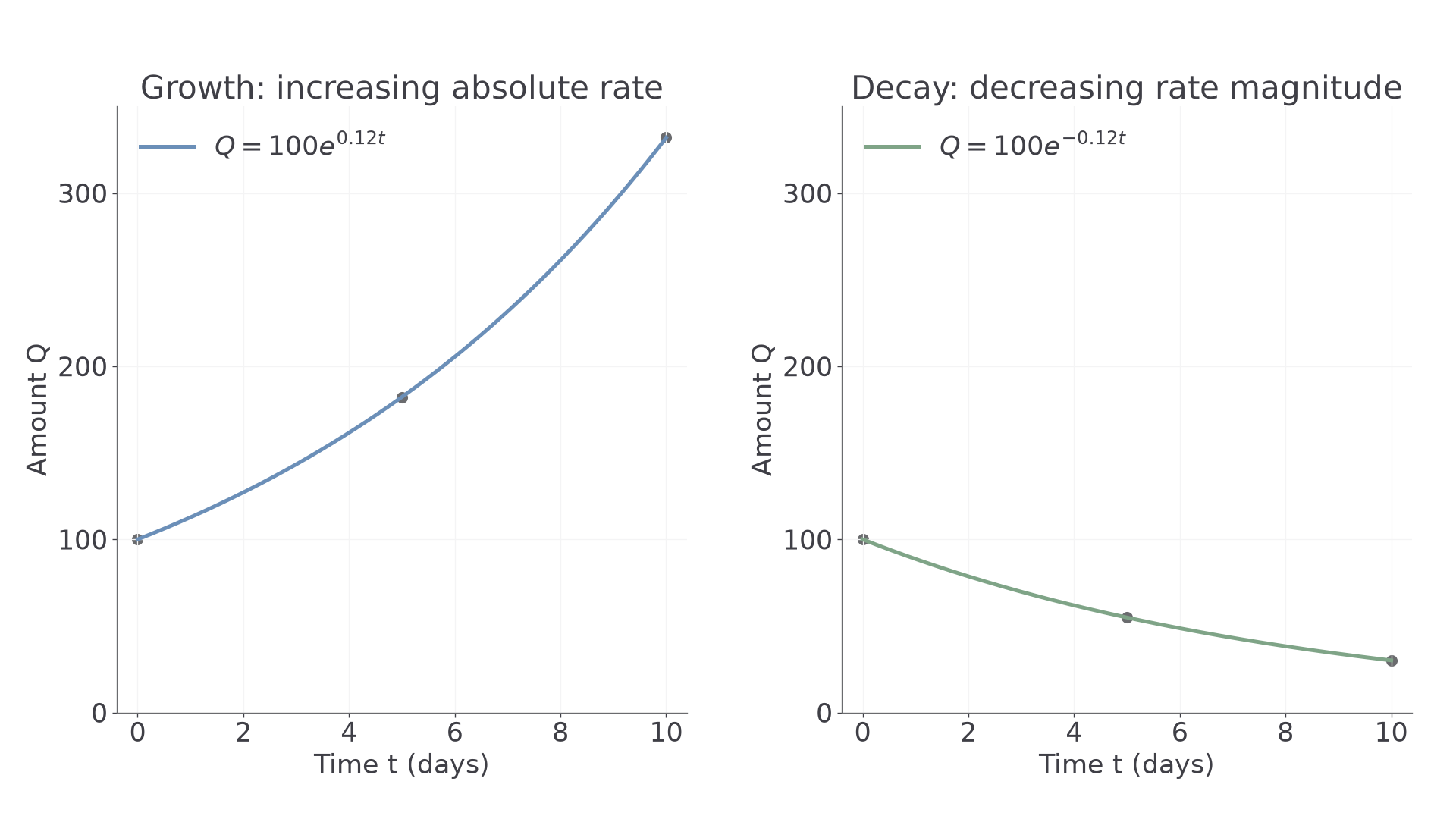
The growth curve steepens as more is present. The decay rate is negative, but its magnitude gets smaller as less remains. Adding a constant amount each day would instead give a straight line.
Worked example 1: a population's rate and doubling time
Question. A population is modelled by , with in days. Find its initial growth rate, its rate after days, and its doubling time.
Plan. Multiply the population by its relative rate, then solve the equation for twice the starting amount.
Why this step? The amount cancels in the doubling equation, so the time depends on the relative rate, not the initial population.
Answer. Rates: initially and after days approximately organisms per day. Doubling time: approximately days.
Check. . Over any further interval of length , the same factor applies again.
Change only the initial population to . This doubles each absolute rate, but the time to multiply the population by should be unchanged.
Worked example 2: doubling the initial amount
Question. Repeat the rate and doubling-time calculations for , with time in days.
Plan. Use the same relative-rate multiplier and set the target to twice the new starting amount.
Why this step? Doubling both the amount and its growth rate leaves the time to achieve a fixed multiplying factor unchanged.
Answer. Rates: and approximately organisms per day, respectively. The doubling time remains approximately days.
Check. Each unrounded rate is twice its value in example 1, while .
The gradient rule works for negative exponents too. For , the gradient is ; at , it is . The negative gradient describes decrease, not a negative amount.
Watch out
Wrong: “The rate of is organisms per day.” The is a relative rate in . Multiply by the current population: the absolute rate is organisms per day.
Change only the initial population again. Use the rate's units to distinguish it from an amount.
Continuous compound interest
Continuous compounding models a balance increasing at a rate proportional to the balance at every instant.
For a nominal annual rate , compounding times per year gives after years. Increasing makes each interest addition smaller but more frequent; its limiting balance is . Neither of these compounding formulae is supplied in the formula booklet.
Continuous compound interest
Here is the initial balance, the continuous annual rate as a decimal, and time in years. Assume constant and no deposits, withdrawals or fees.
The one-year multiplier is , so the effective annual percentage increase is . Conversely, .
Not in the formula booklet: learn it.
A continuous rate of means ; the effective annual increase is about . Use the same time units as the rate, and retain the exact rate until the final monetary rounding.
Worked example 3: a balance and a target time
Question. An initial £2500 earns continuous interest at rate , with no other transactions. Find the balance after years to the nearest penny, and the time to reach £3500 to two decimal places.
Plan. Substitute the given time, then solve a separate exponential equation for the target balance.
Why this step? Divide by the original deposit before taking logarithms; the target is an amount ratio, not an amount to add to the exponent.
Answer. The balance is £3274.91, including £774.91 interest. The target is reached after approximately years.
Check. ; the target exceeds the six-year balance, and the target time exceeds .
Change only the target from £3500 to £4000. The account's model stays fixed, so compare the new time with the first target time.
Worked example 4: a higher target
Question. For the same initial £2500 and continuous rate , find the time to reach £4000 to two decimal places.
Plan. Form the new balance ratio, then solve its logarithmic equation.
Why this step? A target expressed as a multiplying factor fits the exponential model directly; adding a fixed amount each year would describe a different model.
Answer. Approximately years.
Check. . The higher target takes longer than years, as it should.
These are continuous times. Rounding up to the next integer would answer a different question about the first whole-year anniversary. For comparison, a £1800 deposit at has balance after years.
Watch out
Wrong: . A percentage must be converted to a decimal: , so the exponent is .
Change only the target again and preserve the unrounded logarithm until the end.
Decay constants and half-life
Exponential decay removes a fixed fraction over equal time intervals, so its modelled amount stays positive at every finite time.
A model uses a positive decay constant . The rate is : the minus sign describes decrease. The half-life is the time for the amount to halve. To obtain its formula, divide by , then take : .
Continue this lesson.
You’re previewing NovaLearn without an account. Create a free account to read the rest.
Create free account