Q3 - Vector constant-acceleration motion
Extend constant-acceleration equations to two dimensions, calculate speed and direction from velocity components, and solve conditions that must hold at the same time. You will distinguish where a particle is from the direction in which it is moving, then recover a motion model from observations.
Position and velocity component equations
Can a particle be north of its starting point while moving due east? Use east/north axes, with distances in metres and time in seconds. Start it at , give it initial velocity and constant acceleration . After seconds its northward velocity has disappeared, but its northward displacement has not. Two component equations will tell us exactly where it is.
You already know
For constant acceleration along a line, and . A position vector locates a point from the origin; displacement is final position minus initial position. Perpendicular components add as vectors.
Let and be fixed perpendicular unit vectors in the stated positive directions. They have magnitude and no physical units. You may write a vector as or . The third Cartesian unit vector is unnecessary for this two-dimensional motion.
A constant acceleration vector has constant components. Apply a straight-line equation separately in each direction, using the same elapsed time. Define as initial position, as position and as displacement. This position–displacement relation is not printed in the formula booklet: learn it.
Constant vector acceleration
For constant , initial velocity and elapsed time ,
In the formula booklet.
Position and displacement are measured in metres, velocity in and acceleration in . Adding to a displacement equation gives the corresponding position equation. Constant acceleration need not produce a straight path: the two velocity components can change in different ways.
Worked example 1: three different vectors
Question. A particle has metres, and constant . Find velocity, displacement and position after seconds.
Plan. Use the vector velocity and displacement equations, then add the initial position.
Why add only at the last step? The motion equation finds change in position, whereas measures position from the chosen origin.
Answer. Velocity is , displacement is metres and position is metres. It is north of its start while moving due east.
Check. Average velocity is , giving displacement .
The path , bends even though acceleration is constant. The arrow below is tangent to the path, rather than pointing from the origin to the particle.
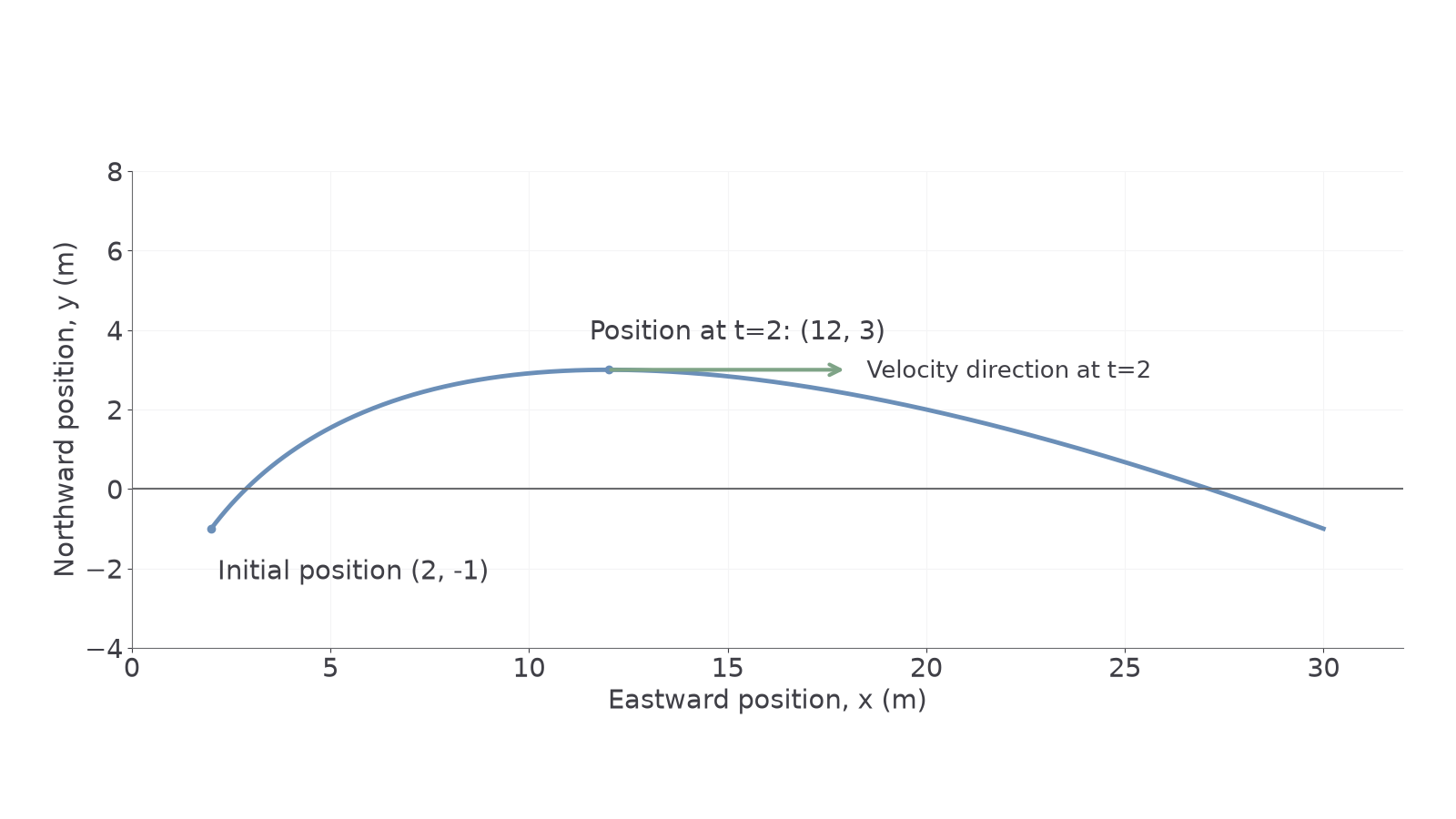
Worked example 2 changes the elapsed time only. The northward velocity now becomes negative, so the same path is being followed downwards.
Worked example 2: continuing past the horizontal tangent
Question. For the same particle, find velocity, displacement and position after seconds.
Plan. Substitute into the same component equations and keep the initial position separate.
Why can the displacement have a positive northward component while velocity has a negative one? Displacement records the whole journey so far; velocity describes motion at this instant.
Answer. Velocity is , displacement is metres and position is metres.
Check. The average-velocity relation gives , agreeing with the displacement.
Both examples use legitimate vector sums. Squaring a vector as if it were a scalar would introduce an operation that these equations do not define.
Watch out
Wrong: . There is no such vector equation in this course or the booklet. Right: use the four vector equations above, or apply and its vertical counterpart to signed scalar components.
Try one more elapsed time. State all three vectors so that position and displacement cannot be confused.
Speed, direction and bearings
Velocity components determine both speed and direction; a position vector or a single velocity component cannot replace them.
If velocity is , the particle moves west and north. Pythagoras gives speed , while a trigonometric ratio gives an angle. Keeping those two jobs separate avoids negative speeds and ambiguous directions.
Magnitude and direction of velocity
For fixed perpendicular unit vectors and ,
When both components are nonzero, the acute reference angle to a horizontal line satisfies
Use the component signs to choose the quadrant. Not in the formula booklet: learn it.
If but , the direction is vertical. If both components vanish, the particle is at rest and its velocity has no direction. With east and north, a bearing is measured clockwise from north and written using three figures, such as . This convention is not supplied in the booklet: learn it.
Worked example 3: moving north-west
Question. A particle has velocity , with east/north axes. Find its speed and bearing to the nearest degree.
Plan. Find the magnitude, then measure the north-west direction clockwise from north.
Why use here? The angle is measured from the northward component, so the westward component is opposite that angle.
Answer. Speed is and bearing is .
Check. The direction lies between west, , and north, , as the signs require.
Worked example 4 changes the sign of the eastward component only. The speed is unchanged, but the compass quadrant changes.
Worked example 4: the reflected direction
Question. Find the speed and bearing of velocity , using east/north axes. Give the bearing to the nearest degree.
Plan. Keep the same magnitude calculation and measure the angle east of north.
Why does the earlier subtraction disappear? The new velocity points clockwise from north into the north-east quadrant.
Answer. Speed is and bearing is .
Check. Reflecting north-west to north-east preserves length and gives bearings whose unrounded values sum to .
Under constant vector acceleration, both speed and direction may change. A magnitude calculation removes direction information; it does not turn two-dimensional motion into one-dimensional motion.
Continue this lesson.
You’re previewing NovaLearn without an account. Create a free account to read the rest.
Create free account