B8 - Composite and inverse functions
A function has a rule and a set of permitted inputs. You will describe its outputs, combine functions in a specified order, and reverse a function when each output identifies just one original input. Domains and ranges keep each operation meaningful.
Functions, domains and ranges
Can a function undo itself without being ? Try : it sends to , then sends back to . To decide whether this works for every input, we first need to say precisely what a function is.
Function, domain and range
A function assigns exactly one output to each input in its domain, the set of permitted inputs. Its range is the set of outputs actually attained. The notation gives the mapping rule. For example, for ; it does not mean multiplication by .
A many-to-one rule can still be a function: gives the same output at and , but each input has just one output. A rule that sends the single input to both and is not a function. In particular, , while the equation has two solutions.
You already know
A denominator cannot be zero, and a real square root needs a nonnegative expression inside it. A quadratic's completed-square form reveals its minimum or maximum.
Unless a question states another domain, use the real inputs for which the expression is defined. A given restriction overrides that largest possible domain. The range must then come from those actual inputs, including endpoint inclusion.
Sets can be written with braces, such as , or intervals, such as . A square bracket includes a finite endpoint; a round bracket excludes it. Infinity is never an included real endpoint. A union joins sets. Membership is written . These definitions and notation are not supplied as results in the formula booklet.
Worked example 1: an excluded input need not exclude its output
Question. Find the range of with domain .
Plan. Locate the vertex and check both domain boundaries, remembering that different inputs may have the same output.
Why this step? Although is excluded, is included and gives the same output .
Answer. The range is , or . Every intermediate height occurs on the continuous quadratic branch.
Check. The equation gives or ; one permitted input is enough to include the output.
Change only the left endpoint's inclusion in the next example. The maximum output now behaves differently.
Worked example 2: exclude both inputs giving the boundary output
Question. Find the range of with domain .
Plan. Keep the vertex minimum, then ask whether any permitted input attains .
Why this step? Both inputs giving output are now excluded, so approaching that height does not include it in the range.
Answer. The range is , equivalently .
Check. Inputs close to or give outputs close to , but solving for gives only the excluded endpoints.
Finite domains work differently: evaluate only the listed members. For on , the range is , without any intervening outputs.
Watch out
Wrong: copy the domain's brackets onto the range. Right: establish which output bounds are actually attained; another input can include a height whose corresponding endpoint was excluded.
Now use the definition of a real square root to find both sets.
One-to-one functions and restrictions
An output can identify the original input only if two inputs have not been merged. For , output could have come from or , so reversing the unrestricted rule is ambiguous.
One-to-one and many-to-one
A function is one-to-one when different inputs in its domain always have different outputs: implies . It is many-to-one if at least two different inputs have the same output. Both satisfy the definition of a function.
An inverse function reverses the mapping. It exists on the original range precisely when the function is one-to-one on its chosen domain. Graphically, every horizontal line must meet the original graph at most once. This condition is not in the formula booklet: learn it.
For , the pair proves that it is many-to-one on . Restricting its domain to gives an increasing branch; then output identifies input , and the inverse is . Restricting instead to gives a decreasing branch and inverse . A restriction changes the function being defined, so state it explicitly.
A few successful pairs cannot prove one-to-one behaviour. For , a general argument does:
This covers arbitrary permitted inputs. Strictly increasing or strictly decreasing behaviour over the whole domain also establishes one-to-one behaviour; testing a few plotted points does not.
Key idea
Restrict the original domain before finding its inverse. Its range then becomes the inverse's domain.
AQA's “Fully justify” needs a reason for the classification. If you say a function is many-to-one, exhibit two different permitted inputs with the same output or give an equivalent general argument.
Composition order and permitted inputs
A composite function uses one output as the next input. If adds and squares, , whereas : the order matters.
Composition
The function nearest the input acts first. For to be defined on all of 's stated domain, the range of must be a subset of the domain of . Not in the formula booklet: learn it.
If that subset condition fails, do not say the composite works on the whole original domain. You may define it on a stated restricted domain: keep exactly those original inputs whose intermediate outputs are allowed by the second function. Simplification must not restore an input excluded at either stage.
Worked example 3: reciprocal after square root
Question. Let , , and , . Find and its largest permitted domain.
Plan. Substitute the square-root output into , then apply both functions' restrictions.
Why this step? Output belongs to the range of but is excluded from the domain of , so the composite requires a restriction.
Answer. , for , .
Check. At , and ; the composite formula gives . At , the second stage is undefined.
Change only the order in the next example. The original functions are the same, but a reciprocal must now produce a permissible square-root input.
Worked example 4: square root after reciprocal
Question. For the same and , find and its largest permitted domain.
Plan. Put into , exclude the reciprocal's pole, then solve the nonnegative-radicand condition.
Why this step? The numerator can be zero, but the denominator cannot. The two boundary inputs therefore have different inclusion rules.
Answer. , with domain .
Check. At , the radicand is ; at , it is , so this input is excluded; at , it is .
A sign check on each interval supplies the inequality solution; never multiply an inequality by without considering its sign.
Watch out
Wrong: because both use the same functions. Right: follow the actual input through the two stages and keep brackets around the complete substituted expression.
The next question changes the constants but keeps the second example's order and domain decision.
Finding and verifying an inverse
To reverse , undo its operations: subtract the output from , then divide by . Algebra gives a systematic version of that reversal.
Write , solve for the original input in terms of , then rename the inverse's input. Its domain is the original range, and its range is the original domain. The notation means inverse, while means reciprocal.
Inverse identities
These identities express reversal on the permitted sets. Not in the formula booklet: learn it.
A formula may simplify correctly while an intermediate operation is undefined. Always pair the algebra with the correct sets.
Worked example 5: a restricted decreasing function
Question. Find the inverse, domain and range of , .
Plan. Find the original range, solve the equation for its input, then exchange the two sets.
Why this step? The least original output is , so is the least permitted input to the inverse.
Answer. , with domain and range .
Check. . Also , for the stated permitted inputs.
Change only to . The inverse formula is unchanged; the endpoint inclusion is not.
Worked example 6: an open boundary
Question. Find the inverse, domain and range of , .
Plan. Repeat the reversal and track strictness through the range inequality.
Why this step? The original function approaches but never attains it on this domain, so the inverse cannot accept input .
Answer. , with domain and range .
Check. Input to the inverse gives , which is allowed by , and . Input would give the excluded old input .
The opening example is a different reversal: for on , solving gives . Thus . A function really can undo itself while swapping most of its inputs in pairs; only stays fixed. This identity is derived here and is not in the formula booklet.
Watch out
Wrong: . That is a reciprocal. Right: solve for the old input, then exchange domain and range.
Use the same method for an increasing linear function.
Inverse graphs and the chosen branch
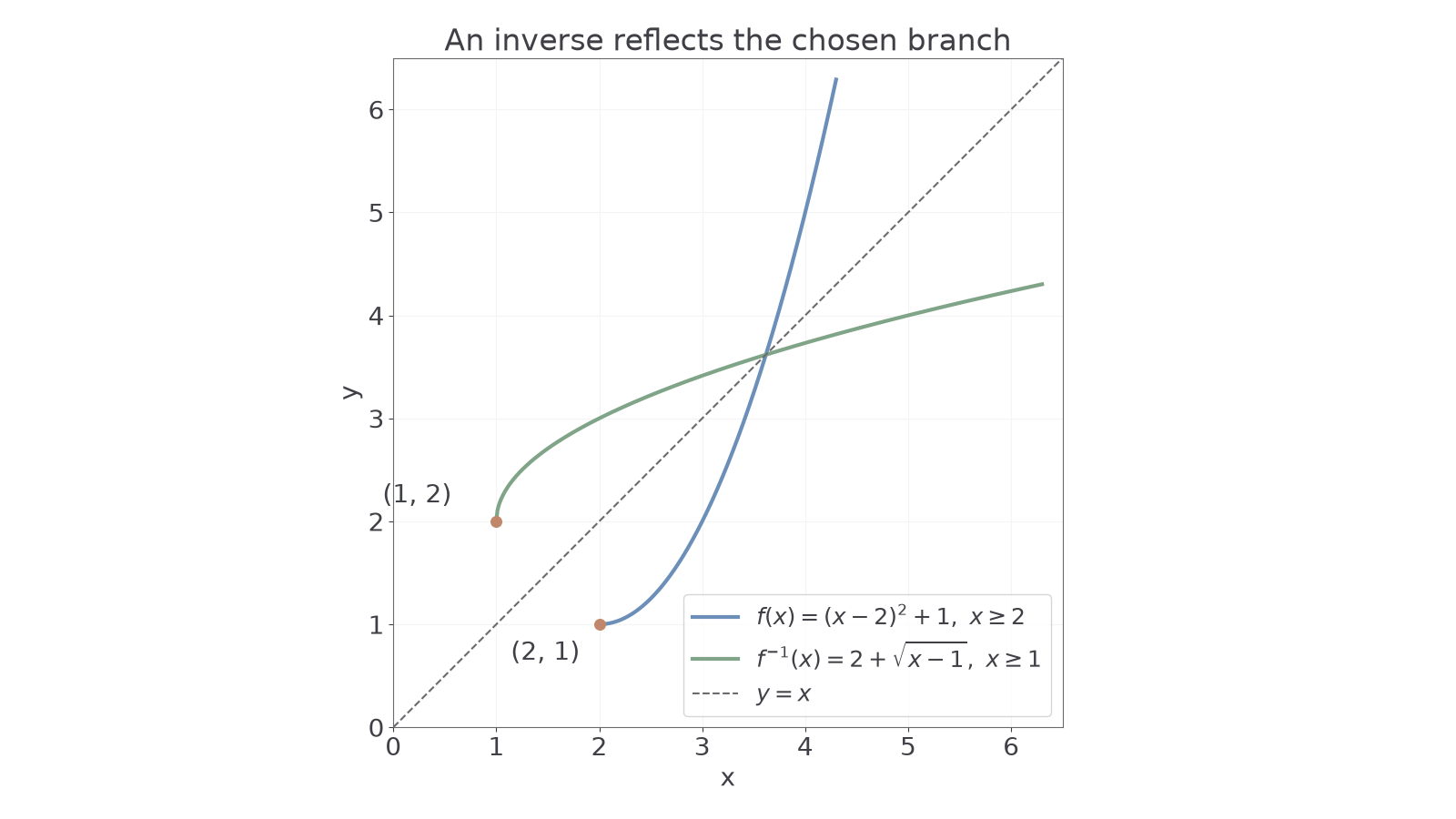
Reversing input and output swaps the coordinates: a point becomes . The line is the mirror for this swap.
Reflect only the points belonging to the stated original domain. Reflecting an unrestricted many-to-one parabola would give a sideways curve with two outputs for some inputs, which is not an inverse function. The reflection rule and branch selection are not in the formula booklet: learn them.
Worked example 7: reflect the right-hand branch
Question. Find and sketch the inverse of , .
Plan. Solve for the old input, choose the square-root sign using , then swap points.
Why this step? The negative square-root sign would return inputs below , outside the original domain.
Answer. The inverse has domain , range , and endpoint . Reflect the original endpoint and the right-hand quadratic branch in .
Check. Original point becomes ; .
The diagram uses equal scales, so swapping coordinates produces the expected mirror image.
Change only the original branch in the next example. The same original formula now has a different inverse function.
Worked example 8: reflect the left-hand branch
Question. Find the inverse of , , and describe its reflected endpoint and direction.
Plan. Solve the same square equation but select the nonpositive value of the original .
Why this step? The domain restriction selects the minus sign before variables are renamed; it is part of the inverse definition.
Answer. The inverse has domain , range , included endpoint , and extends downwards to the right.
Check. , so ; the minus-sign formula gives .
The identity explains why the restriction matters. It equals on the right branch and on the left. This square-root identity is not in the formula booklet.
Watch out
Wrong: put in an inverse function's formula and leave both branches. Right: use the stated domain to choose the one value that recovers the original input.
Select a left-hand branch once more, then identify the reflected endpoint.
Quick Recap
- A function assigns one output per input; its domain and range are sets.
- A one-to-one function has an inverse on its range; state any branch restriction first.
- Compose from the inside out and check every intermediate input.
- An inverse exchanges domain with range and reflects the chosen graph in .
The opening function undoes itself because , even though it changes every input except .