G1 - First principles for sine and cosine
Derive the sine and cosine derivatives from first principles, explaining why radians matter. Use second derivatives to connect changing gradients with convexity, concavity and inflection.
The trigonometric limits in radians
Why is the gradient of at the origin when is in radians, but about when the horizontal axis counts degrees? At a radian input , . At a degree input , . The angle unit changes the horizontal scale and therefore the gradient.
You already know
On a unit circle, a sector of radian angle has area . A degree increment is radians. These conversion and sector results are recall requirements, not supplied in the formula booklet.
For , compare an inscribed triangle, a sector and the outer triangle formed by the tangent to the circle. Their areas are , and , so
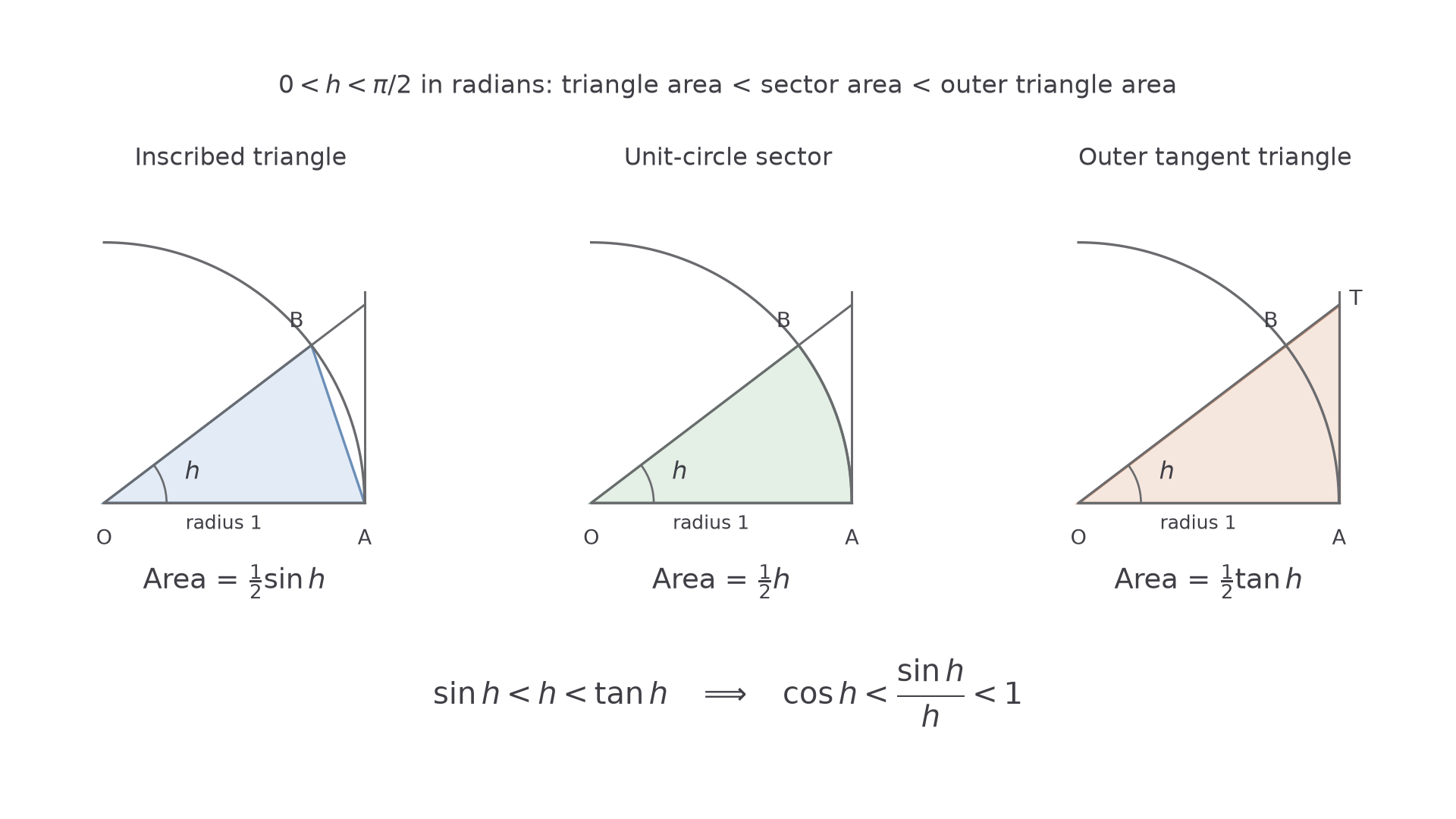
Both outer bounds tend to as , forcing the middle ratio to do the same. For negative , both and change sign, leaving their ratio unchanged. This proves the two-sided limit without using the derivative we want to derive.
Two radian limits
The increment must be in radians.
Not in the formula booklet: learn it.
For the second limit, use the recall identity , which is not supplied in the formula booklet. Then, for ,
The booklet supplies the small-angle approximations , and , in radians. They agree with these limits, but an approximation at a small input is different from an exact limiting statement. More generally, for nonzero constant ; for the ratio is zero. This scaled limit is not printed in the booklet.
Key idea
Match the denominator to the small radian angle. With degrees, , not ; a calculator sample corroborates a limit but does not prove it.
Check both the scaling and the sign in this diagnostic question.
Deriving the sine derivative
At , the sine difference quotient is exactly , so the first limit gives gradient . At a general input, the addition formula separates the changing increment from the fixed angle.
Sine addition formula
In the formula booklet.
Keep fixed throughout the limit: only approaches zero. Neither nor needs to be small.
Worked example 1: the full sine derivation
Question. Derive from first principles, with in radians.
Plan. Expand , separate the two limiting ratios and use their exact limits.
Why this step? Separating the quotient exposes the two ratios whose limits are already known, avoiding any assumption about the derivative.
Answer. for every real radian input.
Check. At , the gradient is ; the sine graph has a horizontal tangent at its peak.
Change only the multiplier, from to . Carrying it through the quotient shows why a constant multiple stays attached to the derivative.
Worked example 2: a constant multiple of sine
Question. Differentiate from first principles.
Plan. Factor from the difference quotient and complete the same addition-formula argument.
Why this step? The height multiplier scales every change in height by , so it scales each chord and tangent gradient by .
Answer. .
Check. At , the quotient is , agreeing with .
The sine derivative and its constant-multiple extension are not in the formula booklet: learn them. The supplied first-principles definition is a starting point, not a completed proof.
Watch out
Wrong: “, so the derivative is .” Sine does not split over addition. Right: use , then apply both limiting ratios.
Change the multiplier again, and show the argument rather than quoting the rule.
Deriving the cosine derivative
Cosine is falling at , so its gradient there must be negative. The minus sign enters through the subtraction in its addition formula.
Cosine addition formula
In the formula booklet.
The two limits remain the same. It is the coefficient of that changes.
Worked example 3: the full cosine derivation
Question. Derive from first principles, with in radians.
Plan. Expand , retain its minus sign and apply the two radian limits.
Why this step? The minus sign belongs to the whole term and survives the limit.
Answer. for every real radian input.
Check. At , the gradient is , consistent with the falling curve.
Continue this lesson.
You’re previewing NovaLearn without an account. Create a free account to read the rest.
Create free account