K1 - Sampling techniques and inference
Choose and describe a sampling method that fits a real investigation. You will make selections reproducible, compare practical advantages with possible bias and explain why two well-chosen samples can still give different results.
Selecting a simple random sample
If every person has the same chance of selection, must the sample be simple random? Surprisingly, no: equal individual chances can hide restrictions on which people can appear together.
You already know
The population is the whole group your question concerns; the sample is the group observed, and the sampling frame is the list or accessible set used for selection. When you calculate a sample percentage, its denominator is the number sampled, rather than the population size.
First make a genuinely random selection from a complete frame. Suppose records are labelled to . A uniform random-integer generator can choose the labels without the investigator favouring familiar or convenient records.
Simple random sample
For a fixed sample size, a simple random sample gives every possible sample of that size the same chance of selection. Here records must be distinct, so sampling is without replacement. Giving each individual an equal chance is necessary, but not sufficient: every possible combination must also be possible with the correct chance.
Generate labels uniformly from the frame. If a wider range is used, reject out-of-range labels. Reject repeated labels and continue until the required number of distinct records has been selected. Never replace a rejected label with somebody convenient.
Worked example 1: accepting valid distinct labels
Question. Select five records from labels –, using the stream
Plan. Read in order, accepting a label only if it is in the frame and has not already been selected.
Why this step? We need five different eligible records, not merely five generated numbers.
Answer. Select , in that order.
Check. There are five distinct labels, all between and .
Change only the required sample size from five to four. The rejection rules do not change, but the stopping point does.
Worked example 2: changing the stopping rule
Question. Use the same frame and stream to select four records.
Plan. Apply the same validity checks and stop at the fourth accepted label.
Why this step? The required size counts accepted distinct labels. The fifth generated number is not the fifth selected record.
Answer. Select . Do not continue to .
Check. Eight draws were needed for five records in the first example, but only seven draws for four records here.
In a spreadsheet, another approach attaches an independent random helper to each row, freezes the helpers as values, sorts whole rows and takes the first required rows. Resolve any ties randomly. Freezing preserves this realised sample; a live random function can change on recalculation. The AQA Random number column is a sampling helper, not a car characteristic.
Watch out
Wrong: “The first five generated numbers are the sample,” even when they include , or a repeat. Right: keep drawing until five distinct eligible labels have been accepted. Substituting a convenient record changes the random procedure.
Random selection reduces investigator choice within the frame. It does not repair omitted population members or ensure that selected people respond.
Systematic sampling and the order of a frame
Systematic sampling spreads selections along a list using a fixed interval, so the order of the list matters.
For records and a sample of , taking every twelfth position gives the required size if the start is chosen appropriately.
Systematic sampling
Choose a random starting position, then select at a fixed interval through the frame. For example, with interval and start , select positions .
When the population size is divisible by the required sample size , use the following rule. It is not in the formula booklet.
Integer systematic interval
Here is an integer and the starting position is selected uniformly from to .
Not in the formula booklet: learn it.
If is not an integer, a suitable selection rule must be stated. Rounding the interval blindly can give the wrong sample size or an uneven chance of inclusion.
Worked example 3: calculating the positions
Question. Select a systematic sample of from records, using the uniformly random start . State the first three and last positions.
Plan. Calculate the interval and add it repeatedly, checking the twentieth position.
Why this step? Counting twenty records requires nineteen gaps after the starting record.
Answer. Select .
Check. , and every selected position is in the frame.
Change only the random start from to . The interval and sample size remain fixed.
Worked example 4: a different random start
Question. Use start for the same systematic sample of from records.
Plan. Keep interval and translate the selection positions by the changed start.
Why this step? A random start changes the particular sample, but a fixed interval still restricts the combinations possible.
Answer. Select .
Check. The next position would be , outside the frame; the required twenty positions have already been selected.
Here is the distinction from simple random sampling in miniature. With four labels and a sample of two, interval two with a random start gives only or . Each individual appears in half the samples, but four of the six possible pairs are impossible.
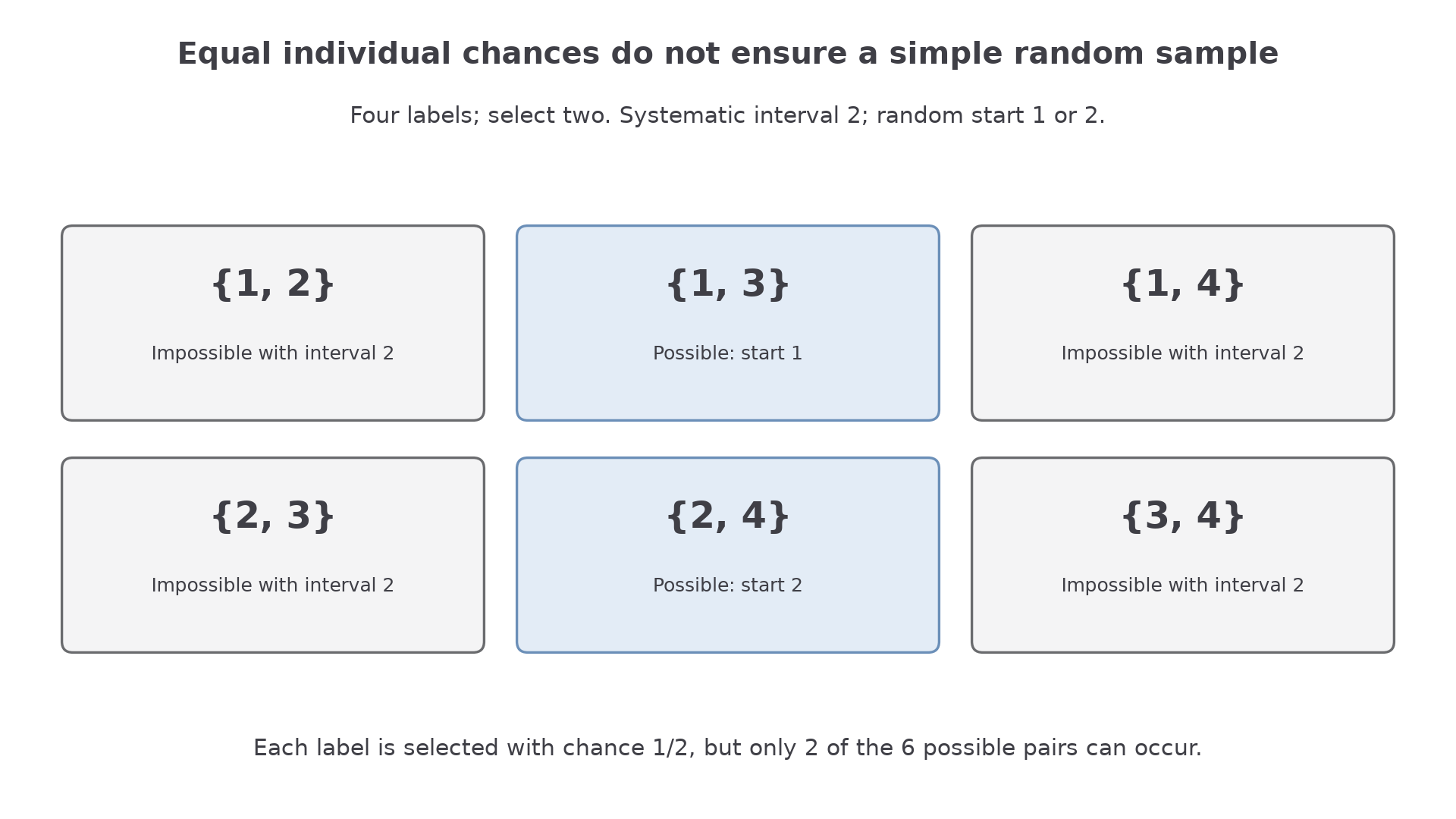
A periodic pattern can also align with the interval. If every tenth record is a company car, selecting every tenth position can produce either all company cars or no company cars. A random start does not remove that alignment. Randomly shuffling the complete list before systematic selection avoids alignment with its original order.
Watch out
Wrong: “The start is random, so this is a simple random sample.” Right: it is systematic. For interval , neighbouring positions cannot be selected together, so not every sample of the required size is possible.
A contextual criticism should identify the ordering pattern and show how the interval selects it repeatedly.
Stratification uses information about the population
Stratification uses known group sizes to ensure that important groups are represented deliberately.
The AQA extract has London, North West and South West keeper records. An unrestricted random sample might happen to include very few from one region. Sampling separately within the regions can control that feature.
Stratified sampling
Divide the population into non-overlapping groups called strata, covering the population, then select randomly within every stratum. In proportional stratification, the sample shares match the population shares as closely as whole numbers allow. Regions can be strata; choosing convenient people within each region is not random stratified sampling.
The allocation uses proportional reasoning. The formula gives a target; the actual number selected must be a whole number.
Proportional allocation
For stratum size , total population size and required sample size ,
Whole-number allocations must add to .
Not in the formula booklet: learn it.
Stratification needs known group sizes and access to a frame within each group. It controls the characteristic used for the strata; it does not guarantee balance on every other characteristic.
Worked example 5: the AQA region groups
Question. Allocate a proportional stratified sample of from the AQA regions and describe the selection.
Plan. Multiply each region's fraction of the extract by , round consistently and check the total.
Why this step? The denominators must be the same complete frame so that the three shares add to one.
Answer. Select distinct records at random within London, North West and South West respectively.
Check. The population counts add to , the allocations add to , and every region is represented. The original five-make, three-region frame restrictions remain.
Change only the sample size from to . This exposes a rounding issue: independently rounding every target does not always preserve the total.
Worked example 6: keeping the rounded total correct
Question. Allocate a proportional stratified sample of to the same three AQA regions.
Plan. Take each integer part, then give the remaining places to the largest fractional remainders.
The two largest remainders belong to London and North West, so give each one further place. Ordinary nearest-integer rounding would instead give , one too many.
Why this step? Allocations must be integers and must sum to . The stated remainder rule makes the rounding decision reproducible.
Answer. Select randomly within London, North West and South West respectively.
Check. . In a tied-remainder case, state a fair tie rule rather than quietly favouring a stratum.
This allocation method works equally well with school years or departments. Matching the quotas alone is insufficient; random selection within each stratum is part of the design.
Watch out
Wrong: “Allocate , then choose whichever records are easiest.” That replaces random within-stratum selection with convenience. Right: select the allocated number randomly within each complete stratum frame.
Continue this lesson.
You’re previewing NovaLearn without an account. Create a free account to read the rest.
Create free account