J1, J2, J3 - Vector components and operations
Describe directed quantities in two and three dimensions, combine their effects, and move between components and magnitude with a clearly stated direction. J1 supplies the notation, J2 connects an arrow to its length and angles, and J3 explains what addition and multiplication by a scalar do geometrically.
Components and vector notation
If you walk four metres east and three metres south, have you moved seven metres from your starting point? Your route has length seven metres, but your final displacement is a different quantity: it records the direct change of position, including direction.
You already know
Coordinates locate points on perpendicular axes. Pythagoras connects perpendicular lengths, and sine and cosine connect a right triangle's sides to its angles.
We will give those coordinate changes their own notation so that a movement is distinct from its endpoint.
Vector and scalar
A vector has magnitude and direction. A scalar has magnitude only. Displacement and velocity are vectors; distance and speed are scalars. Equal vectors have the same magnitude and direction even if their arrows start at different points.
Think of a vector as a movement instruction. Choose perpendicular axes with equal distance units. The unit vectors and have length one in the positive horizontal and vertical directions. Four units right and three down is
The entries are signed components, rather than two positive lengths. The arrow starts at and ends at ; reversing it gives . These notation and reversal rules are not in the formula booklet: learn them.
In space, add , the unit vector along the third perpendicular axis. Thus . Use the order consistently in a right-handed Cartesian coordinate system. Printed bold letters distinguish vectors from scalars; in handwriting an arrow, underline or overline is acceptable. AQA uses square brackets for columns, but round brackets are equally acceptable. The magnitude of is written . In applications, commonly denote position, displacement, velocity and acceleration vectors respectively.
Worked example 1: translating a graph
Question. A graph is translated two units left and five units up. Write the translation vector and find the image of .
Plan. Give each movement a sign, then add those components to the point's coordinates.
Why this step? A translation describes the change of position, so the components are added to the existing coordinates.
Answer. The vector is , and the image is . The graph keeps its shape and size.
Check. From to , the horizontal change is and the vertical change is .
The next example changes one feature: the movement now has a third component. The first two instructions keep exactly the same meaning.
Worked example 2: translating a point in space
Question. A point is translated two units left, five units in the positive direction and four units in the positive direction. Find its image and give the translation in both vector notations.
Plan. Put the three signed changes in coordinate order and add them to .
Why this step? The third component changes depth or height along the chosen axis; it does not alter the first two components.
Answer. , with translation .
Check. Subtracting the coordinates of from those of returns .
A zero component is still useful information: it says there is no movement along that axis.
Watch out
Wrong: “Three units left means component .” A component records a signed change, so left along the chosen horizontal axis is . Right: three left and four up is .
Try the same conversion with one stationary coordinate.
Addition and scalar multiplication
Two successive movements combine by adding their signed changes, coordinate by coordinate. For and , the combined movement is .
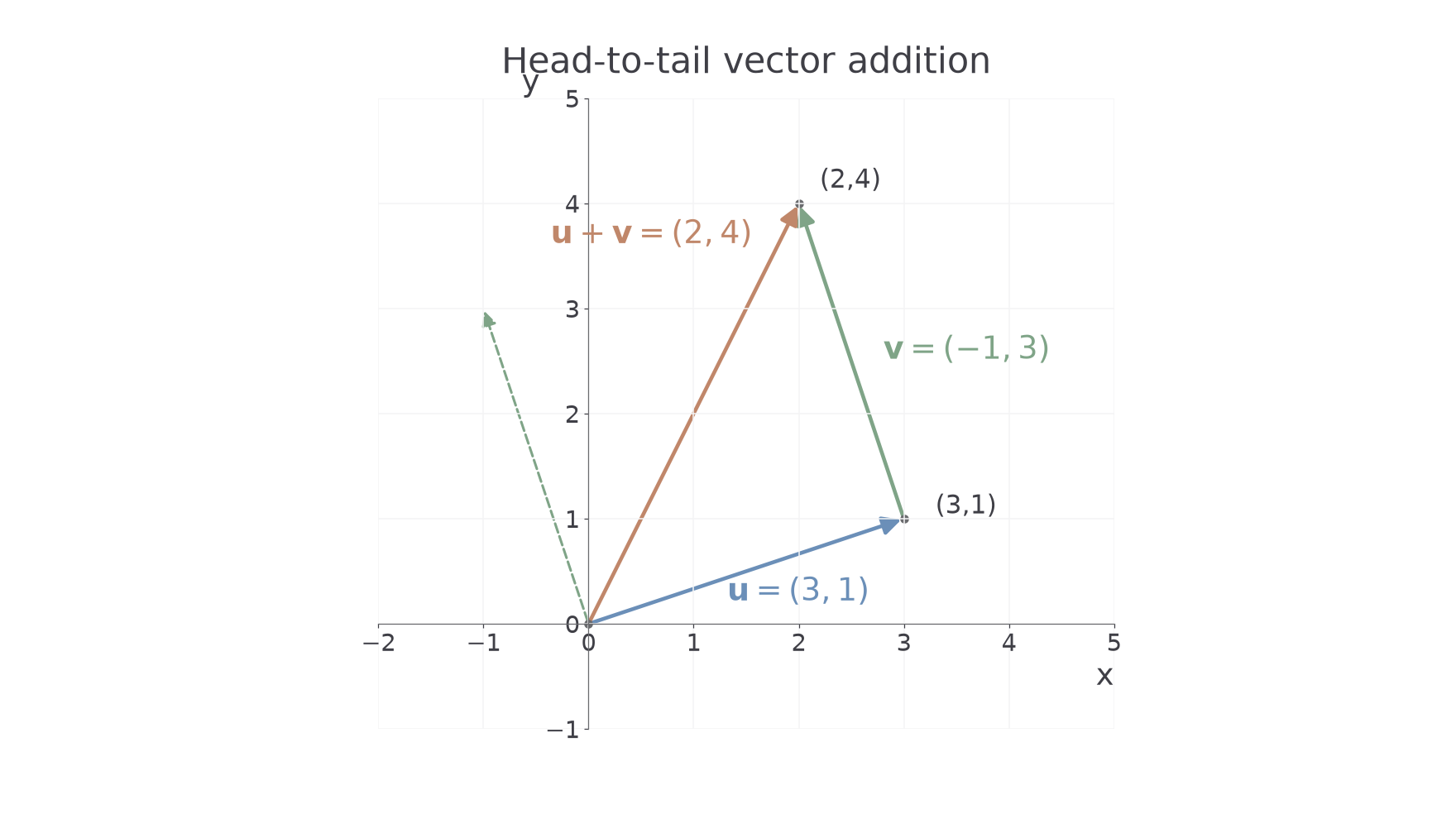
Draw , then place the tail of an equal copy of at its head. The resultant joins the first tail to the last head. The dashed copy shows that translating an arrow without rotating or resizing it preserves its vector. Starting both vectors at the same point gives the parallelogram construction: its diagonal is the same resultant. Reversing the order reaches the same endpoint, so .
Subtracting means adding its reverse, . Multiplication by a scalar multiplies every component by . A positive scalar keeps direction; a negative scalar reverses it. Multiplication by zero gives the zero vector, which has magnitude zero and no direction.
Operations and their geometry
For vectors in the same coordinate system,
Omit the third row in two dimensions. Not in the formula booklet: learn it.
For example, : the arrows are parallel, twice as long and oppositely directed. In general, two nonzero vectors are parallel if one is a scalar multiple of the other. The same scalar must work in every component. This criterion is not in the formula booklet: learn it. Parallel arrows drawn in unrelated places do not establish that all their endpoints lie on one line.
Worked example 3: subtracting a vector in space
Question. Given and , find .
Plan. Multiply every component of by two, then subtract each component of .
Why this step? Subtracting a negative horizontal component adds a positive change.
Answer. .
Check. Adding to the answer returns .
Now change only the operation before , from subtraction to addition. Every component of must respond to that change.
Worked example 4: adding the same vector
Question. For the same and , find .
Plan. Use the same doubled vector, then add the corresponding entries.
Why this step? The operation applies to the whole vector, including its negative entries.
Answer. .
Check. The difference between this answer and the previous one is , as changing to requires.
A resultant may have a zero component even though both added vectors have nonzero components there: they cancel.
Watch out
Wrong: . The first subtraction is , not . Right: .
Keep that sign check when the vectors change.
Continue this lesson.
You’re previewing NovaLearn without an account. Create a free account to read the rest.
Create free account