G3 - Tangents, normals and monotonicity
Find tangent and normal equations from the point and derivative, including horizontal and vertical cases. Use derivative signs and gradient graphs to justify where a function increases or decreases, with care over isolated zero slopes and gaps in the domain.
Finding a tangent equation
Can the tangent to cross the curve at the point where it touches? At the origin its gradient is zero, so the tangent is , yet the curve goes from below that line to above it. Tangency is a local match of point and direction; it does not mean the whole line meets the whole curve only once.
You already know
A line through with finite gradient has equation . Substituting into gives a height, while substituting into gives a gradient. The point-gradient line equation is not supplied in the formula booklet.
Find the point first, differentiate the function and evaluate the derivative at the same input. Keeping the two substitutions separate prevents a height being used as a slope.
Tangent equation
At an input where is finite,
Not in the formula booklet: learn it.
The curve's formula supplies both ingredients, but they come from different functions.
Worked example 1: a tangent to a quadratic
Question. Find the tangent to at .
Plan. Find the height and derivative separately, then put the point and slope into the line equation.
Why this step? The tangent passes through , not through ; is its gradient, not its height.
Answer. .
Check. At , the line gives , and its coefficient of is the required slope .
Change only the point's input, from to . The curve is unchanged, but its tangent now slopes downwards.
Worked example 2: a falling tangent
Question. Find the tangent to at .
Plan. Re-evaluate both the original function and the same derivative at .
Why this step? Changing the input requires changing both the point and the gradient; neither can be copied from the previous tangent.
Answer. .
Check. The curve minus the tangent is , zero at the contact input with no sign change.
AQA accepts equivalent correct line forms when no form is specified. The useful habit is to write the point-gradient equation before simplifying.
Watch out
Wrong: , then differentiate to get tangent gradient zero. Evaluating first loses the changing function. Right: differentiate , then calculate .
Change the input once more and obtain the new tangent.
Normals and horizontal tangents
The normal passes through the same point as the tangent and is perpendicular to it. A shallow upward tangent therefore has a steep downward normal.
Normal gradient
If the tangent has finite nonzero gradient , its normal has gradient
Use through the contact point .
Not in the formula booklet: learn it.
For the root curve below, the tangent gradient at is , so the normal gradient is .
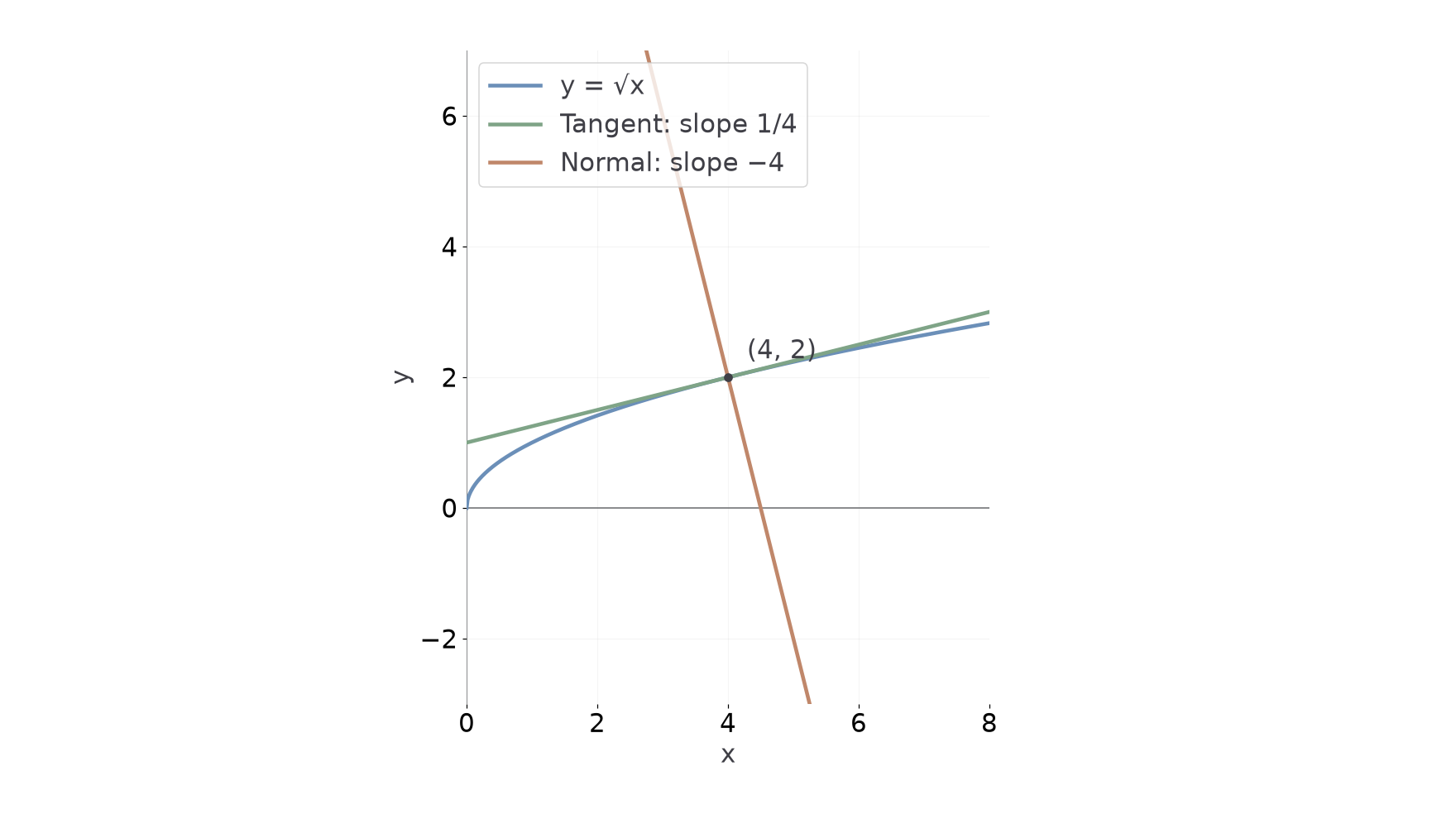
The negative reciprocal changes both sign and magnitude. It applies only when both gradients are finite and the tangent gradient is nonzero.
Worked example 3: normal to a root curve
Question. Find the normal to at .
Plan. Find the contact point, evaluate the derivative and take its negative reciprocal.
Why this step? The normal uses the tangent's gradient to find its direction, but still uses the original curve for its point.
Answer. .
Check. The line passes through and , confirming perpendicular gradients.
Change only the contact input to . The tangent becomes shallower, so the normal becomes steeper.
Worked example 4: a new contact point
Question. Find the normal to at .
Plan. Use the same derivative, evaluated at the new point, and construct the perpendicular line.
Why this step? Taking only the negative, , would change the direction without making the line perpendicular.
Answer. .
Check. It contains , and .
If , the tangent is horizontal, , and the normal is vertical, , with undefined gradient. For at , these are and .
An undefined derivative needs care. For at the origin, chord gradients are : there is a vertical tangent , whose normal is horizontal, . There is no finite derivative there. For , however, different finite slopes approach from the two sides, so there is a corner and no unique tangent or normal. Undefined derivative does not automatically mean vertical tangent. These special-case line rules are not supplied in the formula booklet.
Watch out
Wrong: “Tangent gradient zero gives normal gradient .” Division by zero is undefined. Right: use directions: a horizontal tangent has a vertical normal .
Return to the root curve and change only its contact input once more.
Increasing and decreasing intervals
An interval statement concerns every pair of ordered inputs in that interval, not just a few sample heights. A function is strictly increasing if implies , and strictly decreasing if implies .
Showing throughout an open interval establishes strict increase there; establishes strict decrease. AQA's preferred interval convention uses these strict derivative inequalities, while also accepting the convention permitting derivative zero. The pairwise definition explains why an isolated zero need not interrupt strict increase. These criteria are not supplied in the formula booklet.
Continue this lesson.
You’re previewing NovaLearn without an account. Create a free account to read the rest.
Create free account