H1, H2 - Antiderivatives and the fundamental theorem
Recover a function from its derivative, integrate rational powers and use an antiderivative to measure accumulated change. H2 supplies the integration methods; H1 explains why they also evaluate a definite integral.
Antiderivatives and constants
If you know a curve's gradient everywhere, can you recover the curve itself? The curves , and all have derivative . Their slopes agree, but their heights do not.
You already know
Differentiating a constant gives zero. Differentiating gives , wherever the expression is real and differentiable. These differentiation rules are not in the formula booklet: learn them.
Read differentiation backwards: is one function whose derivative is .
Antiderivative
An antiderivative of on an interval is a function satisfying throughout that interval. For example, is an antiderivative of ; is not, because its derivative is .
Adding any constant leaves the derivative unchanged. These three members of an infinite family all have gradient at .
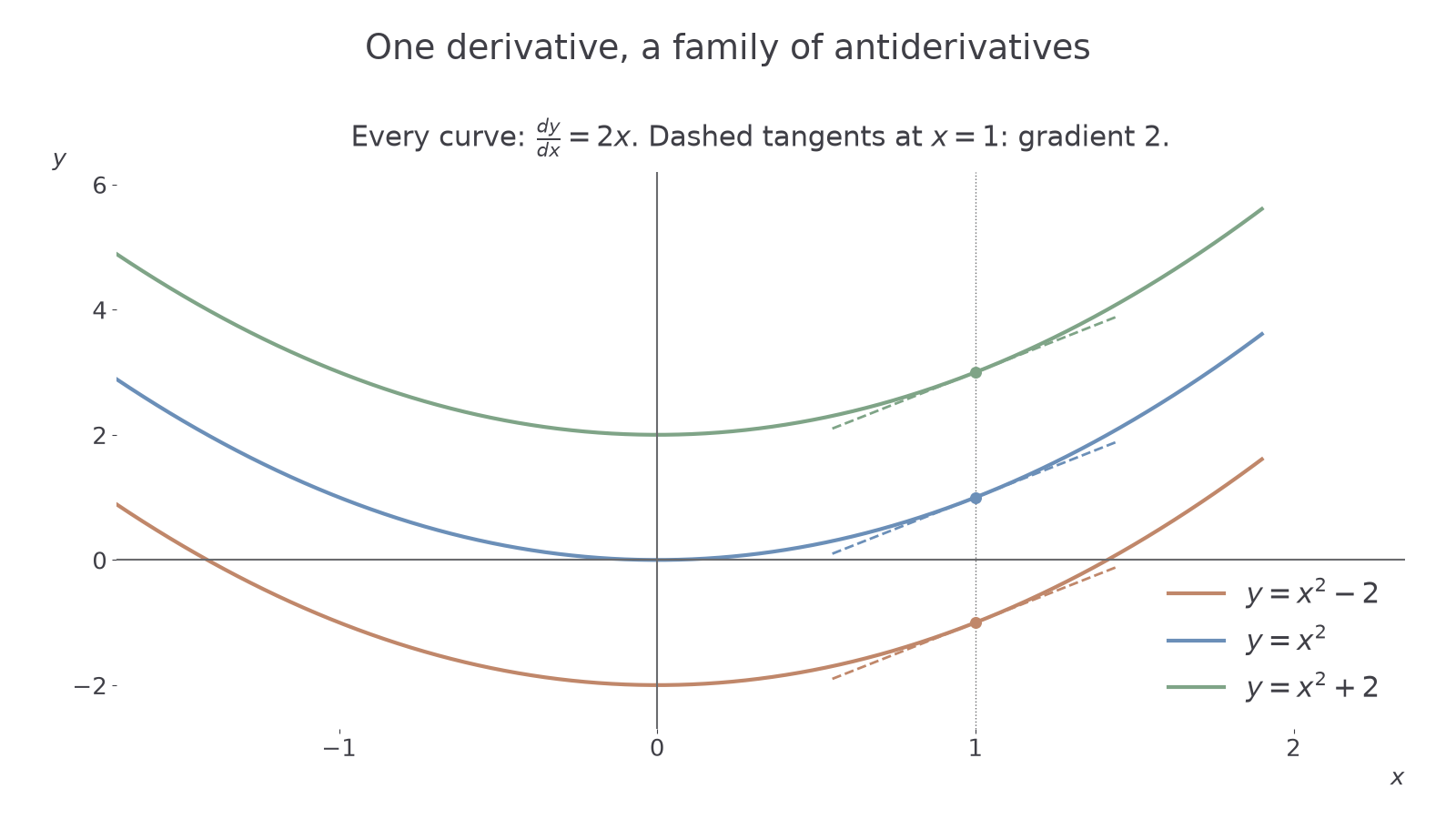
The indefinite integral records the whole family. The identifies the variable of integration.
The constant of integration
If on an interval, then
where is an arbitrary constant. Any two antiderivatives on that interval differ by a constant: their difference has derivative zero.
Not in the formula booklet: learn it.
A point on the curve selects one member. Integrate first, then use the point to find .
Worked example 1: selecting the curve
Question. A function satisfies and . Find .
Plan. Reverse differentiation term by term, then substitute the given value.
Why this step? The derivative determines the variable terms; the point fixes their vertical shift.
Answer. .
Check. and .
Change only the given height from to . The derivative stays the same, so only the constant should change.
Worked example 2: a different height
Question. A function satisfies and . Find .
Plan. Use the same antiderivative family and determine its new constant.
Why this step? Raising the specified height by raises the whole curve by , without changing its gradient.
Answer. .
Check. , and .
The arbitrary constant is added to the function, rather than multiplied by the variable.
Watch out
Wrong: . Its derivative is , which changes the integrand. Right: , whose derivative is for every constant .
Change the specified height once more. Your variable terms should still be identical.
Integrating rational powers
Writing a root or denominator as a power makes its antiderivative easier to recognise: , while .
For instance, differentiating gives . The new exponent is one greater than the old one, and its coefficient cancels the factor introduced by differentiation.
The power rule for integration
For rational , on an interval where the functions are real and differentiable,
Integrate sums and differences term by term, retaining constant multipliers. In particular, .
Not in the formula booklet: learn it.
The reason is . When , the denominator would be zero: the reciprocal needs the next lesson's logarithmic rule. For fractional or negative powers, is a safe common domain. Non-negative integer powers work for every real ; other domains must be checked. Separate intervals of a disconnected domain may have independent constants; a point on one interval does not fix the constant on another.
Worked example 3: roots and negative powers
Question. For , find .
Plan. Write the quotients as powers, then increase each exponent and divide by its new value.
Why this step? The last new exponent is negative, so dividing by it changes that term's sign.
Answer. , for .
Check. Its derivative is , the original integrand.
Continue this lesson.
You’re previewing NovaLearn without an account. Create a free account to read the rest.
Create free account