E4 - Reciprocal and inverse trigonometric functions
Distinguish reciprocating a trigonometric ratio from undoing a function. You will use secant, cosecant and cotangent, select principal inverse angles, and describe the graphs, domains and ranges of all six functions.
Reciprocal ratios and their domains
Why does give an angle, while gives ? The small raised has two different jobs in these notations. First, look at the reciprocal job: , so its reciprocal is .
You already know
A reciprocal of a nonzero number is . An inverse function reverses input and output on a one-to-one domain. These definitions are not supplied in the formula booklet.
The reciprocal trigonometric functions keep the angle as input and reverse the ratio's numerator and denominator.
Reciprocal trigonometric functions
Each displayed denominator must be nonzero. Where sine and cosine are both nonzero, .
These definitions are not supplied as formulae in the booklet: learn them. With radian inputs and , secant excludes ; cosecant and cotangent exclude .
Cotangent has a subtle boundary: at , it is , even though cannot be evaluated there because tangent itself is undefined. The cosine-over-sine definition gives cotangent's complete domain. Simplifying an expression must not silently discard these zeros.
For exact values, , and . Reciprocation preserves the sign of a nonzero ratio. Secant and cosecant cannot have values strictly between and , because their denominators have magnitude at most one.
Worked example 1: an exact secant
Question. Find exactly.
Plan. Find the exact cosine, then take its reciprocal.
Why this step? Secant reciprocates a cosine value; it does not return an angle.
Answer. .
Check. The cosine is negative with magnitude , so its reciprocal is negative with magnitude .
Change only the angle to its reflection in the horizontal axis. Cosine, and therefore secant, stays unchanged.
Worked example 2: a reflected angle
Question. Find exactly.
Plan. Use the reference angle , then reciprocate the signed cosine.
Why this step? Reflection changes the vertical coordinate but not the horizontal coordinate used by cosine.
Answer. .
Check. Both angles have the same horizontal unit-circle coordinate.
At , cosine is zero, so secant is undefined; infinity is not its value. Cosecant is similarly undefined at every sine zero.
Watch out
Wrong: . Infinity is not a tangent value, so this calculation is invalid. Correct: .
Change only the angle in the secant calculation.
Reciprocal graphs and transformations
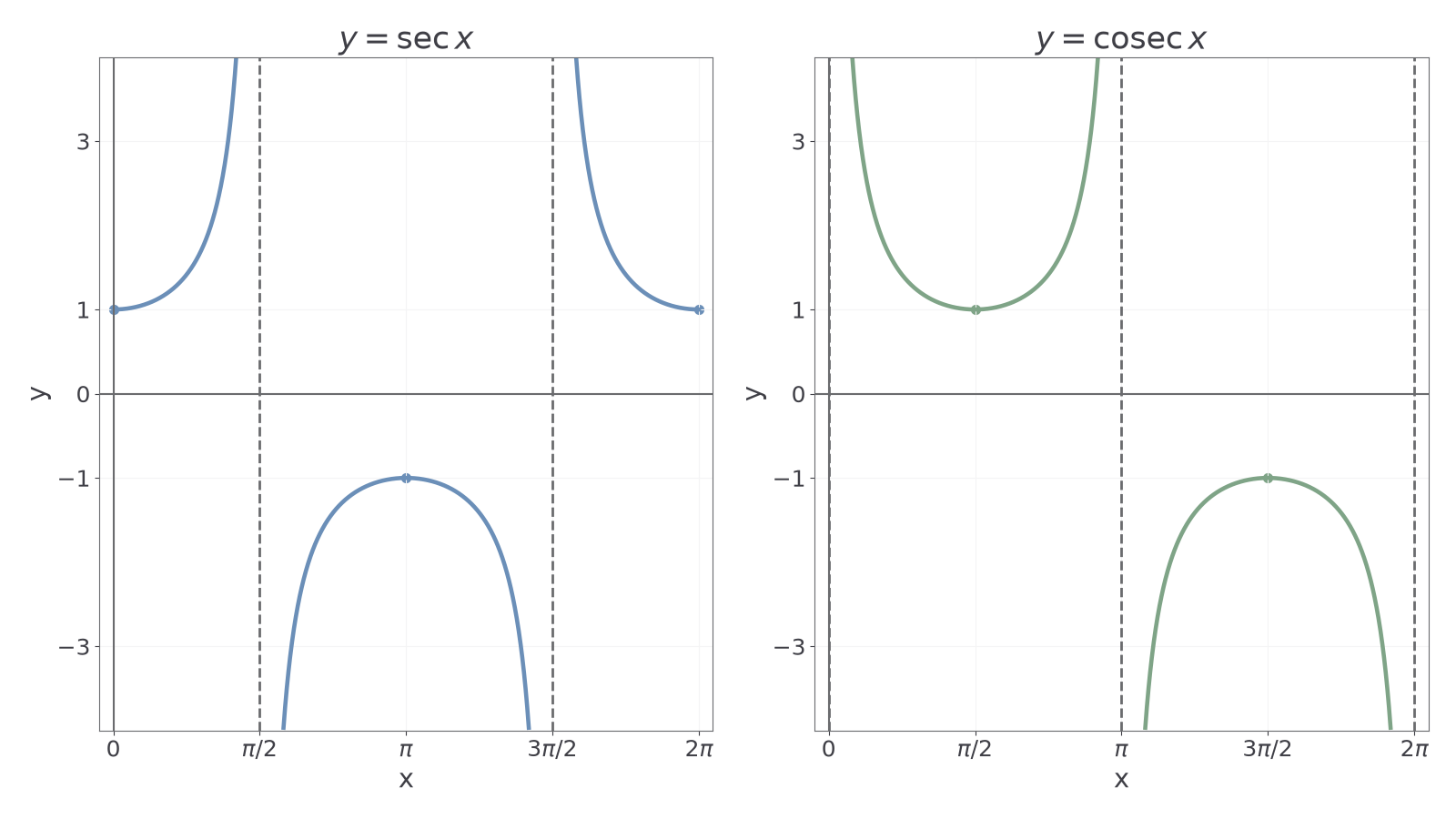
A cosine value near zero produces a secant value with large magnitude. A cosine value of or is unchanged by reciprocation. Those two facts determine the shape of the graph.
For secant, zeros of cosine at become vertical asymptotes. At , secant is . Positive branches have minimum ; negative branches have maximum . Secant is even and has period .
For cosecant, zeros of sine at become asymptotes. At , cosecant is . Cosecant is odd and has period .
Cotangent has asymptotes , zeros and range . Each branch decreases from arbitrarily large positive values to arbitrarily large negative values. It is odd with period .
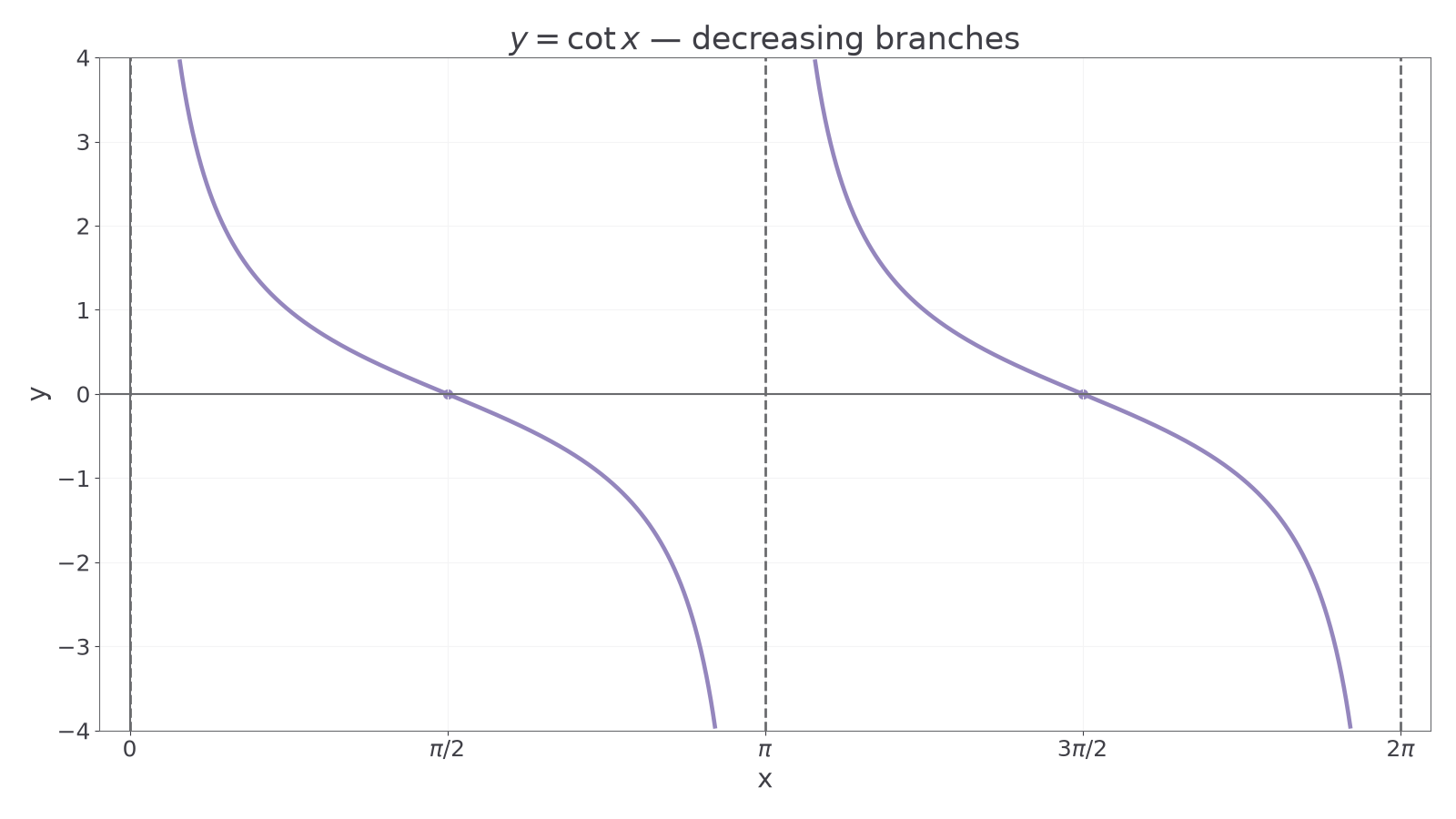
These features follow from the definitions; they are not printed in the formula booklet. Keep the attained range endpoints separate from the excluded asymptote positions.
| Function | Domain, | Range |
|---|---|---|
For or cosecant, with , the period is and the range is or . Solve the whole argument's denominator-zero condition for the domain. A negative reflects branches vertically. For transformed cotangent, the period is , the range is , and the sign of determines whether branches decrease or increase. These transformation results are not in the formula booklet: learn how to derive them.
Worked example 3: stretching secant
Question. For , state the period, domain and range.
Plan. Use the argument for period and exclusions, then transform the secant range.
Why this step? The two separate parts of the range stay separate after a vertical transformation.
Answer. Period ; domain , ; range .
Check. At , ; at , . Both finite range endpoints are attained.
Change only the argument's constant by subtracting . The vertical range and period stay fixed, but exclusions move.
Worked example 4: moving the asymptotes
Question. For , state the period, domain and range.
Plan. Solve the shifted denominator condition and retain the same vertical transformation.
Why this step? The exclusion set is equivalently ; an integer index can be shifted by one.
Answer. Period ; domain , ; range .
Check. At , the argument is zero and ; at , the argument is , which is excluded.
For comparison, has period , exclusions , zeros , and decreasing branches. Sketches should show these separate branches and labelled asymptotes; do not join across an excluded input.
Watch out
Wrong: the range of is . Secant lies outside , with only the endpoints included. Correct: or ; the gap between these branches contains no graph.
Change only the coefficient of in the last secant transformation.
Continue this lesson.
You’re previewing NovaLearn without an account. Create a free account to read the rest.
Create free account