D1 - General binomial expansions and approximations
Use rational powers to build useful approximations near a convenient value. You will rewrite brackets into the right form, state a strict validity range and check whether a truncated expansion is accurate enough for its purpose.
Expanding a rational power
Can four simple terms give correctly to six decimal places? The nearby value is easy. We will describe the small change from , then check how much accuracy survives when we stop the calculation.
For a positive integer power, coefficients eventually stop: in the cubic expansion a fourth selection would contain a factor . A power such as never reaches that zero factor. Its expansion generally continues indefinitely.
You already know
For an integer power, the first terms of are . A rational index includes fractional and negative powers, such as and .
The falling-product pattern extends to rational powers. You need to use this result, not prove the general theorem.
General binomial expansion
For ,
The stated validity condition is . A non-negative integer power terminates and gives an identity for all real ; otherwise use the strict condition. The theorem does not settle the endpoints by this condition alone.
In the formula booklet.
Do not use a factorial such as to find these coefficients. Use the falling factors. State a truncated result with an ellipsis, or use for an actual numerical approximation.
Worked example 1: a positive fractional power
Question. Expand up to and including the term in , and state the validity range.
Plan. Put and into the supplied formula.
Why this step? The small change is the whole expression ; its square includes both and .
Answer. , valid for .
Check. At , both sides start at . Squaring the displayed polynomial gives through the cubic term.
Change only the power from to . That changes the falling factors and therefore every non-constant coefficient.
Worked example 2: a negative fractional power
Question. Expand through , and state its validity range.
Plan. Keep , but use .
Why this step? A negative power changes the coefficients, while the convergence condition still depends on the inner change.
Answer. , valid for .
Check. Multiplying this polynomial by the one in example 1 gives through , as reciprocal square roots require.
The original function can exist outside the series' interval. For example, exists at , but this expansion about zero is outside its stated validity range there.
Watch out
Wrong: the range is . That tests the real function's denominator but misses convergence on the negative side. Right: , giving .
Change the exponent once more while keeping the same inner change.
Rewriting the bracket before expanding
A bracket such as does not start with , but does. Factor out the constant before applying the general expansion.
Normalising a bracket
For ,
Apply the supplied expansion to , requiring . In this interval the inner bracket is positive, so the real rational powers are defined. This rewriting uses index laws.
Not in the formula booklet: learn it.
The factor multiplies every retained term. Leaving it out changes the constant term as well as the other coefficients.
Worked example 3: a square root with constant four
Question. Expand through , and state the validity range.
Plan. Write the expression as , expand, then multiply by .
Why this step? The binomial formula applies to ; here , rather than .
Answer. The displayed expansion is valid for , or .
Check. The constant is . Squaring the retained polynomial gives through .
Change only the power to . The outside factor becomes , so it must be reconsidered too.
Worked example 4: a reciprocal square root
Question. Expand through , and state the validity range.
Plan. Factor out , then use the negative fractional power.
Why this step? Taking a reciprocal changes into ; retaining the old outside factor would fail even at zero.
Answer. , valid for .
Check. Multiplication by example 3 gives through .
If the small change contains , track its powers and solve the corresponding inequality: requires , hence . If two expansions are combined, use the intersection of their validity intervals.
Watch out
Wrong: use after factoring . Right: test the normalised change . The range belongs to the expression actually substituted into the formula.
Change the constant under the same reciprocal square root.
Choosing a useful approximation
To estimate , use the small change . Truncation means stopping an infinite expansion; the retained polynomial is generally an approximation, even though its coefficients are exact.
The supplied general binomial formula gives
This particular square-root expansion is not printed separately in the formula booklet; derive its coefficients from the supplied general formula. Small usually makes a short truncation more useful. Merely satisfying does not guarantee a requested number of decimal places.
Worked example 5: a small positive change
Question. Use the cubic binomial approximation to estimate . Check whether it is correct to six decimal places.
Plan. Substitute , then compare the rounded estimate with the calculator value.
Why this step? Accuracy is a statement about the omitted tail, so check the actual rounded values rather than counting the retained terms.
Answer. The estimate is , and both values round to at six decimal places.
Check. The estimate exceeds the true value by approximately . The next term is , consistent with this sign and scale.
Four rational terms have recovered six correct decimal places of an irrational number. That is the useful surprise behind these expansions: near the centre, simple arithmetic can capture a curved function very closely.
The next example changes only the sign of the small change. The odd-power terms switch sign.
Worked example 6: a small negative change
Question. Use the same cubic approximation to estimate , and check six-decimal accuracy.
Plan. Use , keeping its sign in the cubic term.
Why this step? is negative, so the cubic contribution must decrease the estimate.
Answer. , correct to six decimal places at this input.
Check. The absolute error is approximately ; both rounded values are .
A first omitted term suggests an error's sign and scale in these examples, but it is not automatically the entire error or a rigorous bound. If the question supplies a calculator value, compare with it; if it asks for a guaranteed tolerance, use a justified bound or exact remainder.
Watch out
Wrong: “Four terms means four-decimal accuracy.” Right: the input and the omitted terms determine the error. A value close to a rounding boundary needs particular care.
Change only the size of the positive change.
Quantifying an approximation error
For a reciprocal, multiplication gives an exact remainder. Take and its quadratic binomial approximation . Then
This remainder is not in the formula booklet: derive it. The algebraic identity needs ; obtaining from the binomial series uses . These are different restrictions.
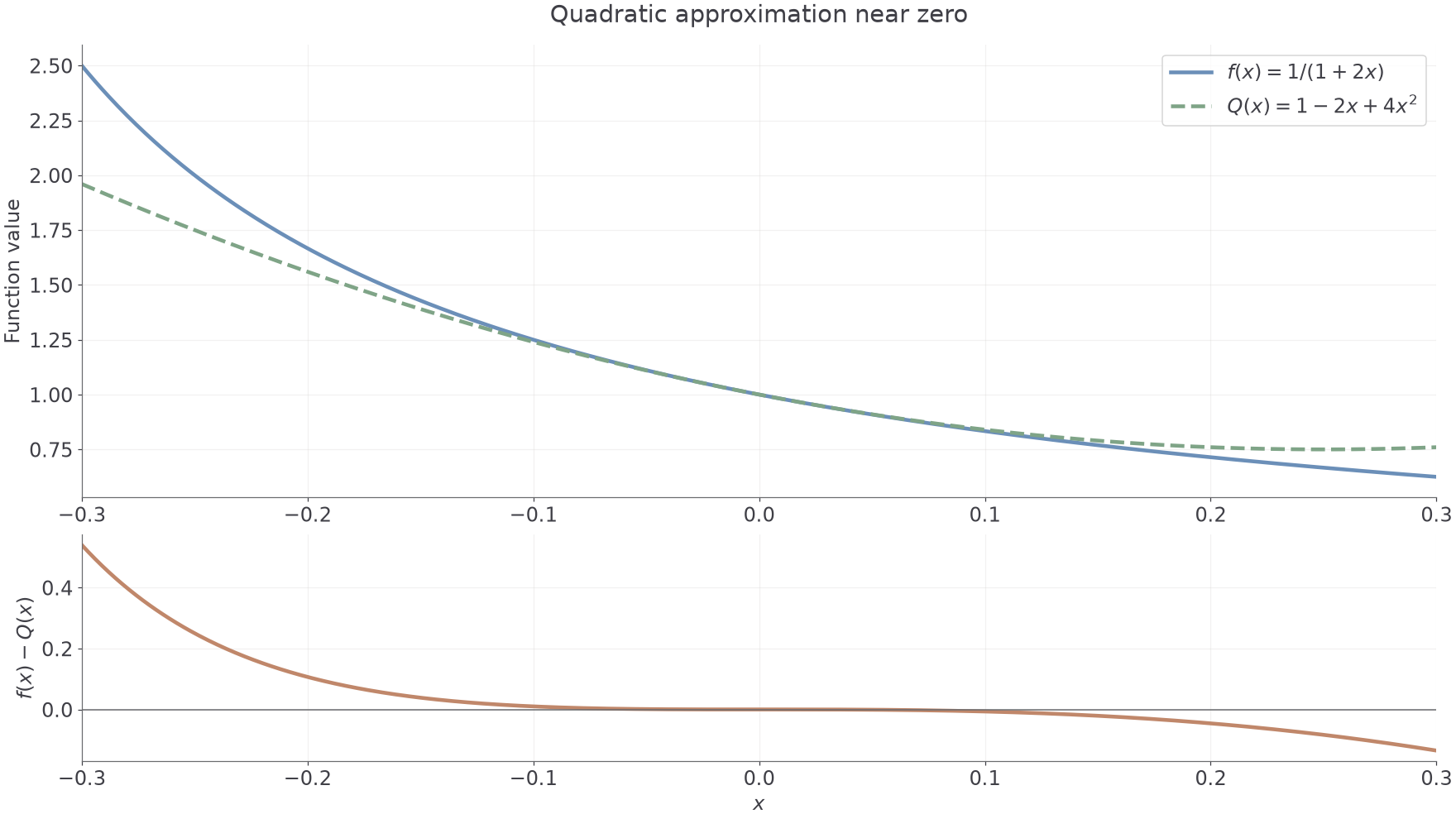
The curves meet closely near zero. In the lower panel a negative signed error means is above the true value. An absolute tolerance uses the magnitude of the error, whatever its sign.
Worked example 7: checking a positive input
Question. Use to approximate , and decide whether the absolute error is less than .
Plan. Evaluate the polynomial and then the exact remainder.
Why this step? The signed difference identifies overestimation; its absolute value decides the tolerance.
Answer. The estimate is , an overestimate whose error is less than .
Check. , and .
Change only the input's sign. A similar-looking polynomial calculation now produces an underestimate, and the denominator changes the error's size.
Worked example 8: checking a negative input
Question. Use to approximate , and test the same tolerance .
Plan. Retain the signed cubic in the exact remainder, then compare its modulus.
Why this step? A positive signed error means the true value is larger than ; it does not mean the tolerance is satisfied.
Answer. The estimate is , an underestimate, and its absolute error exceeds .
Check. , and .
You can also guarantee accuracy throughout an interval. If , then , so
This derived bound is not in the formula booklet. For , it gives , so the error is at most that value everywhere on the interval, not just at one checked input.
Watch out
Wrong: a negative error automatically meets a positive tolerance. Right: compare with the tolerance; use the sign separately to decide overestimate or underestimate.
Change the magnitude of the positive input in the final check.
Quick Recap
- Factor out the constant so the inner bracket starts with .
- Use falling factors for rational powers and state .
- A truncation's accuracy depends on its omitted tail, not its number of terms.
- Use an actual comparison, exact remainder or justified bound to test accuracy.
The opening estimate is ; the checked calculator value confirms six-decimal accuracy.