J5 - Vector proofs and contextual problems
Use directed-vector relationships to prove geometric claims and locate constrained intersections. Apply the same component reasoning to forces and planar motion, stating what the model assumes and checking that the answer describes the physical event asked for.
Vector geometry proofs
If two particles follow paths that cross, must they collide? A shared location is only part of the answer: we will need a shared time too. First, learn how vector relationships establish exactly what a geometric diagram suggests.
You already know
Joining vectors are end position minus start position. Scalar multiples describe parallel directions; signed sine and cosine projections resolve a magnitude and angle into perpendicular components.
Keep the points and the arrow directions explicit when turning these calculations into a proof.
For , and , the joining vectors are and . The second is three times the first. Since both start at , the three points lie on one line.
Parallel and collinear
Two nonzero vectors are parallel when one is a scalar multiple of the other. Distinct points are collinear when they lie on one line; equivalently, for some real . Equal magnitudes alone establish neither condition.
The shared point matters. Two parallel arrows placed far apart do not make all their endpoints collinear. These parallelism and collinearity criteria are not in the formula booklet: learn them. A proof must finish by translating the scalar-multiple relationship into the geometric claim asked for.
Worked example 1: collinearity in space
Question. Prove that , , are collinear, and find .
Plan. Form two vectors starting at , compare their components, then locate on the line.
Why this step? Comparing vectors with a common starting point establishes one common line, rather than only parallel directions.
Answer. are collinear. The multiplier places beyond , and .
Check. Starting at , adding gives .
Change only the multiplier locating the third point, from to . This time the point is on the other side of .
Worked example 2: a point beyond the other endpoint
Question. Prove that , , are collinear, and find .
Plan. Compare with the unchanged , then use nonnegative lengths for the ratio.
Why this step? A negative scalar reverses direction; it does not make a length negative.
Answer. are collinear, with beyond away from . The length ratio is .
Check. Starting at , the position becomes , the coordinates of .
Vector proofs also work with arbitrary positions. Let denote the vertices of a nondegenerate triangle: they are not collinear. Keeping the letters general proves a result for every such triangle, including one tilted in three-dimensional space.
Worked example 3: the midpoint theorem
Question. In a nondegenerate triangle , are the midpoints of . Prove that is parallel to and has half its length.
Plan. Write both midpoint positions, subtract, and recognise a multiple of .
Why this step? Subtraction cancels the shared vertex position , leaving the opposite side vector.
Answer. Since , the scalar multiple proves , and .
Check. The positive multiplier gives the same direction from to as from to , consistent with the two midpoint positions.
Change only the fraction travelled along both sides, from one half to one third. The cancellation is the same.
Worked example 4: a different common fraction
Question. In a nondegenerate triangle , points satisfy . Prove that and .
Plan. Use a travelled fraction of on each side and subtract the resulting positions.
Why this step? The fractions must match on the two sides for the shared terms to cancel.
Answer. and , as required.
Check. More generally, equal travelled fractions give ; recovers the midpoint theorem.
Medians and diagonals
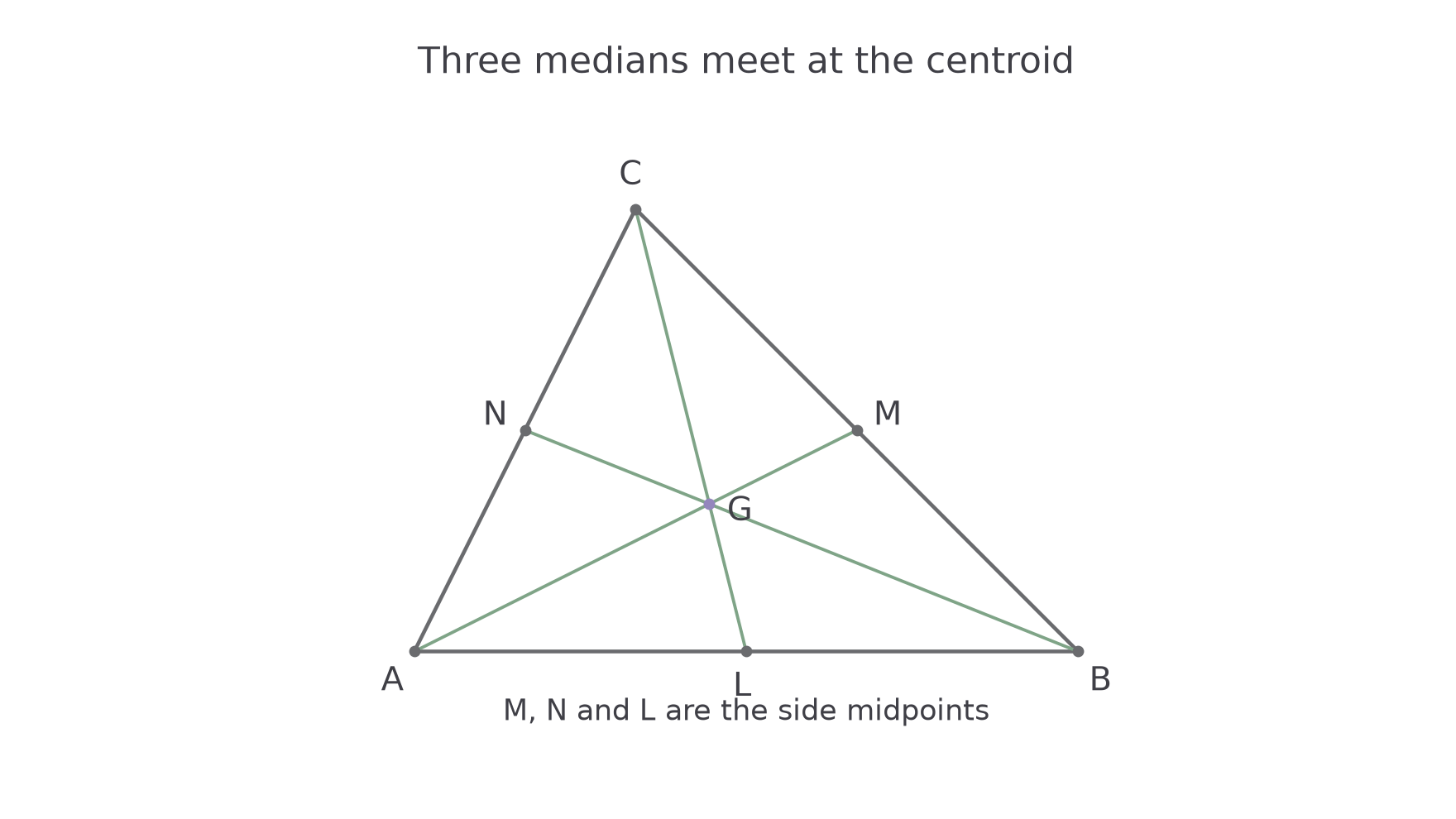
A median joins a triangle vertex to the midpoint of the opposite side. All three medians meet at one point, two thirds of the way from each vertex, however uneven the triangle looks. To see why, let be the midpoint of , and put . Then
Thus is on median , with . The same calculation starting at and reaches exactly the same ; the three medians therefore meet there. This point is the centroid.
For a parallelogram in vertex order, the side relation gives . Hence the midpoint of is , also the midpoint of . This proves that its diagonals bisect one another without assuming that property at the start. The midpoint, common-fraction, centroid and parallelogram results here are not in the formula booklet: learn how to derive them from positions.
Watch out
Wrong: “, so the vectors are parallel.” The third component would have to be . Right: one scalar must work in every component, so these two vectors are not parallel.
Apply the shared-fraction proof with a new ratio, keeping the vertices general.
Intersections and segment constraints
A geometric intersection is a position reached by two routes. Build each route with its own parameter, then ask whether the two positions can agree.
Positions on the line through distinct points can be written , with real ; its segment requires . A second line through has positions . These are position constructions from fractions of joining vectors, not an instruction to assume .
A common position
At an intersection,
All corresponding components must agree. For intersection of the closed segments, also require and . Not in the formula booklet: learn it.
In three dimensions, two component equations may give candidate parameters, but the third still has to agree. For example, positions and give from their first two coordinates, but their third coordinates differ for every choice. Those lines have no common point. Parallel lines may likewise be distinct or may be the same line; inspect the actual positions.
Worked example 5: crossing segments
Question. , , , . Find the intersection of the extended lines and decide whether both segments contain it.
Plan. Equate two independently parameterised positions and check both parameter ranges.
Why this step? The two parameters turn out equal because of the horizontal equation; equality was not assumed beforehand.
Answer. The lines meet at . Both parameters lie in , so both segments contain the intersection.
Check. The second route gives too.
Translate only the second segment upwards by eight units in the next example. Its direction stays the same, but the intersection moves beyond the endpoints.
Worked example 6: intersection outside a segment
Question. , , , . Find the line intersection and determine whether the segments intersect.
Plan. Use the same direction vectors, with the new starting position for the second route.
Why this step? Solving the line equations does not automatically enforce the endpoint restrictions.
Answer. The extended lines meet at . Both parameters exceed , so this point is beyond and beyond ; the segments do not intersect.
Check. From , an extra of reaches , the same point.
An endpoint itself is allowed for a closed segment, because the parameter bounds include equality.
Watch out
Wrong: “The equations have a solution, so the segments intersect.” That proves a common point of the extended lines only. Right: check both parameters against ; a value lies beyond the ending point by a further quarter of the full joining vector.
Try one new endpoint translation with the same directions.
Planar force models
Forces combine like directed movements: add their components, not their magnitudes. A force east and an force northwest do not pull with a resultant of , because their directions differ.
Resultant and equilibrium
The resultant force on a model particle is the vector sum of all forces acting on it. In equilibrium, that sum is zero. A balancing force is the negative of the resultant of the other forces, so it has equal magnitude and opposite direction.
The particle model treats the forces as acting at one point. Zero resultant gives translational equilibrium; these calculations do not test the rotational equilibrium of an extended object. Equilibrium need not mean that the particle is stationary: constant velocity is also compatible with zero resultant.
A force at angle anticlockwise from the positive direction has components , . With a bearing from north, east and north components use , instead. These are the projections already used for displacement.
Vector balance
For concurrent planar forces,
Thus, for three forces, . Not in the formula booklet: learn it.
Continue this lesson.
You’re previewing NovaLearn without an account. Create a free account to read the rest.
Create free account