D5 - Geometric sequences and series
Use a common ratio to locate geometric terms and derive finite sums. Decide when an infinite series converges, then use its remaining tail to control accuracy while retaining the signs and the conditions of every formula.
The common ratio and nth term
The list keeps changing sign. Can adding all of these infinitely many nonzero terms produce a finite total? A few partial sums suggest an answer, but the ratio will explain it.
You already know
A sequence rule connects indexed terms, and its starting index must be stated. Powers record repeated multiplication; keep a negative base inside brackets before raising it to a power. Both ideas will matter when the update multiplies by a fixed ratio.
First consider . Each term is half the previous one. Reaching term six takes five multiplications by , just as reaching an arithmetic term takes one fewer changes than its position.
Geometric sequence
A geometric sequence has a fixed common ratio , so . Its terms are , where is the first term. For nonzero adjacent terms, . For example, has ratio ; is not geometric.
A negative ratio alternates signs when the first term is nonzero. A constant magnitude ratio describes the change even when the values themselves are neither increasing nor decreasing.
Geometric nth term
This counts multiplications from the first term. When , use separately and all later terms are zero, avoiding .
Not in the formula booklet: learn it.
Keep the signed ratio inside brackets before raising it to a power.
Worked example 1: a positive ratio
Question. A geometric sequence has . Find .
Plan. Apply five ratio multiplications to the first term.
Why this step? The first term has exponent zero, so the sixth term has exponent five rather than six.
Answer. .
Check. The list contains six terms.
Change only the sign of the ratio. The magnitudes are unchanged, but the parity of the exponent determines each sign.
Worked example 2: a negative ratio
Question. A geometric sequence has . Find and describe its behaviour.
Plan. Use the whole signed ratio, then compare successive signs.
Why this step? Shrinking magnitudes do not make the sequence decreasing: a move from to is an increase.
Answer. . The signs alternate, so the sequence is neither increasing nor decreasing.
Check. Dividing by gives the previous term .
Recovering an unknown ratio can leave a sign choice. If , then , so . Both and work. An even index gap determines an even power, not necessarily the sign. This is derived from the recalled nth term; it is not a supplied parameter formula. If , all terms are zero, and adjacent quotients cannot identify a unique ratio.
Watch out
Wrong: . An odd number of negative multipliers gives a negative result. Right: . If solving , retain both signs unless a condition excludes one.
Change only the magnitude of the negative ratio.
Deriving and using a finite geometric sum
For , multiplication by shifts every term one place along. Subtraction then cancels all the middle terms. The same idea works algebraically:
For , division gives the finite sum.
Finite geometric sum
The two fractions differ by changing both signs. A finite sum does not require .
In the formula booklet.
At , division by is unavailable. Every term then equals , so . This constant-case result is not printed separately in the formula booklet; derive it by addition.
Worked example 3: a growing finite series
Question. Find the sum of the first four terms when .
Plan. Use the supplied finite sum with four terms.
Why this step? A ratio greater than one prevents a nonzero infinite sum, but causes no problem for a finite list.
Answer. .
Check. .
Change only the sign of the ratio. The sum's denominator and the signs of individual terms both respond to that change.
Worked example 4: a negative ratio in a finite sum
Question. Find the sum of the first four terms when .
Plan. Keep in brackets and use one consistent version of the formula.
Why this step? The denominator is , not . Its sign must match the chosen numerator.
Answer. .
Check. Direct addition gives .
For a selected block, reset the first value and count. If , then has first value and three terms, giving . Equivalently, use . The block method uses the supplied finite sum, not an additional formula.
Watch out
Wrong: mix with denominator . This changes the sum's sign. Right: use either or consistently.
Change only the magnitude of the negative ratio in the matched task.
Convergence and the sum to infinity
The partial sums of begin . They approach a fixed level from alternate sides. An infinite sum means the limit of these finite partial sums, not an addition with a final term called infinity.
Modulus and convergence
The modulus is the non-negative magnitude of ; for example, . A series is convergent when its partial sums approach a finite limit. For nonzero first term, a geometric series converges precisely when , meaning .
When , the power tends to zero. Taking the limit in the finite sum therefore gives the result below. The modulus definition and this limiting argument are not separately supplied in the formula booklet.
Sum to infinity
This condition is essential when the first term is nonzero.
In the formula booklet.
At , nonzero partial sums grow as . At , they alternate between and . For , the terms do not even tend to zero. None of these nonzero series converges. The degenerate series with sums to zero for any fixed finite ratio.
Worked example 5: positive convergence
Question. Find the sum to infinity for , justifying its existence.
Plan. Check modulus first, then apply the infinite-sum formula.
Why this step? Checking the condition makes taking the limiting sum valid.
Answer. The series converges to .
Check. ; the remaining positive terms should add to .
Change only the sign of the ratio. The modulus condition still holds, but the denominator changes.
Worked example 6: alternating convergence
Question. Find the sum to infinity for , justifying its existence.
Plan. Check the magnitude, then keep the signed ratio in .
Why this step? A negative ratio does not prevent convergence; shrinking magnitudes make the partial sums settle.
Answer. The series converges to .
Check. The first four partial sums alternate around , with shrinking deviations.
The graph makes that approach visible. Each plotted point is a partial sum after an integer number of terms.
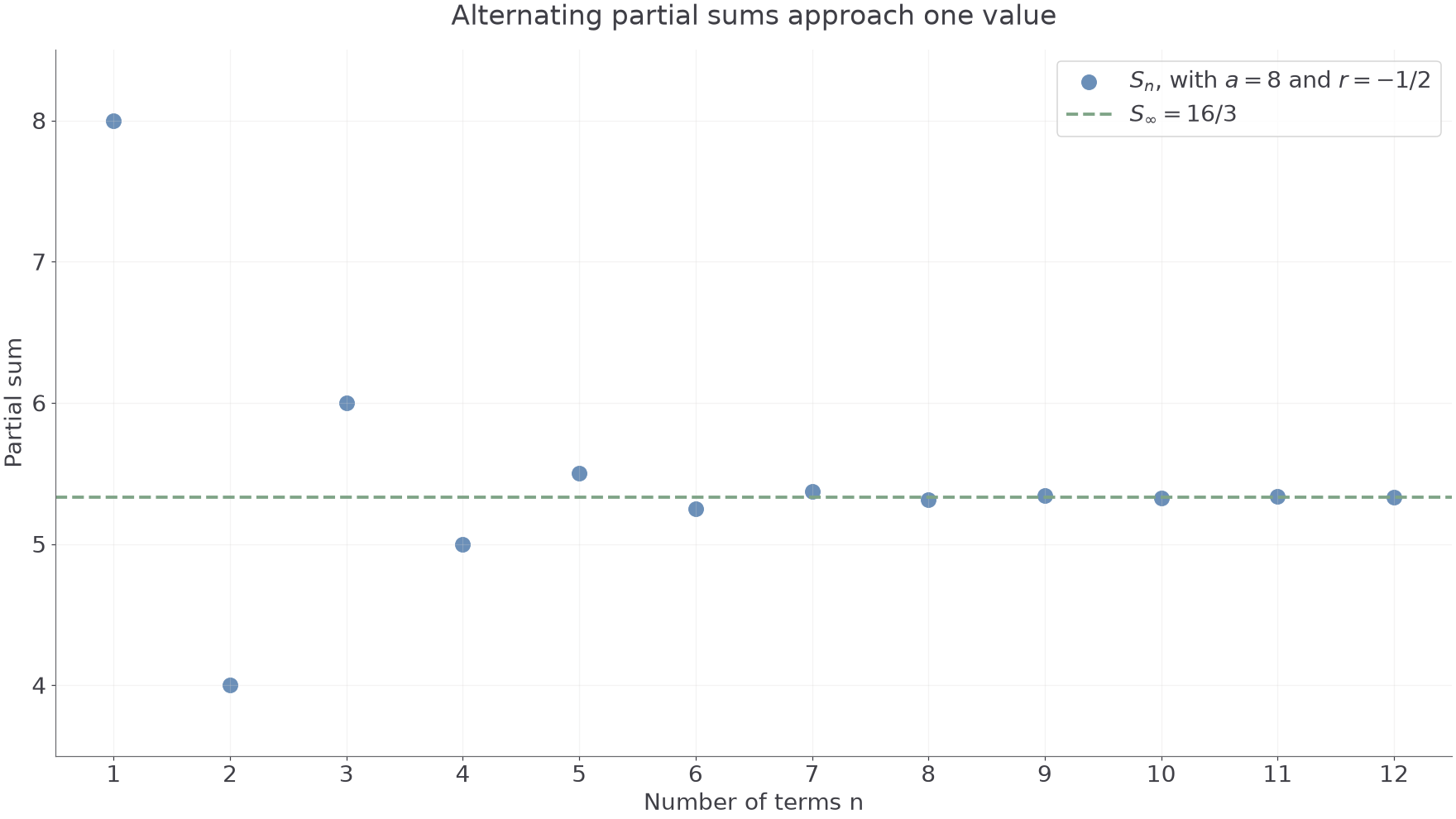
The same limit idea settles a familiar decimal puzzle. The recurring decimal means , with . Its sum is exactly . There is no last digit leaving a final gap. This equality follows from the supplied geometric sum; it is not a separate booklet formula.
Watch out
Wrong: is enough for an infinite sum. The ratio meets that inequality but gives growing magnitudes. Right: require , then use the signed ratio in the denominator.
Change the first term while keeping the alternating ratio.
The remaining tail and accuracy
A finite approximation to an infinite sum leaves a tail. For the positive series with sum , stopping at leaves exactly . Subtracting the supplied formulas gives a general expression.
Remaining geometric tail
For ,
The first expression is signed; the second is its magnitude. The tail begins at , which explains the exponent .
Not in the formula booklet: learn it.
You can derive this whenever needed by subtracting from . To find the least count meeting a tolerance, check both the candidate count and the previous one.
Worked example 7: choosing a positive-ratio count
Question. For , find the least positive integer with .
Plan. Express the tail, then bracket the threshold using consecutive powers of two.
Why this step? The tail decreases with every added term, so a failing count followed by a successful one proves minimality.
Answer. .
Check. The tails at are and , respectively.
Change only the ratio's sign. The magnitude of its power is unchanged, but the denominator changes the scale of the tail.
Worked example 8: choosing an alternating-ratio count
Question. For , find the least positive integer with .
Plan. Use modulus for the tolerance and compare consecutive powers.
Why this step? A negative signed tail can be large in magnitude; only its modulus answers an absolute-error question.
Answer. .
Check. The magnitudes at are and . They decrease, proving that ten is the least count.
For positive and negative , odd partial sums overestimate and even ones underestimate: the signed tail has the sign of . For the opening series, , so is above .
Watch out
Wrong: report a non-integer count from a calculator inequality, or test only the proposed integer. Right: give an admissible integer and establish why the previous count fails, using the decreasing tail magnitude.
Change only the first term in the alternating count problem.
Quick Recap
- The geometric nth term needs multiplications and must be recalled.
- Derive the supplied finite sum by subtracting a ratio-scaled copy; handle separately.
- A nonzero infinite geometric series needs , with both endpoints excluded.
- Keep the sign for overestimation and take modulus for an absolute tolerance.
- A least-count answer needs an integer boundary check.
The opening infinite series has sum : its alternating partial sums approach that finite value because .