B9 - Transforming function graphs
Use a known graph to build a new one by moving, stretching or reflecting its points. You will distinguish changes to outputs from changes to inputs, track domains and ranges, and describe combinations in an order that produces the required equation.
Vertical translations and stretches
Does moving a graph up by , then doubling its heights, give the same graph as doing those operations in reverse order? Take a point at height : the two routes give and . The graph's equation records which operation happened first.
You already know
A point lies on when . A transformation must tell you what happens to both coordinates, even when one stays unchanged.
Changes outside act on its output. In , every point becomes : a translation by . Positive moves up; negative moves down. In , the height becomes : a stretch in the vertical direction with factor when . A factor between zero and one reduces distances from the horizontal axis.
Changing outputs
For , describe a reflection in the horizontal axis and a vertical stretch with positive factor , followed by the translation. The domain stays the same; transform every attained range value by . Not in the formula booklet: learn it.
The final addition happens after multiplication. A negative multiplier reverses the ordering of heights, so a minimum can become a maximum.
Worked example 1: reverse and scale heights
Question. For , describe . Find its equation, vertex, range and the image of .
Plan. Apply to the old vertex and point, then simplify the equation.
Why this step? The negative multiplier turns the lowest original height into the greatest new height.
Answer. Reflect in the horizontal axis, stretch vertically by factor , then translate up . The vertex is , range , and mapped point .
Check. At , the new equation gives , agreeing with the point map.
The original upward parabola and its changed heights are shown together below.
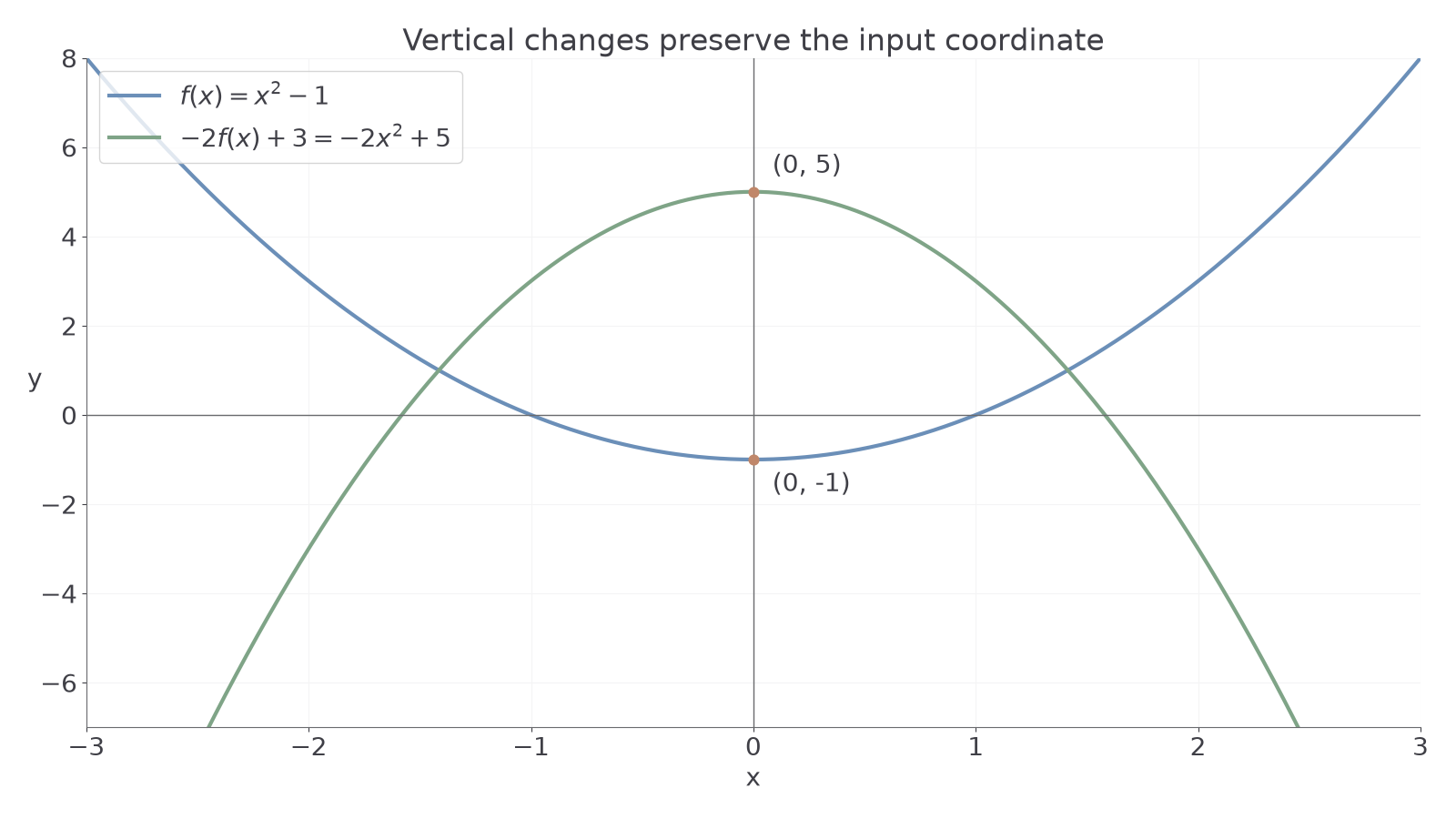
Change only the final translation in the next example. The new maximum should move by exactly the same amount.
Worked example 2: change the final translation
Question. For the same , describe and find its vertex, range and the image of .
Plan. Keep the reflection and stretch, but add to the scaled heights.
Why this step? The added constant acts on every height after scaling, so increasing it by raises every point by .
Answer. Reflect in the horizontal axis, stretch vertically by factor , then translate up . The vertex is , range , and mapped point .
Check. The equation can never exceed , and attains it at .
The horizontal coordinates have stayed unchanged in both examples. A vertical stretch is measured from the horizontal axis, not from the graph's vertex.
Watch out
Wrong: . Expanding the right side gives , a different graph. Right: perform the outside operations in their stated order.
Use a new scaling and translation on the next point.
Horizontal translations and stretches
A change inside asks which new input produces a particular old input. For , an old input occurs when , so the new input is : the point moves left by .
Changing inputs
For a point on ,
The first is a translation by ; the second is a stretch in the horizontal direction with factor . Not in the formula booklet: learn it.
These rules follow by solving or . The output values stay the same. To find the new domain, require that the complete expression inside belongs to the old domain.
Worked example 3: double the input inside
Question. A function has domain and a point on its graph. Describe , find the new domain and the corresponding point.
Plan. Solve for the new input and impose the old-domain condition on .
Why this step? The new input must be half as large to supply the same old input, so the horizontal factor is .
Answer. A horizontal stretch with factor , domain , and corresponding point .
Check. At new input , .
Change only the inside multiplier from to . This makes the new graph wider rather than narrower.
Worked example 4: halve the input inside
Question. With the same function, describe , find its domain and the point corresponding to .
Plan. Solve and apply the original interval to .
Why this step? The reciprocal of the inside multiplier gives the horizontal scale factor: .
Answer. A horizontal stretch with factor , domain , and corresponding point .
Check. The endpoint supplies old input , so the included right endpoint has been tracked correctly.
Translations use the same reasoning. If the old domain is , then requires , giving . This is a shift left by , not right.
Watch out
Wrong: call a horizontal stretch of factor . Right: solve , giving new input and scale factor .
Try another positive inside multiplier.
Reflections and negative scale factors
A minus sign outside a function reverses heights; a minus sign inside reverses inputs. For a point , these give and , respectively.
| New equation | Point mapping | Transformation |
|---|---|---|
| Reflection in the horizontal axis | ||
| Reflection in the vertical axis |
These reflection rules are not in the formula booklet: learn them. With a larger negative multiplier, name a reflection and a positive stretch factor separately: has vertical factor , while has horizontal factor .
Worked example 5: reflect outputs
Question. For , , describe and sketch , giving its domain and range.
Plan. Reverse the sign of each original height and keep each input.
Why this step? The original square root still receives , so its domain condition has not changed.
Answer. Reflection in the horizontal axis, domain , range . The curve begins at the included origin and extends downwards to the right through .
Check. At , the new output is , the negative of the old output.
Change only the position of the minus sign, moving it inside the function. Now the inputs, rather than the outputs, change sign.
Worked example 6: reflect inputs
Question. For the same , describe and sketch , giving its domain and range.
Plan. Require , then reverse the original points' horizontal coordinates.
Why this step? Outputs still come from a positive square root, so the range remains nonnegative.
Answer. Reflection in the vertical axis, domain , range . The curve starts at the included origin and extends upwards to the left through .
Check. At , the output is , matching the reflected old point .
A reflection can leave a graph unchanged. Since , reflecting in the vertical axis produces the same set of points. More surprisingly, different kinds of transformation can also produce the same equation: for , . A horizontal factor and a vertical factor therefore produce the same parabola, although they move its individual points differently. This identity is derived directly, not supplied in the formula booklet.
Watch out
Wrong: leave inequality signs unchanged when dividing a domain condition by a negative number. Right: gives ; also keep track of which endpoint was excluded.
Combine a reflection with a horizontal scale factor in the next domain calculation.
Combined transformations and their order
Track the old input and the old output separately when an equation contains several changes. For , the old input appears where ; the old height becomes .
Combined point mapping
For , ,
Solve the inside equation for the new input and apply the outside operations to the old output. Not in the formula booklet: learn it.
One valid sequence is: horizontal stretch of factor , reflection in the vertical axis if , then horizontal translation by ; vertical stretch of factor , reflection in the horizontal axis if , then vertical translation by . Changes to different coordinates can be interchanged; changes to the same coordinate may give different outcomes in a different order.
Worked example 7: transform a modulus graph
Question. Let . Sketch , finding its vertex, roots, range and the image of .
Plan. Map the vertex and named point, then solve the zero-height equation.
Why this step? Factoring the inside as reveals a horizontal factor followed by a shift right by .
Answer. A downward V with vertex , roots , range , and mapped point .
Check. , and .
The image shows how a point left of the original corner can land on the new vertical axis.
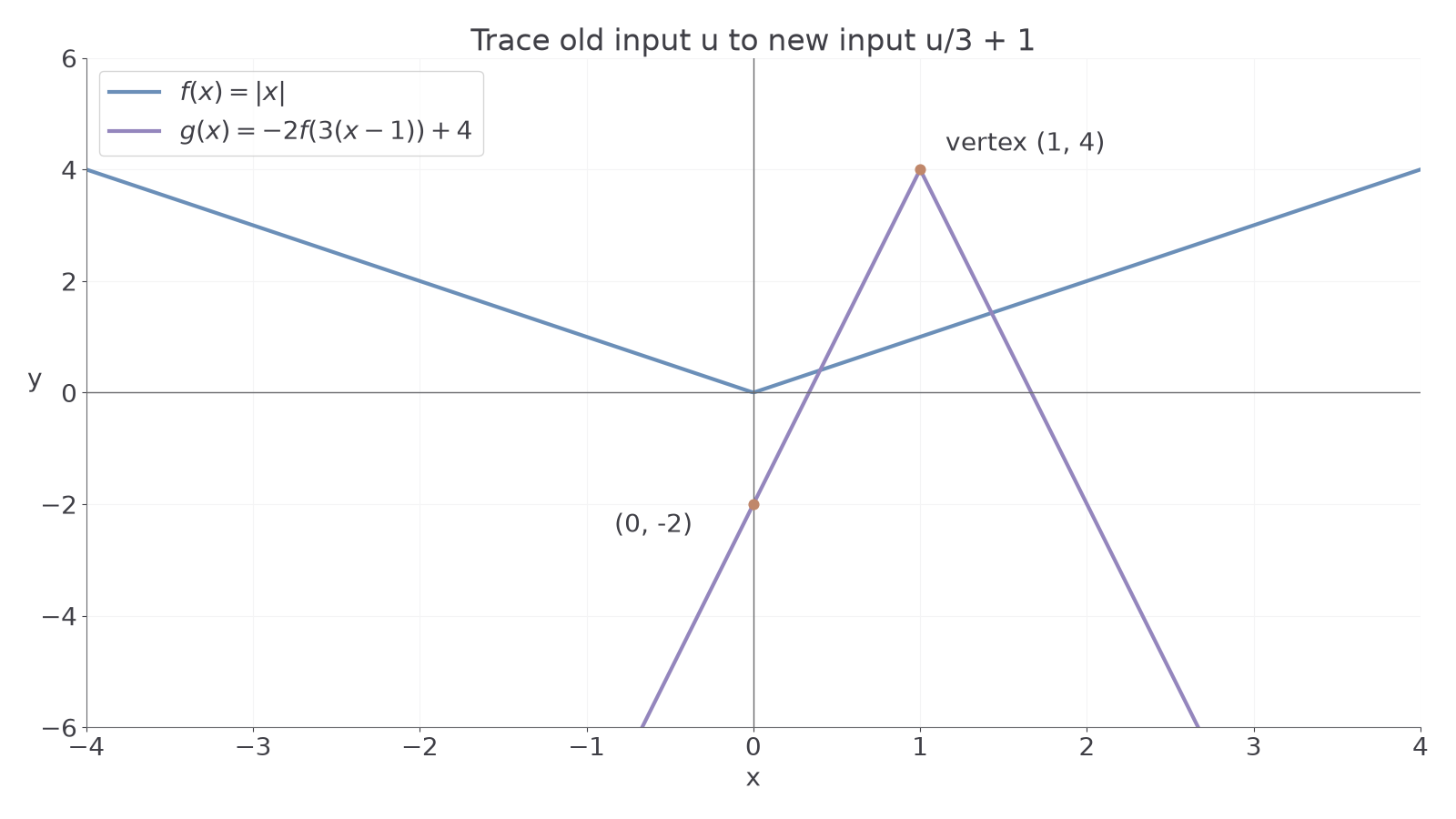
Change only the final height shift from to . The new roots move even though the vertex's horizontal coordinate does not.
Worked example 8: shift the transformed graph
Question. For the same , sketch , giving its vertex, roots, range and the image of .
Plan. Keep the horizontal map and replace the final vertical addition by .
Why this step? The final translation shifts the whole downward V up by , so the zero-height line cuts its arms further from the corner.
Answer. Vertex , roots , range , and mapped point .
Check. At , ; the roots are symmetric about .
Return to the opening order puzzle. Starting with , translating up , then stretching vertically by , gives . Reversing the order gives . In the first route the translation itself is stretched. This algebraic comparison is not supplied in the formula booklet.
The nonzero conditions in the point map matter: gives a constant output on the permitted original composite domain, not an invertible stretch. With , is defined only if the original function accepts zero.
Watch out
Wrong: describe as horizontal factor , then right . Right: solve , giving : factor , then right .
Alter the final translation again and check all three intercepts.
Quick Recap
- Outside operations change heights directly; inside operations must be undone to find new inputs.
- has horizontal factor for positive .
- A minus outside reflects in the horizontal axis; a minus inside reflects in the vertical axis.
- Trace both coordinates and their permitted sets when combining transformations.
The opening operations give different graphs: translating then doubling produces ; doubling then translating produces .