B3 - Quadratic graphs and discriminants
Sketch quadratics from their intercepts and turning points, and use completed-square form to explain their maximum or minimum values. Then use the discriminant to count real roots and find parameter conditions, including values where an equation stops being quadratic.
Features of a quadratic graph
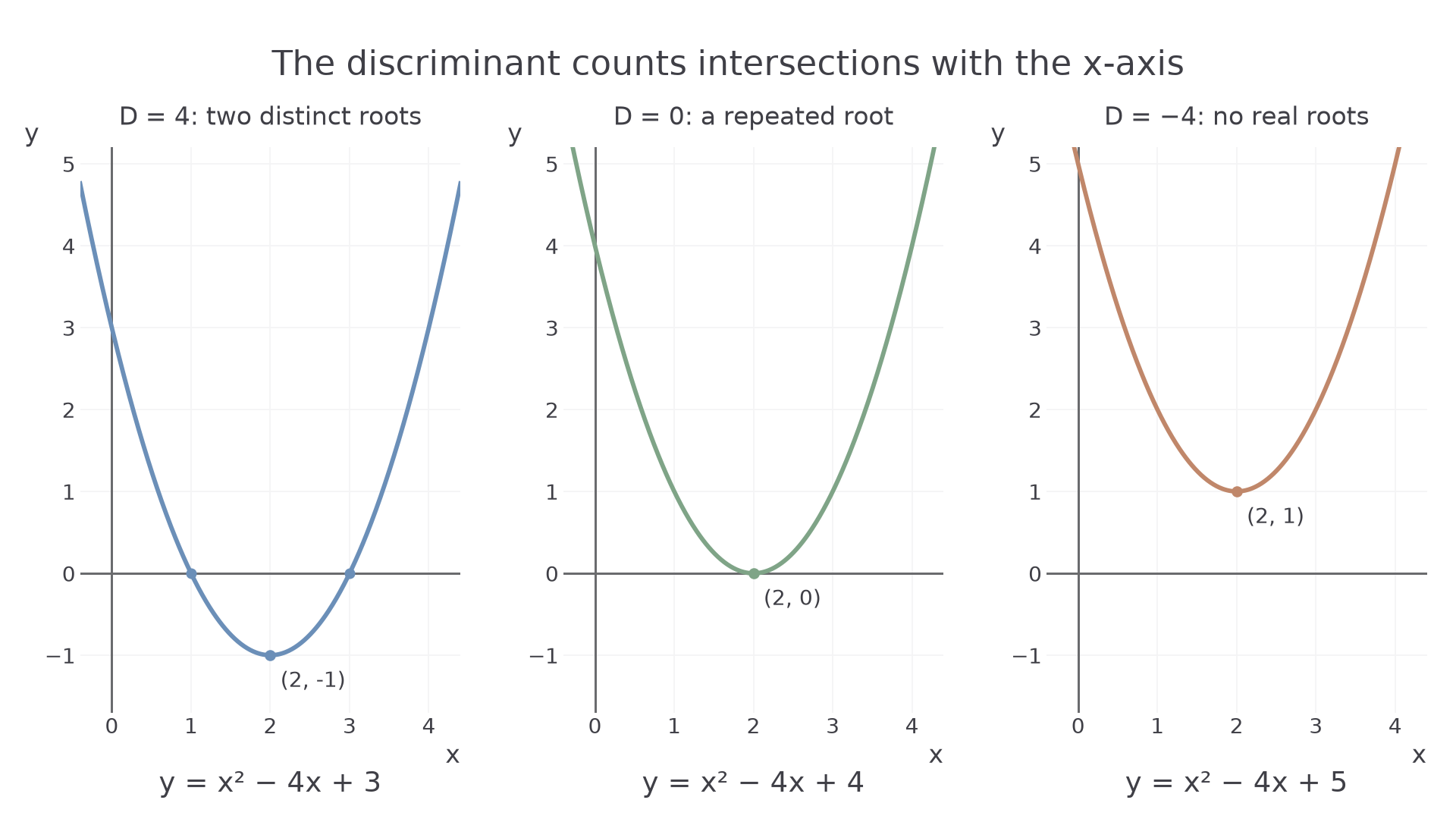
Can changing just the constant turn two crossings of the horizontal axis into no crossings at all? Compare , and . Their shapes match, yet their meetings with the axis do not. We will explain exactly where the change happens.
Start with . At , its value is ; at and , its value is zero. These easy calculations already locate three points on the curve.
Quadratic function
A quadratic function has the form , with real constants and . Its graph is a parabola. Unless restricted, its domain is all real numbers. The expression is not quadratic because its squared-term coefficient is zero.
If , both arms rise and the curve has a minimum. If , both arms fall and it has a maximum. The vertex, or turning point, lies on a vertical axis of symmetry: points equally far to either side have equal heights.
The -intercept is . The -intercepts come from , so their horizontal coordinates are the equation's real roots. If there are two distinct roots , the symmetry line is halfway between them, . These graph results are not in the formula booklet: learn them.
Worked example 1: build a quadratic sketch
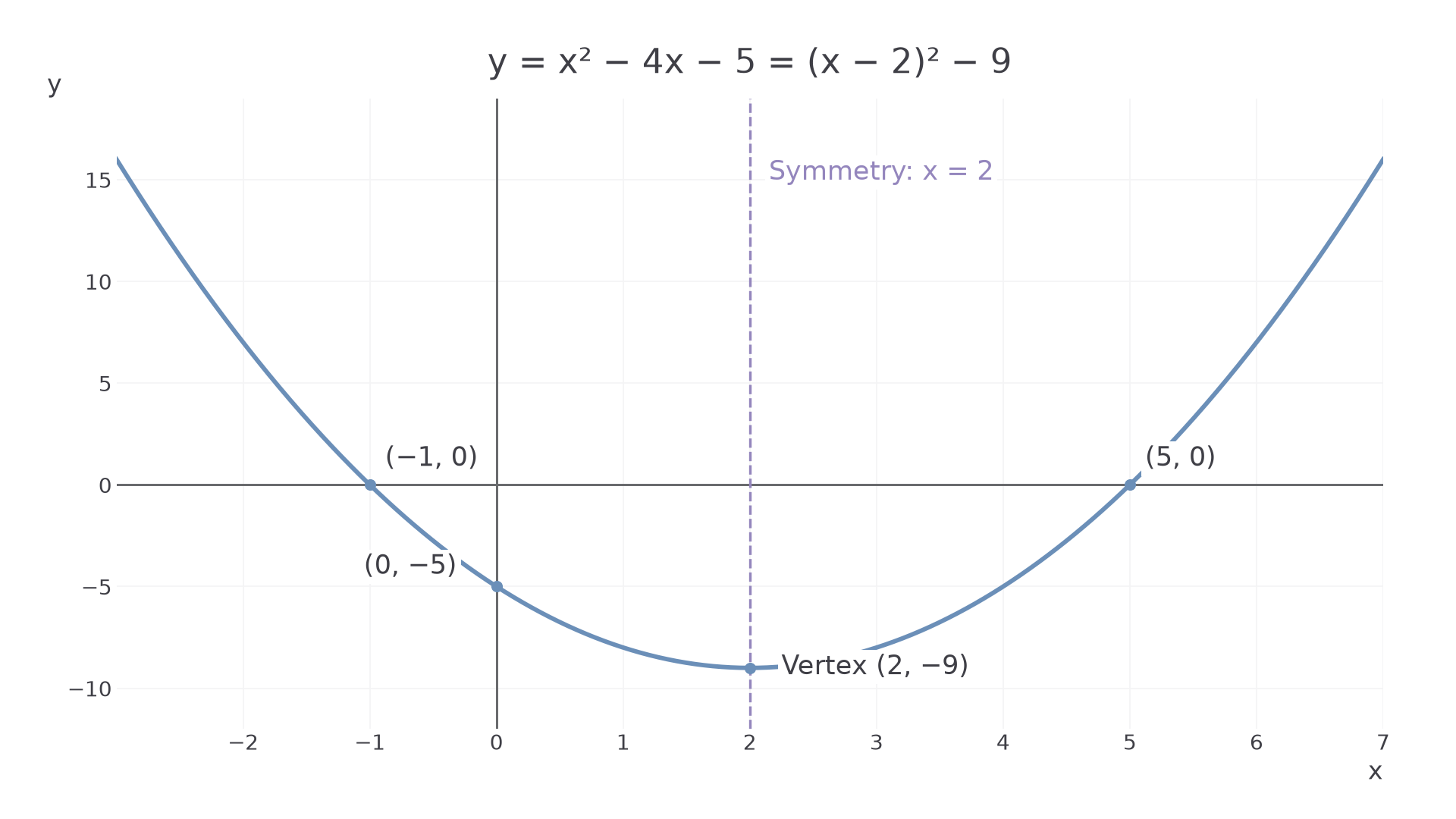
Question. Sketch , labelling the intercepts and vertex.
Plan. Find the intercepts, use the midpoint of the roots for the symmetry line, then calculate the vertex's height.
Why this step? Symmetry locates the vertex horizontally without needing an accurate plot of many points.
Answer. Draw a smooth upward parabola through , and , with minimum vertex , as shown below.
Check. , confirming symmetry about .
The picture joins the features with a curve, not straight segments. A sketch need not use an exact scale, but the relative positions and opening direction must agree with the algebra.
The next example changes only the sign of the entire function. Each vertical coordinate changes sign, while the roots and symmetry line stay fixed.
Worked example 2: reverse the opening direction
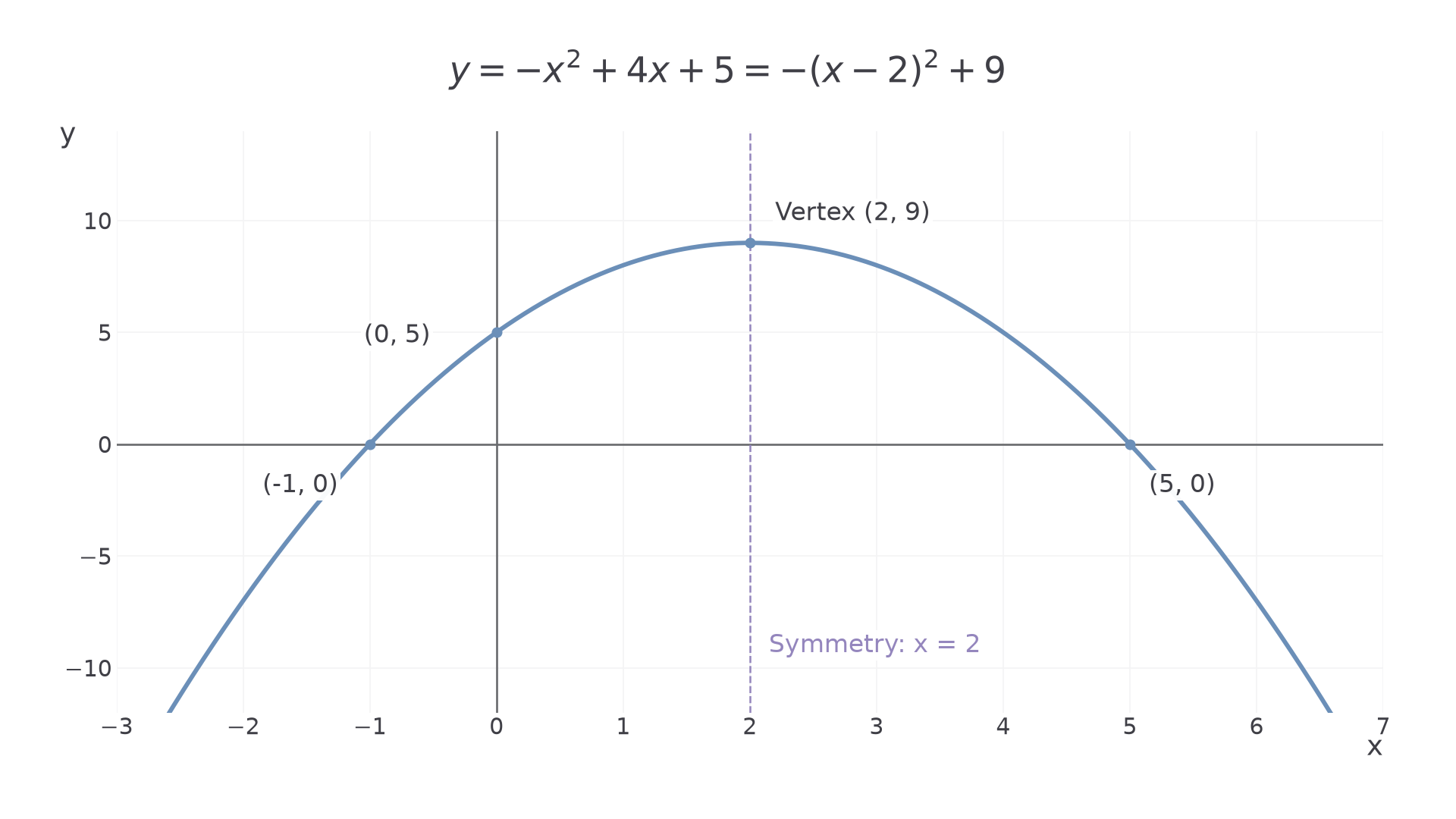
Question. Sketch , labelling the intercepts and vertex.
Plan. Factorise and find the same key features, now checking for a maximum.
Why this step? The negative squared-term coefficient changes the minimum into a maximum.
Answer. A smooth downward parabola has intercepts , , and maximum vertex .
Check. Its values are the negatives of those in example 1; in particular, at both and .
The second sketch reflects the first in the horizontal axis; each labelled point agrees with the new equation.
AQA's sketch instruction asks for important features and a consistent shape. A list of coordinates is useful preparation, but does not itself draw the requested curve.
Watch out
Wrong: the -intercept of is . Right: put , giving . Coordinate order tells you which axis you are on.
Now locate features for a different quadratic. This check asks for the values rather than a drawing.
Completing the square and turning points
Completing the square makes the vertex visible even when the graph has no real roots to use as landmarks.
You already know
A real square is at least zero, and exactly when . The sign of the squared-term coefficient determines whether the vertex is a minimum or maximum.
Expand . To reproduce , subtract the extra . In general, halving the linear coefficient produces the required bracket:
If the leading coefficient is not one, factor it from the quadratic and linear terms first.
Completed-square form
For real coefficients with ,
In the form , the vertex is and symmetry line is . The extreme value is : a minimum if , a maximum if .
Not in the formula booklet: learn it.
Use the expansion to keep track of the constant inside the factored bracket. It will be multiplied by the leading coefficient too.
Worked example 3: expose a minimum
Question. Express in completed-square form and find its minimum.
Plan. Factor from the first two terms, complete the square, then use its least possible value.
Why this step? The compensating is inside the bracket, so it contributes , not .
Answer. , with minimum at , giving vertex .
Check. Expanding returns .
The next example changes the sign of the leading coefficient, retaining the same bracket after factorisation. The square now contributes a non-positive term.
Worked example 4: expose a maximum
Question. Express in completed-square form and find its maximum.
Plan. Factor , complete the same square and identify when the negative square is largest.
Why this step? , so its largest value is zero, rather than an arbitrarily large positive number.
Answer. , with maximum at , giving vertex .
Check. Expansion gives .
Completed-square form also gives the full set of output values: in example 3 and in example 4. The bracket can become arbitrarily large in magnitude as varies.
Watch out
Wrong: the vertex of is . Right: the square vanishes when , so its vertex is .
A calculator can find a numerical vertex in an ordinary Find task. When the question requests completed-square form, give that form explicitly.
The discriminant and real roots
The discriminant counts real roots without requiring you to calculate them individually.
For the opening family, write . Raising lifts the vertex without changing its horizontal position. At , both roots meet at the vertex. A tiny further upward shift removes both real roots at once.
Discriminant
For , where are real and , the discriminant is . A repeated root is one distinct real value occurring twice in the factorisation, as in .
The square root in the quadratic formula explains the three cases.
Discriminant test
The quadratic formula is
For real coefficients and , gives two distinct real roots, a repeated real root, and no real roots. A repeated root is .
Not in the formula booklet: learn it.
A positive square root gives two different choices of sign; a zero square root makes them equal; a negative radicand has no real square root.
This is also a consequence of completing the square, rather than a separate trick:
Since , the right side has the sign of . A real square can equal a positive number in two ways, zero in one way, and a negative number in no way. This derived identity is not in the formula booklet; derive it from completed-square form when needed.
Worked example 5: no real roots
Question. Determine the number of real roots of .
Plan. Evaluate the discriminant and interpret its sign.
Why this step? A negative discriminant rules out real roots without needing an approximation to either root.
Answer. There are no real roots.
Check. , so the graph stays above the axis.
Change just the constant from to . The vertex reaches the axis, producing a repeated root.
Worked example 6: a repeated root
Question. Determine the number of distinct real roots of , and find the root.
Plan. Check the discriminant, then use the zero square to identify the root.
Why this step? Zero discriminant means the two formula signs give the same value, not two different intercepts.
Answer. One distinct real root, , repeated twice.
Check. Substitution gives , and the square form shows the graph touches the axis there.
No real roots does not by itself mean a positive function. For , an upward parabola lies above the axis and a downward one lies below it: their extreme value is .
Watch out
Wrong: “, so there are no roots.” Right: there is a repeated real root. “No real roots” requires .
Change the constant again to move the graph below its tangency position.
Root conditions involving parameters
When coefficients contain a parameter, the requested roots become a condition on that parameter.
Translate the words first: two distinct real roots need ; a repeated root needs ; real roots, allowing equality, need . These conditions assume the squared-term coefficient is nonzero. None of these parameter rules is in the formula booklet: use the discriminant test you have learned.
Worked example 7: find all parameter cases
Question. For real , classify the real roots of .
Plan. Factorise the discriminant in , then consider the signs between its zeros.
The zeros are . If , both factors are negative and the product is positive. If , one is negative and one positive. If , both are positive.
Why this step? The discriminant itself is a quadratic in the parameter; its sign changes at its roots, so solving only would find boundaries without the intervals.
Answer. Two distinct real roots for or ; no real roots for ; a repeated root for or . The repeated root is : respectively and .
Check. At , the equation is , with no real roots. At the boundaries it becomes and .
The next example changes which coefficient contains the parameter: it is now the leading coefficient. Before using the discriminant, set aside the value where that coefficient vanishes.
Worked example 8: a disappearing squared term
Question. Find all real for which has at least one real solution.
Plan. Treat the quadratic case , then check in the original equation.
Why this step? The discriminant classifies quadratic roots; it does not classify the linear equation left when .
Answer. , including the separate linear case .
Check. At , has a repeated root; at , , so there is no real solution.
A boundary can be included because a repeated root is allowed, or because a separate linear equation has a real solution. Give the reason: the final interval alone can hide a missed exceptional case.
Watch out
Wrong: “Real roots means .” Right: unless the question says distinct. Also join the two outer intervals in example 7 with “or”; no value can be less than and greater than at once.
The opening family is now explained: changing in changes . Its sign changes at , exactly when the vertex reaches the axis.
Quick Recap
- Intercepts, opening direction and symmetry determine the essential quadratic sketch.
- Completed-square form gives the vertex and explains the extreme value.
- Positive, zero and negative discriminants give two distinct real roots, a repeated real root and no real roots.
- Translate the exact root condition, solve its parameter inequality and check any vanishing leading coefficient separately.
Changing the opening family's constant raises the vertex: gives two crossings, one tangency, and none.