D2, D3 - Sequences, recurrence and sigma notation
Generate and analyse sequences from direct formulae and recurrence rules (D2). Read and write sigma sums (D3), keeping a term's value separate from its index and a sequence separate from its sum.
Terms and their indices
Start with , then repeatedly replace the current number by . Can you find the thousandth term without doing a thousand calculations? Your first job is to be clear about what “thousandth” means: the starting counts as term one.
You already know
A function rule takes an input and returns an output. In , apply to first, then apply the same rule to that output. This repeated substitution will help you read recurrence rules.
For a simpler list, take . Substitution gives . The first two values agree, but their positions differ and the sequence is not constant.
Sequence and index
A sequence assigns a value to each allowed integer index . An nth-term formula gives that value directly from . Usually ; a start at must be stated. The subscript in is an index, not multiplication.
A formula is useful only together with its index domain. An algebraic equation may have real solutions that are not permitted sequence positions.
Worked example 1: calculating indexed values
Question. For , , find the first four terms and .
Plan. Substitute each requested index into the whole formula.
Why this step? The index goes into every occurrence of ; it is not the value to multiply by the previous term.
Answer. , and .
Check. The equivalent form gives .
Change the task from finding a value at a known index to finding an index for a known value. You must now test whether the algebraic solution belongs to .
Worked example 2: deciding membership
Question. For the same sequence , determine whether is a term.
Plan. Solve , then check both roots against the index domain.
Why this step? A negative index can solve the quadratic without being a position in this sequence.
Answer. is the eighth term; reject because .
Check. .
These are uses of substitution and algebra, rather than special supplied sequence formulae. The formula booklet does not supply the individual nth-term rules used in these examples.
Watch out
Wrong: every real solution of the membership equation gives a sequence position. Right: retain only indices in the stated integer domain. For example, gives , so is not a term of for .
Keep the membership task but change the specified value.
Generating terms and finding a possible limit
A recurrence uses the previous value to make the next one. Starting at , the rule gives , then : substitute the new value each time.
Recurrence and fixed point
A first-order recurrence has the form , with an initial value and starting index. A fixed point satisfies . For a continuous update rule, if the terms approach a finite limit , that limit must satisfy this equation. Neither the general recurrence nor the fixed-point equation is supplied as a sequence formula in the formula booklet.
Solving the fixed-point equation finds candidates, not proof that a sequence approaches one. Compare the distance from the fixed point to see what the updates actually do.
Worked example 3: moving away from a fixed point
Question. Let , for . Find . Does the fixed point give the limit of this sequence?
Plan. Update successively, then track the gap from the fixed point.
Why this step? The gap begins at and doubles, so it moves away from zero even though a fixed point exists.
Answer. ; the sequence does not approach and has no finite limit.
Check. Starting at would instead give . The initial value matters.
Change only the multiplier of the gap from : replace by . The fixed point stays put, but distances now shrink.
Worked example 4: approaching the fixed point
Question. Let , . Find the next three terms and the limit.
Plan. Generate the terms, then show that the gap from halves at each update.
Why this step? A shrinking positive gap establishes approach to ; the equation for alone does not.
Answer. , with limit .
Check. The gaps are , consistent with the derived expression.
Neither gap expression is in the formula booklet; each follows from its recurrence. Also check denominators before updating a rational rule: a term making a denominator zero would stop that sequence.
Watch out
Wrong: substitute the index into when the rule says . Right: substitute the current term. Also, identifies a possible limit only when the limiting step is valid.
The next rule has a different fixed point; the question explicitly supplies convergence, so you can use the fixed-point equation directly.
Increasing, decreasing and periodic behaviour
The terms rise while remaining below . Increasing describes comparisons between successive terms; it does not mean that the terms grow without bound.
Sequence behaviour
A sequence is increasing if for every permitted index, and decreasing if throughout. A periodic sequence satisfies throughout for a positive integer ; its period is the least such . A constant sequence is neither strictly increasing nor strictly decreasing.
AQA uses these strict inequalities for increasing and decreasing sequences. If equality is allowed, say “non-decreasing” or “non-increasing”. The definitions are not printed as formulae in the booklet. A general difference can establish behaviour at every index.
Worked example 5: proving increase
Question. Show that , , is increasing.
Plan. Subtract successive terms and establish the sign for every permitted index.
Why this step? Positivity of the difference for every allowed proves the claim for the whole sequence.
Answer. The sequence is increasing for .
Check. Its first values rise, and explains its upper bound.
Change only the numerator of the nth-term formula from to . The same comparison method now gives the opposite sign.
Worked example 6: proving decrease
Question. Show that , , is decreasing and positive.
Plan. Find the successive difference and check the original term's sign.
Why this step? Decreasing and negative are different properties; checking the original fraction establishes positivity separately.
Answer. The sequence is decreasing and every term is positive.
Check. agree with the conclusion, though these values alone would not prove it.
A recurrence can repeat rather than rise or fall. Returning to a previous value returns to the same future, provided all updates remain defined.
Worked example 7: finding a repeating cycle
Question. Let , . Find its period and .
Plan. Generate terms until the starting value returns, then use the index's position in the cycle.
Why this step? The three distinct values repeat under the same rule, and none is , so no denominator fails later.
Answer. The least period is , and .
Check. Indices all have value ; is one of these indices.
There is a neat algebraic reason for this cycle. For , applying the rule twice gives , and a third application gives , for . Three reciprocal updates undo themselves. This derived identity is not in the formula booklet.
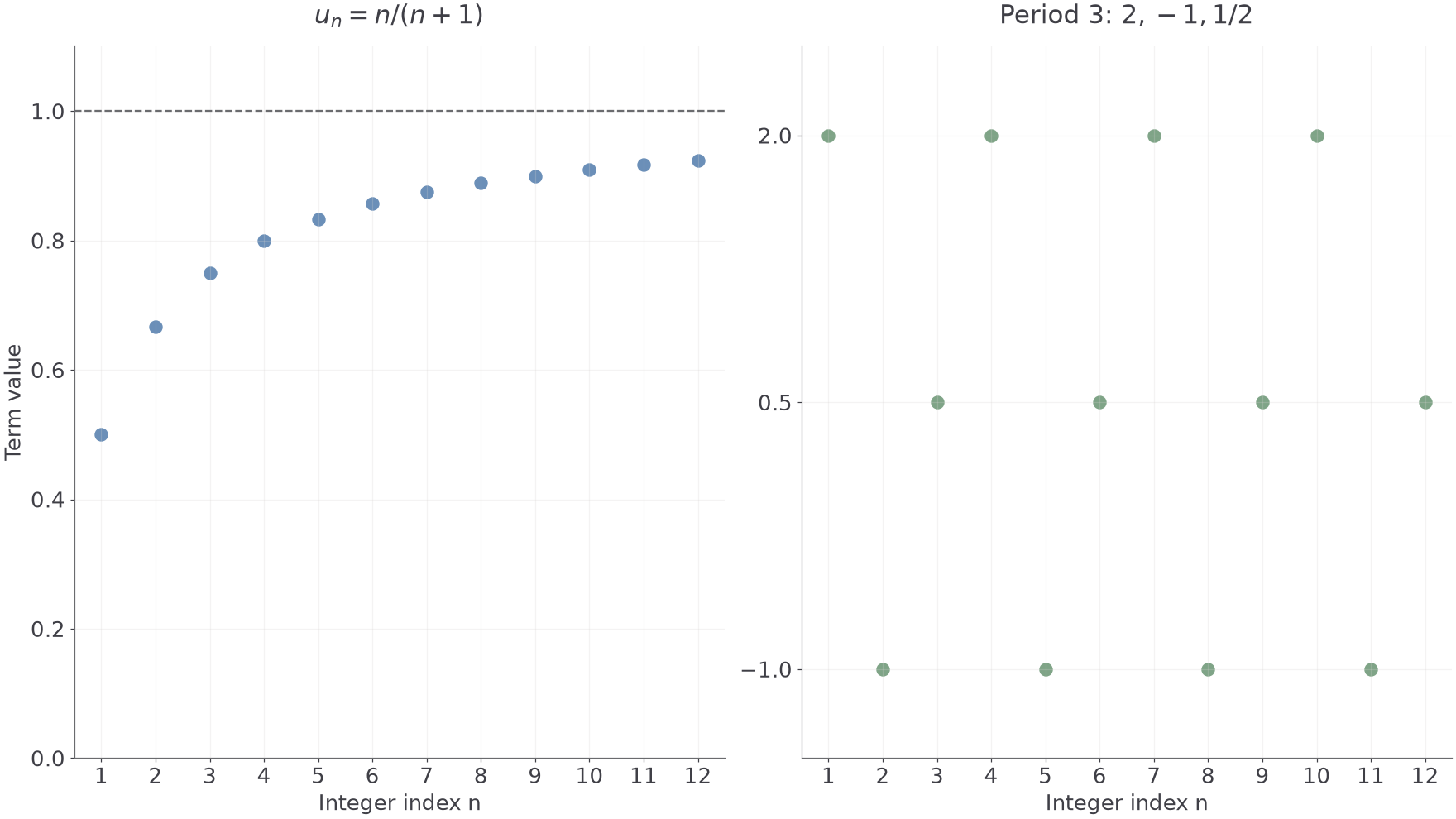
Only the plotted integer-index points are sequence terms. The periodic example is neither increasing nor decreasing; the increasing example approaches the dashed line without reaching it.
Watch out
Wrong: four rising terms prove increase forever. Right: justify the sign of a general difference. For a periodic rule, identify the complete repeating cycle and check that all its updates exist.
Change the denominator in the decreasing example, leaving the proof strategy unchanged.
Reading and rewriting sigma sums
The sum can be written compactly as . The bounds tell you which indices to substitute, including both ends.
Series and sigma notation
A series is a sum of sequence terms. In , substitute the integers and add the values. For , there are terms. The index letter is a dummy label: changing it consistently does not change the sum. These notation rules are not supplied as formulae in the booklet.
Write for the sum of the first terms, keeping it distinct from the single term . This is notation to learn, rather than a separately supplied sum formula. Write the first and last contributions before using a calculator sum function. This is a quick way to check that the calculator is evaluating the intended range.
Worked example 8: evaluating a sum
Question. Evaluate .
Plan. List the four permitted indices and add the corresponding values.
Why this step? The upper index is the last index, not the number of terms when the lower index is .
Answer. .
Check. There are terms; their average is , giving .
Change only the indexing: start the new index at zero but keep the same four values. Both bounds and the summand must change together.
Worked example 9: changing the starting index
Question. Rewrite with an index running from to , then evaluate it.
Plan. Set and substitute this relation throughout.
Why this step? Merely replacing the lower bound by zero adds unwanted values; the substitution must preserve each selected term.
Answer. .
Check. At the new bounds , the summand gives the old endpoints .
Constants can be taken outside sums, and sums can be split:
These rules follow from ordinary addition and are not in the formula booklet. A constant inside the summation is included each time: . For comparison, means multiplication, so , whereas . This recognition of a product symbol is background; D3 requires sigma sums.
Watch out
Wrong: . Right: there are four contributions of , giving . A constant outside sigma contributes once; a constant inside contributes at every index.
Keep the new zero-based index but change the terms being summed.
Quick Recap
- A sequence's index domain is part of its definition.
- A recurrence needs an initial value; use the previous value in each update.
- A fixed-point equation finds a possible limit, while the actual behaviour needs justification unless convergence is given.
- Prove increase or decrease for every index; find a full cycle for periodic behaviour.
- In sigma notation, change the bounds and summand together when changing index.
The opening recurrence cycles through . Since , its thousandth term is .