G1 - Derivatives from first principles
Learn how a chord gradient approaches a tangent gradient, and use that idea to derive derivatives of polynomial powers. Connect the resulting gradient function with instantaneous rates and with the shape of a curve.
Tangent gradient as a limit
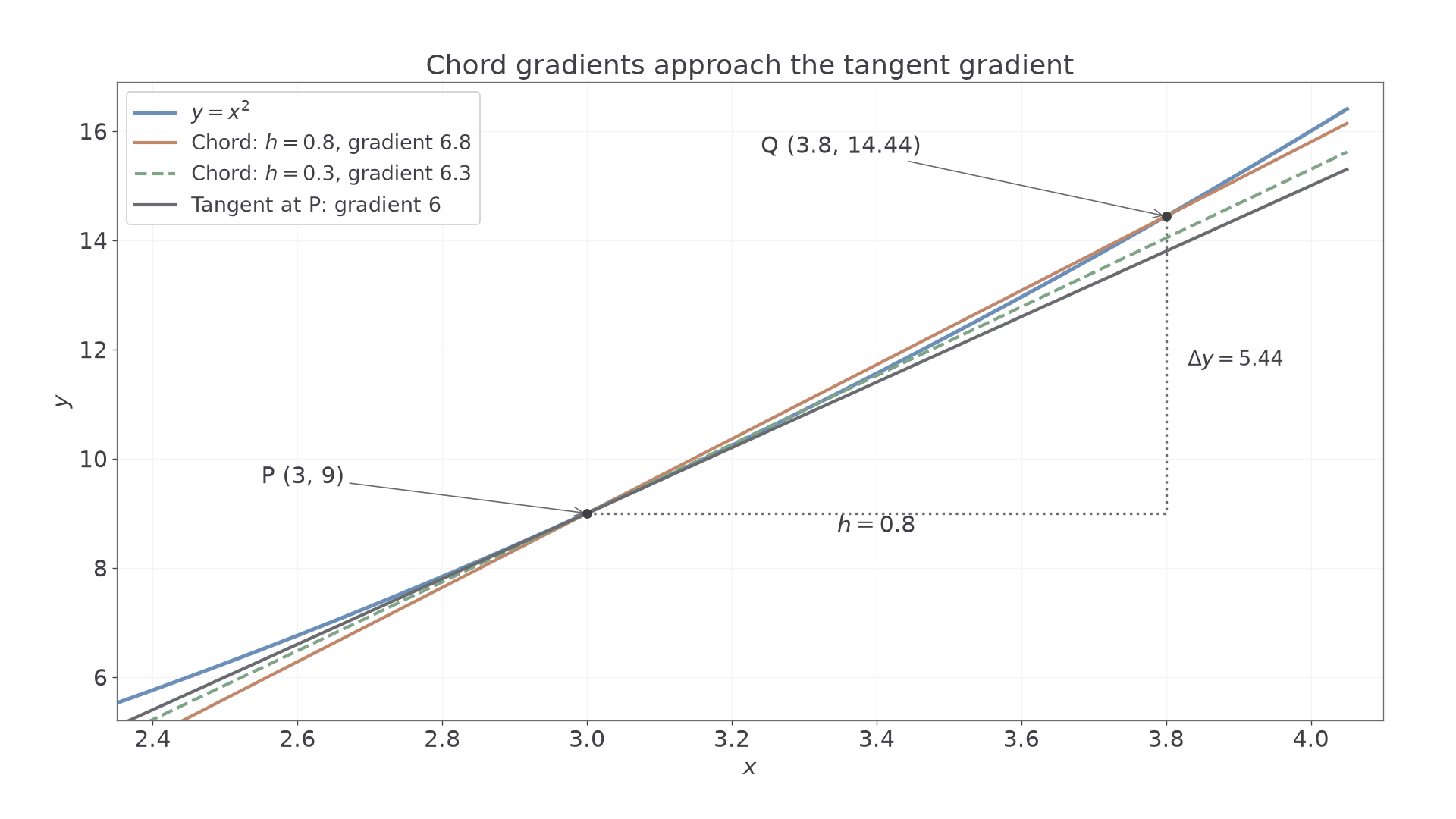
How can a curve have a gradient at one point when the gradient formula needs two points? On , the chord from to has gradient . Moving the second input to gives gradient . The approaching value, , describes the tangent at the first point.
You already know
A straight line has gradient . Expanding gives . These are recall results, not supplied in the formula booklet.
For and , the change in input is , also written or . It may be positive or negative. The chord gradient is , with . As approaches , those chord gradients may approach a common value.
Derivative
The derivative at an interior input is the common finite limit of the chord gradients from both sides, when it exists. It is the tangent gradient there. For , write it as , or .
A limit is an approached value; the expression need not be defined at the limiting input. A corner illustrates the boundary: for at zero the left chord gradients are and the right ones are , so there is no derivative there.
Differentiation from first principles
Simplify while , then take the limit.
In the formula booklet.
This definition turns the opening numerical pattern into an exact calculation.
Worked example 1: a tangent gradient at a fixed input
Question. For , use a chord gradient and a limit to find the tangent gradient at .
Plan. Form the quotient at , expand, cancel the nonzero increment and take its limit.
Why this step? Cancelling is legal before taking the limit because the approaching increments are nonzero.
Answer. The tangent gradient is .
Check. At and , the chord gradients are and , approaching the same value.
Now change only the fixed input, from to . A negative gradient should emerge because this side of the parabola falls as you move right.
Worked example 2: approaching from either side
Question. For , find the tangent gradient at from first principles.
Plan. Keep the negative input in brackets and repeat the difference-quotient method.
Why this step? The square applies to the whole input ; keeping the brackets prevents the middle term's sign being lost.
Answer. The tangent gradient is .
Check. Increments and give and , consistent with a falling tangent.
Both calculations keep a distinction between a small increment and an increment equal to zero.
Watch out
Wrong: substitute into the original quotient and call . Division by zero is undefined. Right: simplify for , then take the limit of the simplified expression.
Try one more input, retaining the limit notation in your conclusion.
First principles for polynomial powers
Keeping the input as gives every tangent gradient at once: , so . This gradient function can then be evaluated at any required input. The result is not in the formula booklet: learn it.
The same method works for other small positive integer powers. Form by replacing every by , subtract the whole of , expand and cancel, divide by , then take the limit. Keep fixed while changes.
Worked example 3: the cubic power
Question. Differentiate from first principles.
Plan. Expand the cube inside the difference quotient and identify which terms survive the limit.
Why this step? Only the term originally containing exactly one factor of remains after division and the limit.
Answer. .
Check. At , the chord quotient is , which tends to .
Change only the function's exponent, from to . There is an extra binomial term, but the same cancellation decides the answer.
Worked example 4: a fourth power
Question. Differentiate from first principles.
Plan. Expand , cancel and divide before taking the limit.
Why this step? The powers of show exactly why the extra terms disappear; quoting a power rule would skip the requested derivation.
Answer. .
Check. At , the quotient is , tending to .
For a small positive integer , the binomial expansion begins . The binomial expansion is supplied in the formula booklet. After subtraction and division, the surviving term is . For , the quotient is exactly . Constants have zero change. Thus the first-principles calculation for gives quotient and limit . These derived power and constant results are not supplied in the formula booklet.
Watch out
Wrong: . The missing middle terms contain the gradient information. Right: .
The next question changes the exponent once more; its expansion is longer, but only one term survives.
Continue this lesson.
You’re previewing NovaLearn without an account. Create a free account to read the rest.
Create free account