M1 - Events, independence and probability
Use sets to describe chance events, combine their probabilities and test independence. You will distinguish “cannot happen together” from “does not affect the probability”, then see why an exact value behaves differently in discrete and continuous models.
Outcomes and event notation
Can two events overlap and still be independent? On one fair die, “even” and “at most four” do overlap. We will return to those events once we have a precise language for what happens.
Begin with one roll. The possible scores are . Let mean an even score, so , and let mean a score of at least , so . A score of belongs to both events; a score of belongs to neither.
You already know
A set collects objects with a stated property. Fractions compare a favourable count with a total; the denominator must describe the population from which you select.
Here the objects are possible scores, and an event collects the scores that satisfy a condition.
Sample space and event
The sample space is the universal set of possible outcomes of an experiment. An event is a subset of ; it occurs when the observed outcome is in that subset. For example, , whereas .
The symbol allows equality. A proper subset, such as , contains only elements of but is not all of . Write for the number of elements in a finite set. These set meanings are not in the formula booklet: learn them.
| Notation | Meaning | Die example |
|---|---|---|
| Intersection: both events | ||
| Union: either event or both | ||
| Complement: not , within | ||
| Empty set |
“Or” is inclusive unless a question says “but not both”. Thus “neither” is , while “not both” is . The latter includes outcomes where exactly one event happens.
Counting equally likely outcomes
For a finite sample space of equally likely outcomes,
Every probability model satisfies , and .
Not in the formula booklet: learn it.
Counting favourable outcomes works because each outcome has the same probability. For a biased die, the six scores still form the sample space, but their probabilities must come from the stated model.
Worked example 1: an intersection
Question. A fair six-sided die is rolled. Let and . List and find its probability.
Plan. Keep only scores belonging to both sets, then divide their count by six.
Why this step? Intersection asks for simultaneous membership, so and are excluded even though each belongs to one set.
Answer. , with probability .
Check. The intersection has fewer outcomes than either three-element event.
Change just one feature: complement the second event. Now you need scores in that are outside .
Worked example 2: an intersection with a complement
Question. For the same fair die and sets , , list and find its probability.
Plan. Form the complement within the six possible scores, then intersect with .
Why this step? The complement changes which scores qualify; it does not change the original sample space.
Answer. , with probability .
Check. The two parts of have probabilities .
A complement belongs to a specified universe. Numbers outside the die's possible scores never enter .
Watch out
Wrong: . That is the intersection. Union keeps every score in either set: , counting each once.
Use the same membership test in the following new sample space.
Combining event probabilities
Suppose of students attend art and attend badminton, with attending both. Adding counts those twice. Subtracting one copy leaves students in at least one club.
Addition rule
For any two events,
In the formula booklet.
The complement fills the rest of the sample space, so . This complement rule is not in the formula booklet: learn it. In particular, “neither” is the complement of the union.
For the club counts, fill the overlap first. Then subtract it from each whole-circle total and put everyone else outside.
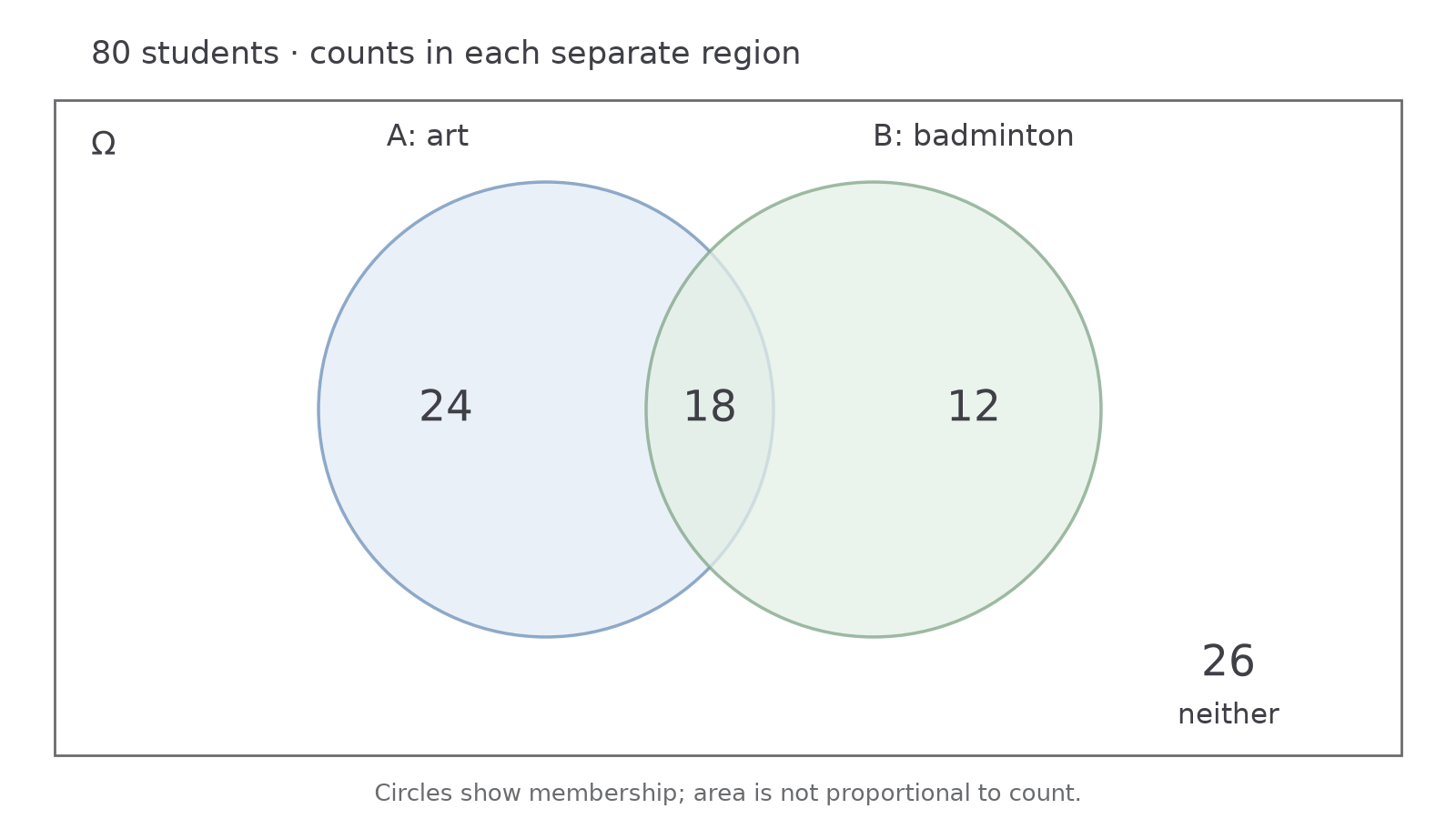
The four separate regions add to the whole population. Their nonnegative probabilities also constrain an overlap :
The upper bound says an intersection fits inside either event. The lower bound prevents the union exceeding . These bounds follow from the addition rule and nonnegativity; they are not in the formula booklet: learn the reasoning.
Worked example 3: at least one club
Question. Of students, attend art, badminton and both. One is selected uniformly at random. Find the probabilities of at least one club and neither club.
Plan. Count the union once, then take its complement.
Why this step? “At least one” includes both, so the overlap is subtracted once, rather than removed completely.
Answer. At least one: ; neither: .
Check. .
Change only the requested event from “at least one” to “exactly one”. The club data stay the same, but the overlap must now be excluded entirely.
Worked example 4: exactly one club
Question. With the same students, in art, in badminton and in both, find the probability that a uniformly selected student attends exactly one club.
Plan. Find each single-only region, then add these disjoint counts.
Why this step? A student in both clubs satisfies neither single-only condition.
Answer. .
Check. Exactly one plus both gives the union: .
In general, exactly one has probability . This derived result is not in the formula booklet: learn the region reasoning.
Watch out
Wrong: “Neither has probability .” That removes the overlap twice. Use , after finding the union correctly.
A calculation in probabilities uses the same four regions as a calculation in counts.
Continue this lesson.
You’re previewing NovaLearn without an account. Create a free account to read the rest.
Create free account