R2, R4, R6 - Rough slopes and connected dynamics
Resolve forces on rough slopes, choose friction from the actual motion or tendency to move, and solve connected-particle models with separate equations. You will check rest before predicting release, and rebuild the model at a stop, reversal, slackening or loss of contact.
Sliding friction and slope equations
Can a particle slide downhill while both its friction and acceleration point uphill? Yes: it may still be moving down while slowing. The friction direction follows relative sliding, whereas acceleration describes how that velocity changes.
You already know
Resolve weight into parallel to a slope and normal to it. Apply along a chosen axis. At rest, friction satisfies , with equality only at the limiting boundary. These force relationships are not in the formula booklet: learn them.
For a sliding particle, use the stated simplified friction model , opposing its velocity relative to the surface. This sliding equality is not supplied in the formula booklet: learn when it applies. If real static and sliding coefficients differ, a more detailed model needs separate values; the examples here explicitly use one coefficient for both static capacity and sliding friction.
On a fixed slope, choose parallel and normal axes. For contact to persist with no motion normal to the plane, the perpendicular resultant is zero. Without another normal force, this gives . If sliding downhill, take downhill positive:
This resolved equation is derived, not a supplied formula. Negative means slowing in the current downhill motion; do not reverse friction until the sliding direction actually changes.
Worked example 1: sliding downhill and speeding up
Question. A particle slides down a fixed rough slope with and . The coefficient is , sliding friction has magnitude , and no other applied force acts. Contact is maintained. Find the reaction, friction and acceleration using , to two significant figures.
Plan. Resolve normally for the reaction, then parallel to the slope with downhill positive and friction uphill.
Why this step? Friction opposes the stated downhill motion. Its capacity uses the normal reaction, not the full weight.
Answer. Reaction , friction uphill and acceleration downhill.
Check. The parallel resultant is , in the direction of motion. Use unrounded when finding friction.
Worked example 2 adds an angled pull to the same moving particle. This one extra force changes both the normal reaction and the parallel resultant.
Worked example 2: sliding downhill but accelerating uphill
Question. The same particle is still sliding downhill on the same slope, with coefficient . It is now pulled by a force directed above the uphill direction of the plane. Contact is maintained; sliding friction is . Find its reaction and acceleration using , to two significant figures.
Plan. Include the pull's outward normal component when finding reaction, then keep downhill positive and friction uphill because the particle is still sliding down.
Why this step? The angled pull partly lifts the particle, reducing both reaction and friction. Its uphill component and friction together exceed the downhill weight component.
Answer. Reaction ; acceleration uphill. The particle is slowing while it still slides downhill.
Check. , so the assumed contact is possible. The parallel resultant is negative in downhill-positive coordinates, consistent with the stated uphill acceleration.
The velocity arrow is separate from the force arrows. It sets friction's direction but is not another term in the force equation.
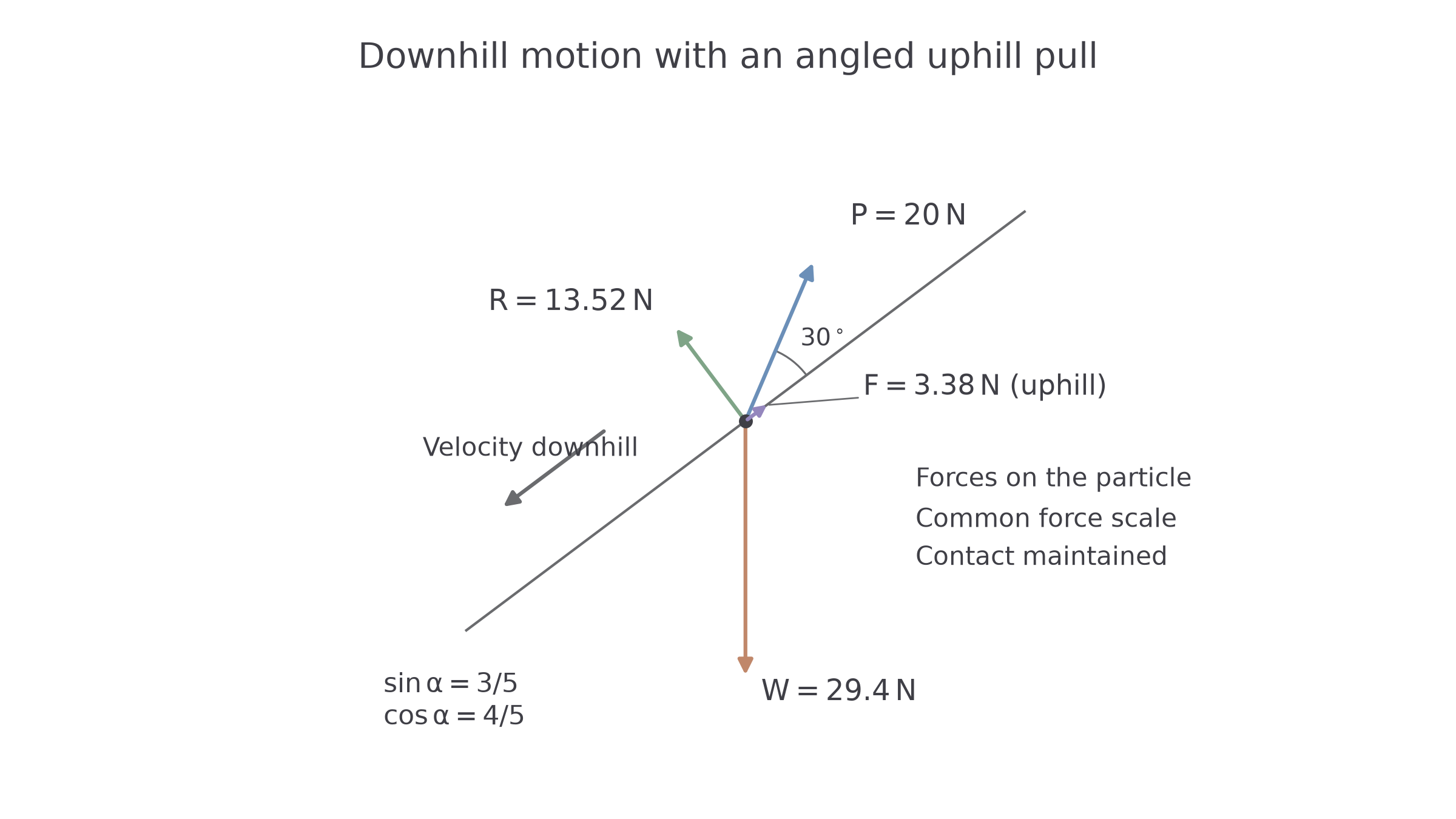
An angled pull on a slope generally gives when is measured above the plane and there is no other normal force. This is a consequence of the normal balance, not a supplied result. If it predicts , the contact model fails; do not put that value into .
Watch out
Wrong: “The acceleration is uphill, so friction must act downhill.” That confuses acceleration with sliding velocity. Right: while the particle slides downhill, friction is uphill, even when the particle slows. Reconsider the model when it actually stops.
The next pull is stronger. Keep the particle's given velocity direction when assigning friction.
Stopping and reversing on a rough slope
A particle projected uphill has both friction and the slope component of weight acting downhill. When it stops, do a static check before declaring that it reverses. Momentary zero velocity does not settle whether the particle can remain at rest.
With uphill positive during ascent and no other applied force,
At the stop, rest would need uphill friction , so compare it with . If capacity is insufficient, the particle starts downhill and friction reverses; with downhill positive the new acceleration is
These are derived force-equation results, not supplied booklet formulae. The constant-acceleration equations used within each sliding stage are in the formula booklet. One set of constants cannot cover both stages when friction changes direction.
Worked example 3: stopping and sliding back
Question. A particle is projected up a rough slope at . The simplified model uses for both static capacity and sliding friction . No other applied force acts and contact is maintained. Use . Find the stopping distance, decide whether it remains at rest and find its subsequent acceleration, to two significant figures.
Plan. Use the uphill sliding equation to reach the stop, check static capacity there, and form a new equation only if it slides back.
For rest, the required coefficient bound is
The given is smaller, so the particle cannot remain at rest. Once it slides down, friction acts uphill:
Why this step? At the stop, friction becomes a static balancing force if capacity permits. Only after that check fails can the downhill sliding equation be used.
Answer. It stops after , then slides back with acceleration downhill.
Check. Both sliding accelerations point downhill physically, but their magnitudes differ. Friction adds to gravity during ascent and subtracts from it during descent.
There is a surprising consequence over the same distance. The ascent time is . The return from rest over takes , which is longer. The general reason is that gravity and friction produce a smaller downhill acceleration magnitude than the uphill deceleration magnitude; equal travel distances do not mean equal travel times. These time relationships are obtained from the supplied kinematics, rather than additional booklet entries.
Worked example 4 changes only the coefficient. The particle still stops, but this time the static check gives a different outcome.
Continue this lesson.
You’re previewing NovaLearn without an account. Create a free account to read the rest.
Create free account