F1, F3 - Exponential and logarithmic functions
Exponential functions turn an input into a power; logarithmic functions recover that input. Use F1 to recognise exponential graphs and F3 to find their inverses, including the domains, ranges and transformations of the natural functions.
Positive-base exponentials
If , can the exponent be both negative and fractional, and can a graph explain why there is only one answer?
Start with repeated multiplication: the outputs of at are . Each step of one in the input multiplies the output by . Moving backwards divides by , so , while fractional inputs fill the gaps: .
You already know
For , , and . These index results are not in the formula booklet: learn them.
An exponential function has the variable in the exponent. The function , with , is defined for every real . For , it increases; for , it decreases. When , its range is , its intercept is , and its horizontal asymptote is : the curve approaches this line without reaching it. These graph facts are not supplied in the formula booklet.
The boundary cases matter. If , the function is constant with range , so it has no inverse on . A negative base does not define a real-valued function on all real inputs: is not real.
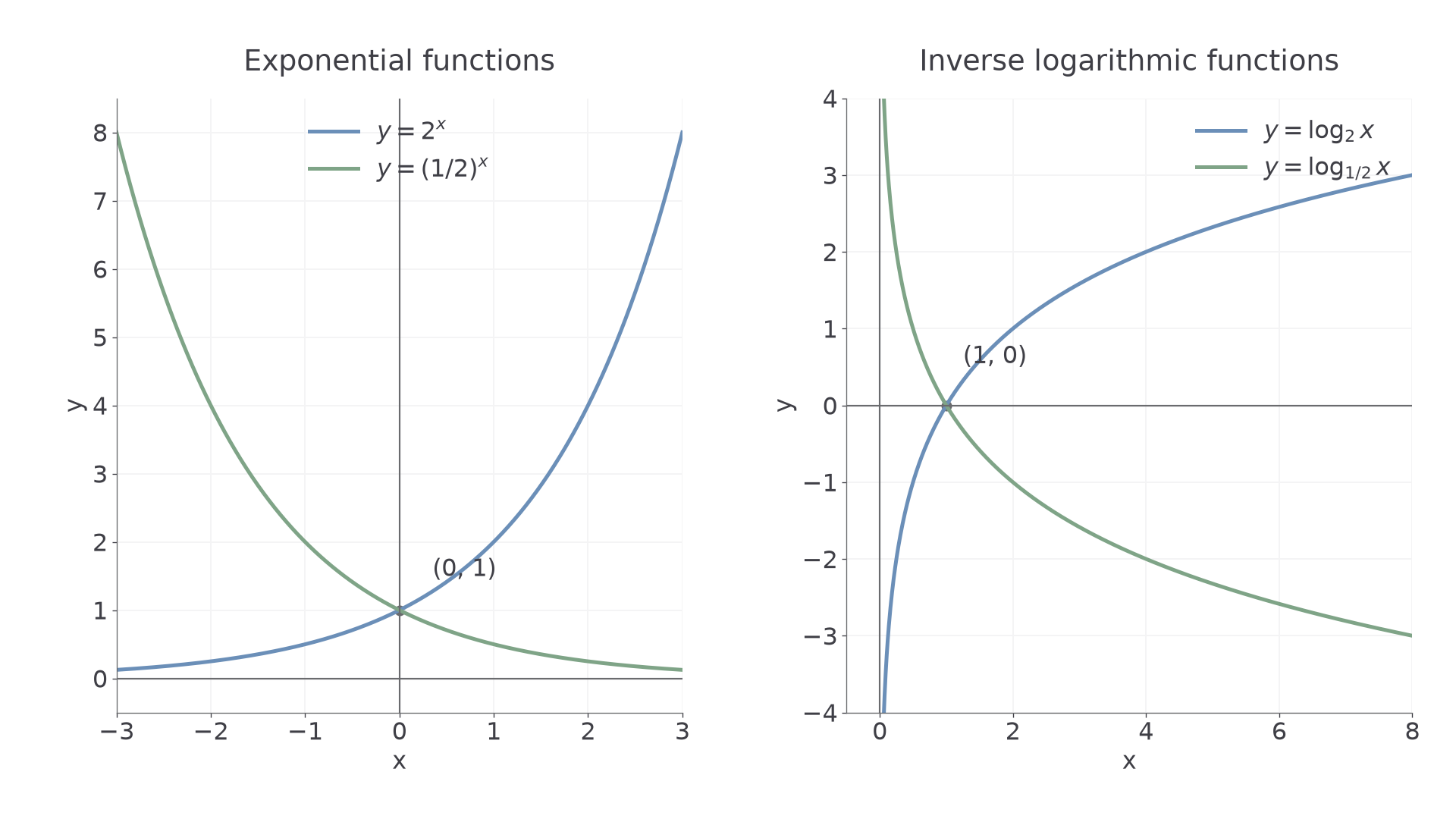
The left panel shows the two directions of change. The right panel will let us reverse those same input-output pairs.
Worked example 1: a decreasing exponential
Question. For , find the values at and state the features needed for a sketch.
Plan. Evaluate three powers, then use the base to decide the direction and limiting behaviour.
Why this step? A base between and multiplies each new output by a fraction, so the curve decreases while remaining positive.
Answer. Sketch a smooth decreasing curve through , and , approaching to the right. Domain: ; range: .
Check. Moving from to multiplies by , giving ; the next step gives .
Now change just the base to its reciprocal. The intercept and range stay the same, but the direction reverses; in fact , a reflection in the -axis.
Worked example 2: reversing the base
Question. For , find the values at and state its sketch features.
Plan. Use the same inputs and compare the base with .
Why this step? The base gives an increasing function, so its approach to zero is now on the left.
Answer. The curve increases through , and , with asymptote , domain and range .
Check. Each output is three times the previous one. The outputs match example 1 when the input signs are reversed.
A negative exponent changes the size of a positive output, not its sign. This is especially useful when checking whether a sketch belongs above the axis.
Watch out
Wrong: . A negative exponent means a reciprocal, so . An unshifted positive-base exponential never crosses the -axis.
Change the base again in your own calculation. State the full range, rather than only the values you evaluated.
Inverse logarithms
A logarithm tells you which exponent produces a given positive output.
Since , the statement records the same input-output pair in reverse. The argument is positive, but the logarithm itself need not be positive.
Logarithm
For , and ,
The base is ; the argument is . For example, . There is no real or , because a positive-base power is strictly positive.
The exponential is one-to-one when , so each positive output gives exactly one exponent. Its inverse graph is reflected in : has domain , range , intercept and vertical asymptote . It increases when and decreases when . The definition, inverse identities and graph facts here are not supplied in the formula booklet.
Worked example 3: a fractional exponent
Question. Find the exact value of .
Plan. Name the exponent and express both sides using base .
Why this step? Equal powers of the same valid base have equal exponents; guessing integer powers would miss a fractional answer.
Answer. .
Check. .
Change only the argument to its reciprocal. The corresponding exponent must change sign, because taking a reciprocal negates a power.
Worked example 4: answering the opening puzzle
Question. Find the exact value of .
Plan. Convert to an exponential equation and again compare powers of .
Why this step? The positive argument is below , so an increasing exponential reaches it at a negative input.
Answer. , the unique solution of the opening equation.
Check. , so the answer is negative and fractional without giving a negative output.
The inverse identities are for real , and for . Their different restrictions come from the domain of the inner logarithm.
Watch out
Wrong: . The exponent gives , not . A negative logarithm is allowed; a negative real logarithm argument is not.
Use the reciprocal idea once more, with a new argument.
Continue this lesson.
You’re previewing NovaLearn without an account. Create a free account to read the rest.
Create free account