I2 - Newton-Raphson iteration
Derive Newton–Raphson from a tangent, use its recurrence to approximate roots, and justify the digits you report. You will also recognise starting values that cause undefined steps, cycles, divergence or convergence to the wrong root.
Tangents give new estimates
How can a straight line help find the root of a curved graph? For , the point at is , close to the horizontal axis. The tangent there has gradient ; following that tangent to the axis gives the next estimate, .
You already know
The derivative gives a tangent's gradient. A line through with gradient has equation . This point-gradient equation is not in the formula booklet: learn it.
At the current input , the curve point is and the tangent gradient is . Set the tangent's height equal to zero to locate its intercept:
The tangent is a local approximation to the curve, so its intercept is a new estimate rather than automatically the true root. Repeating this construction is the Newton–Raphson method.
Newton–Raphson iteration
To solve , use
The derivative must be defined and nonzero at the current input.
In the formula booklet.
This is another recurrence , now with . Unlike a fixed-point rearrangement chosen by inspection, its rule comes from the tangent construction.
Worked example 1: following one tangent
Question. For , use to find , and verify it with the tangent equation.
Plan. Evaluate the curve height and gradient at , apply the recurrence, then set the tangent's height to zero.
Why this step? Both the function and derivative must be evaluated at the same current input; the tangent is attached to that point.
Answer. . The tangent also gives , hence .
Check. : the intercept improves the estimate but is not the root itself. The true positive root is .
Change only the constant term, from to , retaining the starting input . The gradient is unchanged, while the height and tangent intercept change.
Worked example 2: a different curve height
Question. For , starting at , find the tangent and its intercept .
Plan. Keep , calculate the new height, and find where the new tangent meets the axis.
Why this step? A more negative height with the same positive gradient needs a larger move to reach the axis.
Answer. The tangent is , giving .
Check. The supplied recurrence gives , and , closer to zero than .
The left panel draws the first example. The horizontal tangent on the right will explain an important failure later.
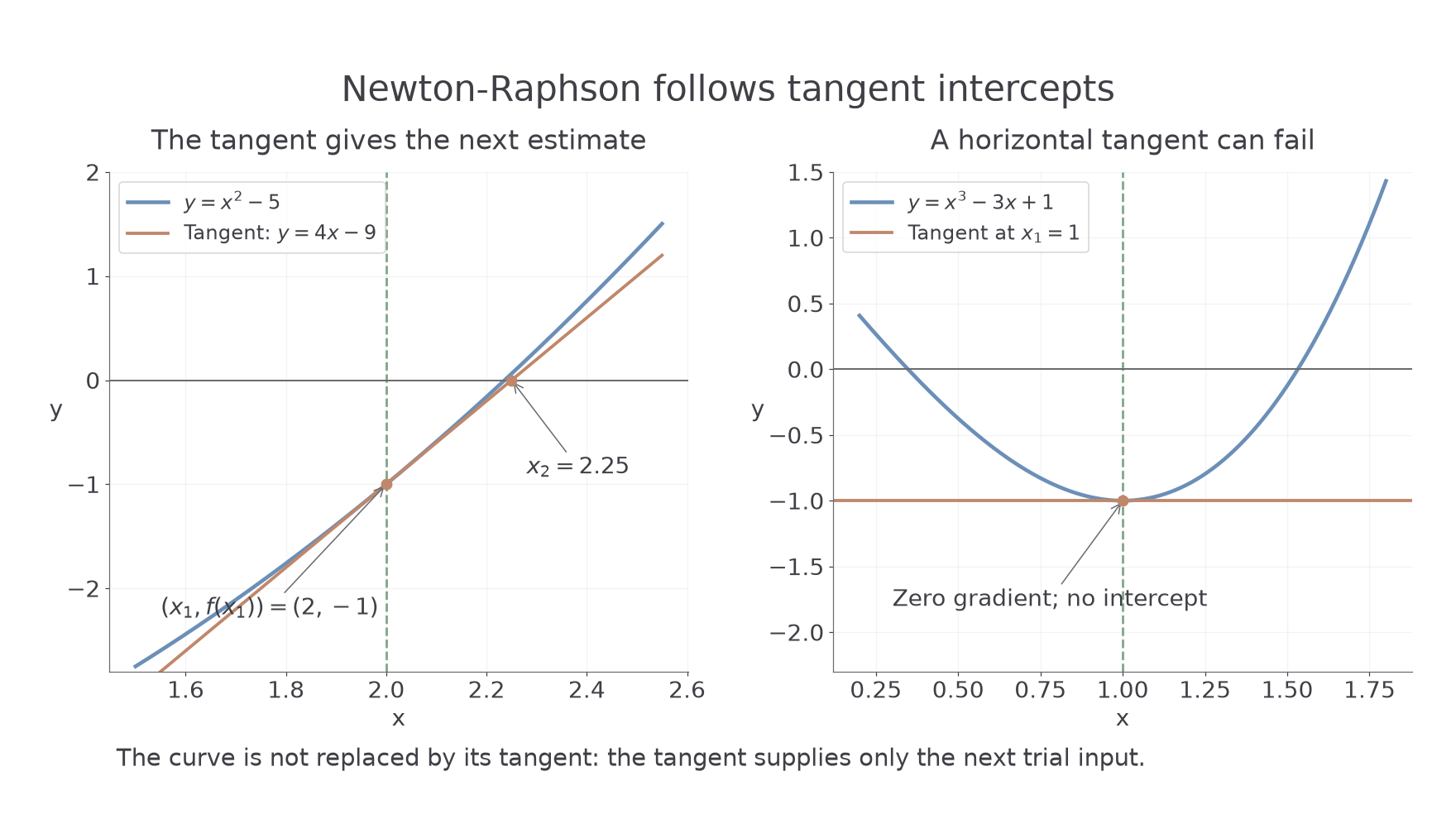
The polynomial derivatives used above are recall results, not supplied in the formula booklet. The same method applies beyond polynomials: for , , so a start at gives . The exponential derivative is also a recall result; the Newton–Raphson recurrence itself is supplied.
Watch out
Wrong: . This inverts the tangent correction. Correct: subtract the height divided by the gradient, , as the intercept derivation shows.
Change only the constant again, keeping the same starting input and tangent method.
Iterating and certifying accuracy
Use a graph or continuous sign-changing bracket to select a starting input near the root you want, then keep full precision through the repeated steps.
Differentiate algebraically before entering the recurrence. Store the current input and calculate both and at that value. Show the function-specific recurrence and requested iterates when Newton–Raphson is prescribed. A calculator root-solver value alone does not show that method.
Worked example 3: a cubic root and its last digit
Question. Use Newton–Raphson from for , then certify the nearby root to three decimal places.
Plan. Differentiate, apply three Newton steps with stored digits, then test the rounding boundaries of the suggested answer.
The candidate is . At its rounding boundaries,
Why this step? The iteration suggests the digits, while the continuous sign-changing bracket establishes them independently of consecutive-iterate agreement.
Answer. Continuity gives , so to three decimal places.
Check. On this interval , so it contains just one root. Also and , consistent with the initial search.
Change only the constant term from to , retaining the same starting value and three-decimal-place target. Recalculate the iterates and the rounding boundaries.
Continue this lesson.
You’re previewing NovaLearn without an account. Create a free account to read the rest.
Create free account