B5 - Linear and quadratic inequalities
Learn to solve inequalities with brackets and fractions, use a quadratic graph to choose whole intervals, and describe single or combined solution sets precisely. You will see why finding boundary values is only the beginning of solving an inequality.
Rearranging linear inequalities
The equation has two solutions. Can the inequality have infinitely many? At , the expression equals , so this value satisfies the inequality even though it is not a root. To find every allowed value, first make sure your rearrangements preserve a comparison.
For instance, becomes , then . The last sign reverses: on a number line, multiplying by a negative number reverses left and right. The true comparison becomes when multiplied by .
You already know
Expand a bracket by multiplying every term inside it. To solve an equation, perform the same operation on both sides; for an inequality, also check the sign of any multiplier or divisor.
An inequality states that one expression is smaller or larger than another. The signs and are strict and exclude equality; and allow equality. Thus excludes , while includes it. A solution must make the original comparison true.
Order-preserving operations
Adding or subtracting the same real quantity on both sides preserves an inequality. Multiplying or dividing both sides by a positive number preserves its direction; multiplying or dividing by a negative number reverses it. Division by zero is not allowed.
Not in the formula booklet: learn it.
When denominators are positive constants, their positive common multiple clears the fractions without reversing the inequality. Keep each complete numerator in brackets until you expand.
Worked example 1: clearing positive denominators
Question. Solve .
Plan. Multiply by , expand the brackets and collect the terms in .
Why this step? A positive common multiple clears both denominators and leaves the direction unchanged.
Answer. .
Check. At , is true. At , is false. Equality holds at .
Worked example 2 changes only the coefficient of in the right numerator, from to . Collecting now gives a negative coefficient, so the final division changes the direction.
Worked example 2: reversing the comparison
Question. Solve .
Plan. Clear the same positive denominators, then reverse the sign when dividing by the negative coefficient.
Why this step? Dividing by reflects the comparison on the number line. Keeping would select the wrong side of .
Answer. .
Check. At , both fractions equal . At , the comparison is , which is false; at , it is true.
These examples use constant denominators. Multiplying an inequality by an expression such as is unsafe unless you know its sign: it is negative on one side of , positive on the other and zero at .
Watch out
Wrong: gives . Right: dividing by gives . The boundary value is unchanged; which side is allowed changes.
The next question changes the same numerator coefficient once more. Check the direction as carefully as the arithmetic.
Quadratic signs and critical values
A quadratic's roots locate where its graph meets the horizontal axis; the graph or the signs of its factors then show which intervals satisfy an inequality.
For , try , and . The products are , and . These test values lie in the three intervals separated by and . A factor cannot change sign inside one of these intervals without passing through zero, so one test value determines each interval's sign.
Critical values
For a polynomial inequality, the critical values are the real zeros of the expression after one side has been made zero. They divide the number line into intervals to test. They are boundaries to investigate, rather than the full solution set.
Always collect the inequality onto one side before choosing intervals. The leading coefficient matters: an upward-opening quadratic is positive outside two distinct roots, while a downward-opening quadratic has the opposite sign pattern. These sign rules are not in the formula booklet: learn how to recover them from a sketch or factors.
Worked example 3: on or below the axis
Question. Solve .
Plan. Factorise, find the critical values, then select where the upward-opening graph is on or below the axis.
| Interval | Sign of | Sign of | Product |
|---|---|---|---|
| negative | negative | positive | |
| positive | negative | negative | |
| positive | positive | positive |
Why this step? Solving the equation identifies only the boundaries. The sign test selects the whole interval between them, and includes the zeros.
Answer. .
Check. The interior value gives . The exterior value gives , so it must be excluded.
The graph gives the same argument visually. Its shaded portion is on or below the horizontal axis, and the closed number-line endpoints include equality.
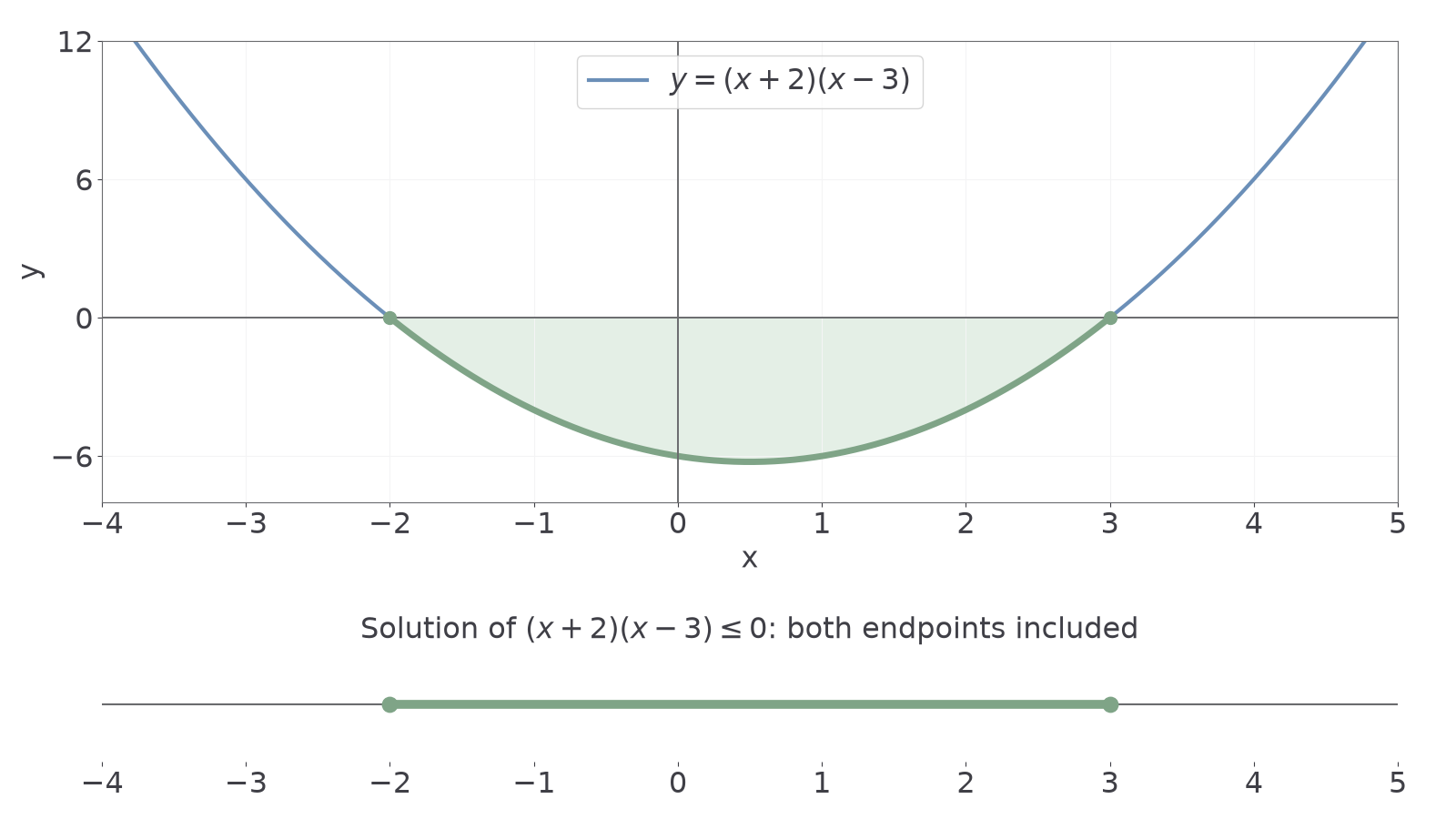
Worked example 4 changes only the sign of the entire quadratic. Its roots stay fixed, but every nonzero height changes sign.
Worked example 4: a negative leading coefficient
Question. Solve .
Plan. Factor out , retain the same critical values and reverse the previous interval signs.
The product is positive outside and , and zero at those boundaries.
Why this step? The negative sign makes the parabola open downward. “Between the roots” cannot be used without checking which sign is wanted.
Answer. or .
Check. At , the original expression is , so the middle interval is excluded. At , it is , so the right interval is included.
For a strict comparison, omit the roots: for instance, becomes , giving . Equality at either root does not meet .
A quadratic inequality can also allow every real number, or none. Since a real square is non-negative, holds for all real , whereas has no solution. A repeated root does not cause a sign change. With no real roots, the sign is constant too: always, while never. These conclusions come from the expressions themselves; they are not supplied in the formula booklet.
Watch out
Wrong: “The roots are and , so those are the only solutions.” Right: roots locate boundaries; signs choose intervals. Include a boundary only when equality is allowed.
Now change the constant and linear terms of a downward-opening quadratic. Establish its new critical values before selecting the outside intervals.
Writing solution sets
Set notation records which values are included, so an interval cannot be mistaken for a list of its endpoints or a list of integers.
The answer includes , and every other real number between the bounds. By contrast, lists exactly six numbers. Braces mean a set, and the commas in a listed set separate its individual elements.
Solution set
The solution set contains all values satisfying the stated condition. For example,
The colon means “such that”. Real values are assumed here; writing explicitly is also correct.
An interval contains every real number between its bounds. A square bracket includes a finite endpoint and a round bracket excludes it. The following notation is not supplied in the formula booklet: learn its meaning.
| Interval | Meaning |
|---|---|
Infinity is not a real endpoint that can be included. Thus is , and is . The empty set, , records no solutions; all real numbers are .
The symbol means “is an element of”, so and . If , then every element of belongs to , so . It is a proper subset, written , because also has elements outside , such as . The notation allows equality; here does not.
For a finite set, counts its elements. Here , while ; the real interval has infinitely many elements.
The domain matters when deciding what “all” means. The standard number sets are:
| Set | Elements |
|---|---|
| positive integers ; zero is excluded in this specification | |
| integers | |
| , | positive integers, and non-negative integers , respectively |
| rational numbers , where and | |
| all real numbers, including rational numbers and irrationals such as |
For instance, but . Restricting to integers gives the six-element set ; keeping a real domain gives the whole interval .
The universal set contains all the values under discussion. If and , the values of outside form its complement, . In general, ; the complement depends on . For real inequality solutions, is usually , unless the question restricts it. These number-set, membership, subset and complement conventions are not supplied in the formula booklet.
Key idea
The brackets carry mathematical information: lists two elements, while includes a whole real interval when .
Read each option below as a claim about every real value, including the endpoints and non-integers.
Combining conditions with and and or
Several inequalities can describe one solution set: “and” keeps their overlap, while “or” keeps values allowed by either condition.
If and , a value must pass both tests, giving . If the conditions use “or”, the value need pass only one. A value passing both is still included: mathematical “or” is inclusive.
Intersection and union
The intersection contains elements belonging to both and . The union contains elements belonging to at least one of them. Intersection represents “and”; union represents inclusive “or”. This notation is not supplied in the formula booklet: learn it.
Solve each condition separately first. Then compare their number-line intervals; do not try to join the unsolved algebra by a new inequality sign.
Worked example 5: both conditions must hold
Question. Find the values satisfying and . Give your answer using set notation.
Plan. Solve the quadratic inequality, then intersect its interval with the linear condition.
Why this step? “And” demands both conditions. The value passes the quadratic test but fails .
Answer. , or .
Check. passes both tests. The boundary is included, while is excluded by the strict second condition.
Worked example 6 changes only the joining word to “or”. The two individual sets are unchanged, but now you keep their union.
Worked example 6: either condition can hold
Question. Find the values satisfying or . Give your answer using set notation.
Plan. Take the union of the same intervals and combine the portions that meet or overlap.
Why this step? Values greater than fail the quadratic condition but pass , so they must be included.
Answer. , or .
Check. passes the first test, also passes the first test, and passes the second. Values below pass neither.
A union need not be one continuous interval. For example, or gives ; the gap stays. Conversely, and has no solution, since a number cannot meet both demands.
Watch out
Wrong: write an outside solution as and . Right: use “or”, or . “And” would give .
For the next question, the second condition moves to the other side of the quadratic interval. Decide whether any gap remains in the union.
Quick Recap
- Reverse an inequality when multiplying or dividing by a negative number.
- For a quadratic, find the critical values and use signs or a graph to select whole intervals.
- Strict comparisons exclude equality; square interval brackets include finite endpoints.
- “And” takes an intersection; inclusive “or” takes a union.
The opening inequality has infinitely many solutions: every real number in satisfies , while only the two endpoints solve the corresponding equation.