J4 - Position vectors and geometry
Use position vectors to locate points, subtract them to find a displacement, and measure the distance between fixed or moving points. You will also locate midpoints and ratio points, while keeping the difference between a whole line and a segment clear.
Position and displacement vectors
If a map moves its origin, do you need to change the journey from your house to school? The coordinates change, but the directed journey does not. Position and displacement answer two different questions: “Where is the point?” and “What change takes us between the points?”
You already know
A vector is a signed change along perpendicular axes. Add vectors head-to-tail or componentwise, and use the square root of the sum of squared components for a length.
An origin lets us use one of those directed arrows to locate a point itself.
Position vector
The position vector of relative to an origin is . Its components are the coordinates of in the chosen axes. The displacement records the directed change from to .
For a small concrete example, positions and are joined by the displacement . Add that change to the starting position and you reach the ending position.
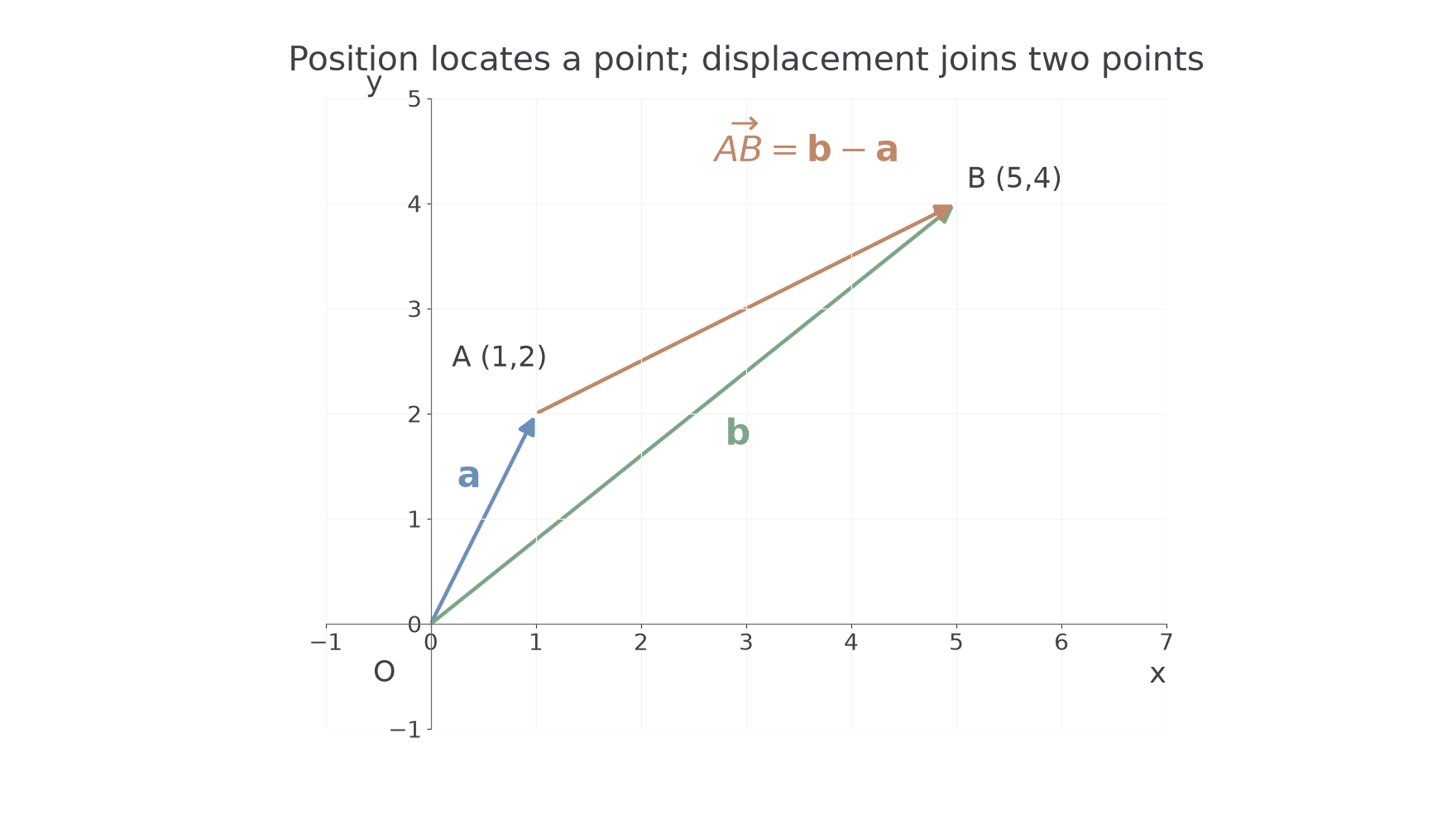
The arrow relationship is . Rearranging gives a subtraction rule; it does not say that their three scalar lengths add.
End minus start
If and , then
Not in the formula booklet: learn it.
If the new origin has old position vector , while the axes keep their directions and unit lengths, the new positions are and . Their difference is
The origin shift cancels. You could move the origin a million units away and the displacement between the two points would remain exactly the same. This follows algebraically for any , rather than just for one chosen map.
Worked example 1: a directed change in space
Question. Relative to the same origin, and have positions and . Find .
Plan. Subtract the starting position from the ending position .
Why this step? The displacement must be the vector that takes you from to , rather than from the origin to either point.
Answer. .
Check. , the position of .
Change only the direction of travel in the next example. Neither point moves, but the joining arrow reverses.
Worked example 2: the return displacement
Question. For and , find .
Plan. Make the start and the end before subtracting.
Why this step? Reversing travel changes every signed component, even though it does not change the distance between the points.
Answer. .
Check. Adding this to returns .
You can always check a displacement by adding it to the stated starting position.
Watch out
Wrong: . Two positions both start at the origin, so adding them does not generally join their endpoints. Right: , hence .
Use the same end-minus-start test in the plane.
Distance between fixed or moving points
The displacement tells you the direction between two points; its magnitude gives their distance apart. For and , the joining vector is , so the distance is .
Distance from position vectors
For positions and ,
Omit the third term in two dimensions. Not in the formula booklet: learn it.
The scalar is a length; is a vector. Reversing the displacement changes every component's sign, but squaring removes those signs, so . Opposite corners of a cube of side are therefore apart: the same three-dimensional rule in a familiar solid.
When positions depend on time, evaluate both at the same time. Comparing one object's position now with another object's position later does not measure their simultaneous separation.
Worked example 3: simultaneous separation
Question. Two moving points have positions and , in metres, where is in seconds. Find their separation at .
Plan. Evaluate both positions at , subtract, then take the magnitude.
Why this step? A distance between moving objects needs their two locations at one common instant.
Answer. Their separation is .
Check. From to , each coordinate changes by one unit in magnitude, matching a unit-square diagonal.
Continue this lesson.
You’re previewing NovaLearn without an account. Create a free account to read the rest.
Create free account