E6 - Compound and double-angle formulae
Derive compound-angle formulae from geometric projections and use them to find exact values. Obtain the double-angle formulae from those results, choose a form that fits the information, and connect the formulae in proofs.
A geometric proof of addition formulae
Can you find exactly using only familiar right triangles? Since , the question asks how the height of a unit length changes when two rotations are combined. It is not the sum of two separate sine values: , which no sine can be.
You already know
A length at angle to the horizontal has horizontal and vertical projections and . For the unit circle these become cosine and sine themselves.
Start with acute and . The right triangle below has , right angle , and angle . The ray makes angle with the horizontal.
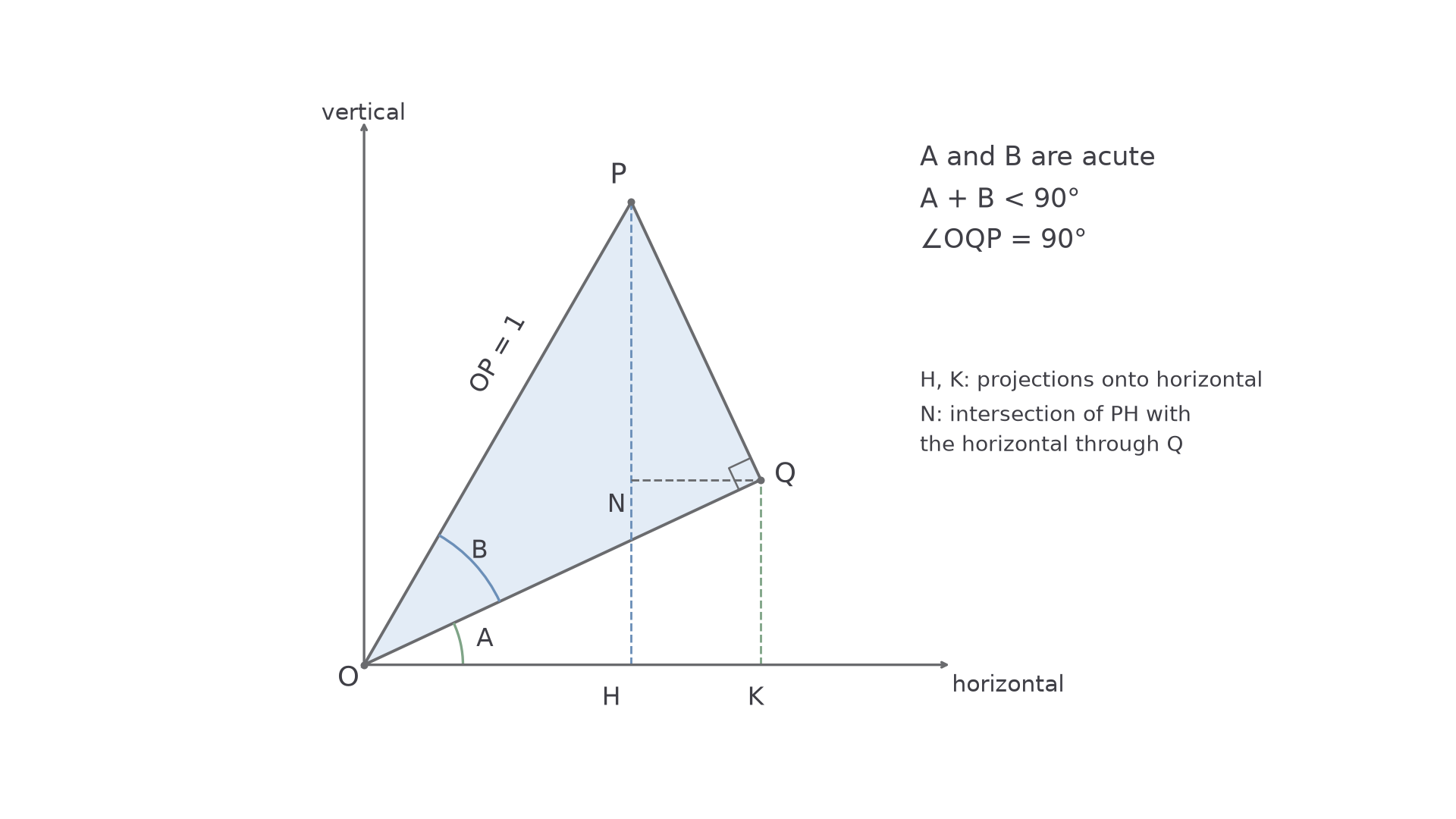
The first right triangle gives and . Project the first length:
Because is perpendicular to , it makes angle with the vertical. Therefore its upward and leftward projections are
The height of adds the upward contributions. Its horizontal coordinate subtracts the leftward contribution:
But the unit length makes angle with the horizontal. Its height is , and its horizontal coordinate is . This proves both formulae in the pictured configuration.
For other angles, use directed projections: right/up are positive, left/down negative. A unit direction at has components ; its anticlockwise perpendicular has components , by right-angle symmetry of the unit circle. The geometric decomposition of a unit length at angle from that direction has coefficients and . Multiply the two component pairs by those coefficients and add. The same expressions follow for any oriented angles; negative coefficients reverse direction. This extends the geometric argument without assuming an addition formula.
Sine and cosine addition
For all real angles, using one consistent angle unit,
In the formula booklet.
Now answer the opening puzzle directly from the height formula:
There is a small surprise here: the square roots of and , coming from two different triangles, combine into an exact value at a new angle. No new triangle table is needed.
Key idea
The sine formula adds two vertical projections; the cosine formula subtracts a leftward projection. Their different signs come from the geometry.
Use the picture to explain those signs, rather than reciting the finished formulae.
Difference and tangent formulae
A negative rotation supplies the difference formulae. Since and , replacing by reverses only the sine contributions.
The even/odd and right-angle symmetries used here follow from the unit circle; they are not separately printed in the formula booklet. For example, a reflection in the horizontal axis preserves the horizontal coordinate and reverses the vertical one.
Difference formulae
For all real angles in a consistent unit,
In the formula booklet.
Tangent is the ratio of the vertical to the horizontal projection in the same construction. Taking that ratio gives
The first denominator is nonzero where exists. The second line additionally divides top and bottom by , so both individual tangents must exist. Substituting also gives the tangent difference formula.
Tangent of a sum or difference
This form requires , and . Its denominator cannot be zero.
In the formula booklet.
Choose familiar component angles before substituting. Exact values keep the result exact.
Worked example 1: tangent of a sum
Question. Use a compound-angle formula to find exactly.
Plan. Write , substitute exact tangents, and rationalise.
Why this step? Rationalising turns the exact quotient into a simple surd while the denominator remains nonzero.
Answer. .
Check. is acute and exceeds , so a positive tangent greater than is sensible.
Change only addition to subtraction in the component angles. The denominator's sign changes with it.
Worked example 2: tangent of a difference
Question. Use a compound-angle formula to find exactly.
Plan. Use with the plus sign in the denominator.
Why this step? For tangent the numerator follows the angle sign and the denominator takes the opposite sign.
Answer. .
Check. The product , agreeing with the complementary angles' reciprocal tangents.
The formula expresses a ratio, not a distributive law for tangent.
Watch out
Wrong: . This omits the denominator. Right: divide that difference by , checking that the terms exist.
Keep the difference form but change the second component angle to . A negative angle now provides a useful sign check.
Continue this lesson.
You’re previewing NovaLearn without an account. Create a free account to read the rest.
Create free account