E3 - Trigonometric graphs and exact values
Derive exact trigonometric values, extend them through symmetry and repeated turns, and describe sine, cosine and tangent graphs. You will use exact landmarks to understand transformations instead of relying on a calculator picture.
Exact values from two triangles
How can two little triangles tell you the exact value of , an angle almost three full turns from zero? Start with a right triangle whose perpendicular sides are : Pythagoras gives hypotenuse , so its sine and cosine are both .
You already know
On the unit circle, is the terminal point, and tangent is vertical coordinate divided by horizontal coordinate when that denominator is nonzero. One full turn is radians. These facts are not supplied in the formula booklet.
Bisect an equilateral triangle of side . The half-base is , the height is and the hypotenuse is . The resulting and ratios, together with the isosceles right triangle, generate the standard exact values.
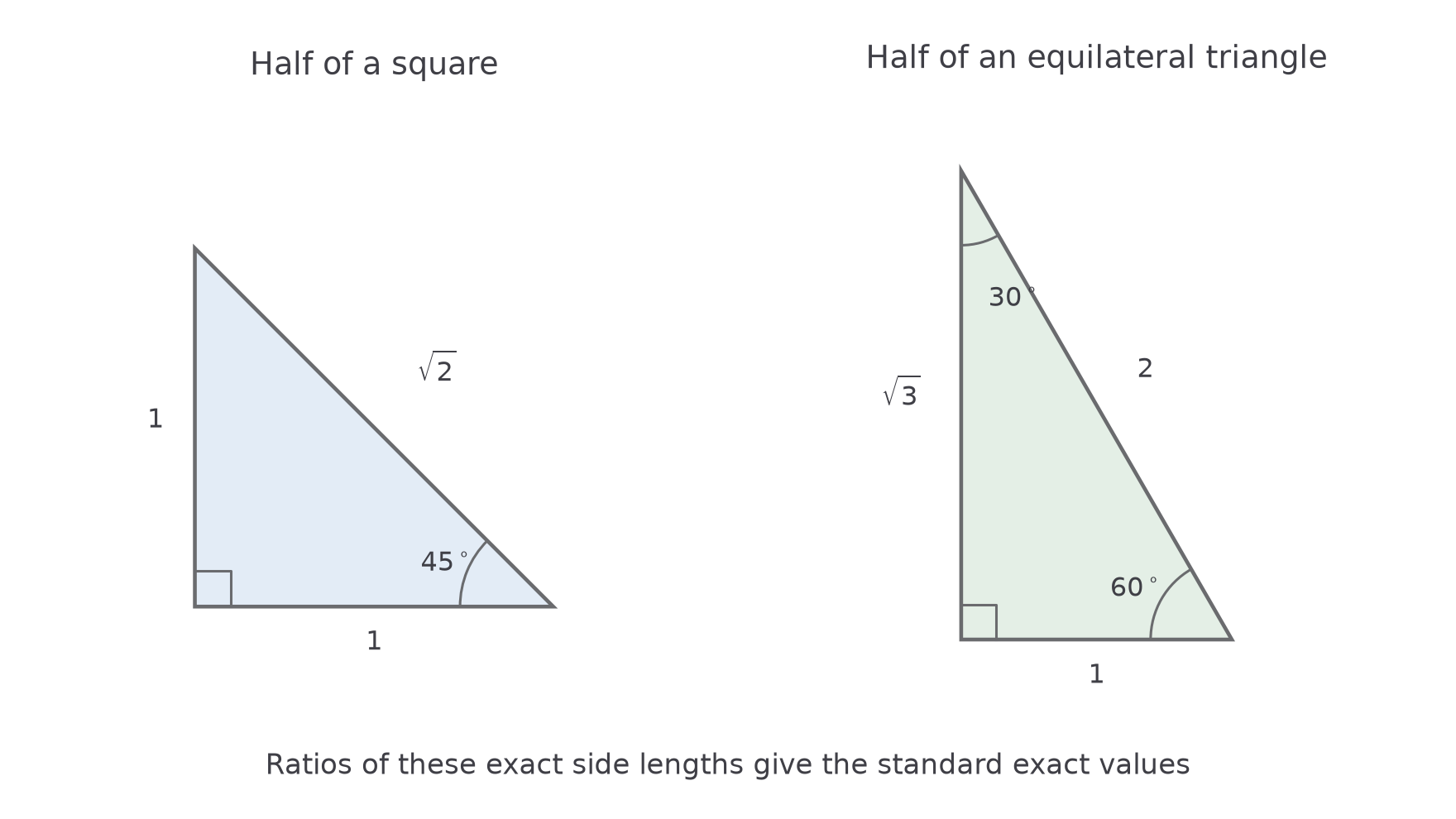
Angles on the axes need unit-circle coordinates instead of a flattened triangle: gives , gives , and gives .
Exact value
An exact value specifies a number without rounding. Here a fraction or surd is exact: is exact, while is a rounded approximation.
The table records what the triangles and axis points give. These exact values are not in the formula booklet: learn them.
| Radians | Degrees | |||
|---|---|---|---|---|
| undefined | ||||
Tangent's undefined entry is division by zero, not a very large number. Every odd multiple of has the same problem; every integer multiple of has tangent zero.
The three acute sine squares have a neat balance: . The corresponding cosine squares give the same sum in reverse order. The symmetry between the two triangles makes these different-looking surds fit together exactly.
Key idea
Two special triangles give the acute exact ratios; unit-circle coordinates give the axis values and their boundary cases.
The following question distinguishes an angle from a function value.
Signs, symmetry and repeated turns
A terminal radius at lies in quadrant III, just past a half-turn. Its vertical coordinate is negative, so its sine is .
The reference angle is the acute angle between a non-axis terminal radius and the nearest horizontal axis. Use it to find a magnitude, then use the quadrant to find the sign. At an axis, use coordinates directly.
Symmetry and periodicity
For real and integer ,
Tangent statements apply only where tangent is defined. Sine and tangent are odd; cosine is even.
Not in the formula booklet: learn it.
A period is a positive horizontal shift reproducing every value and the domain. The smallest positive period is for sine and cosine, and for tangent. A half-turn changes both coordinate signs, so it preserves their quotient but not either coordinate individually.
Supplementary angles have equal sine, opposite cosine and opposite tangent where defined. Thus , while . These relations are not supplied in the booklet: learn them from the circle.
Worked example 1: choosing the sign
Question. Find the exact value of .
Plan. Identify the quadrant and use reference angle .
Why this step? The reference angle gives magnitude only; the terminal position determines the sign.
Answer. .
Check. A quadrant III point lies below the horizontal axis.
Change only the number of full turns by adding . The terminal point does not move.
Worked example 2: adding a full turn
Question. Find the exact value of .
Plan. Remove one full turn before using the previous reference angle.
Why this step? Subtracting a full turn preserves both coordinates, so it preserves sine.
Answer. .
Check. is a full turn plus the original angle, exactly as required.
The same process answers the opening question: , which has negative sine and reference angle . Therefore . A large-looking angle has become a small-triangle ratio.
Watch out
Wrong: . A half-turn reverses the vertical coordinate. Correct: ; the sine period is . Tangent, however, does repeat after .
Add one more full turn in the matched question.
Sine and cosine graph features
Recording the rotating unit-circle point's height against its angle gives the sine wave; recording its horizontal coordinate gives cosine.
Both graphs have domain , range and period , or on a degree axis. Over one radian turn, sine's values at are ; cosine's are .
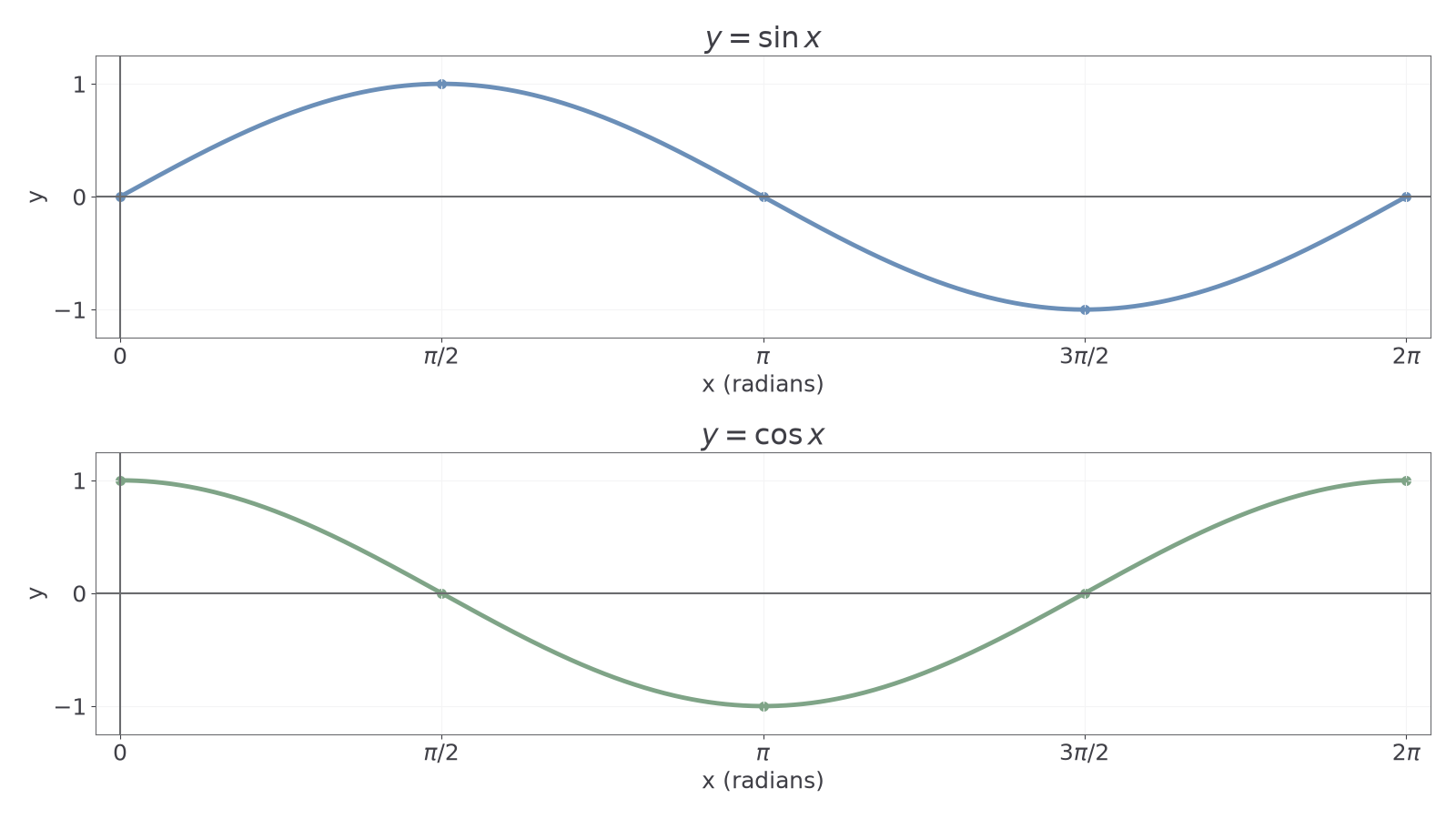
Sine has half-turn symmetry about the origin; cosine has reflection symmetry in the vertical axis. Cosine is sine shifted left by , so . These graph facts and the phase relationship are not supplied in the formula booklet. The supplied addition formula can also recover the phase relationship.
Transformed sine and cosine
For , with and radian arguments,
The horizontal shift is , since . The same rules hold for cosine. On a degree axis, replace in the period by .
Not in the formula booklet: learn it.
Continue this lesson.
You’re previewing NovaLearn without an account. Create a free account to read the rest.
Create free account