B5 - Regions defined by inequalities
Learn to represent linear and quadratic inequalities as regions of the coordinate plane, including strict boundaries and overlaps. You will also recover inequalities from a shaded diagram and check which boundary points actually belong to a common region.
Linear boundaries and half-planes
Can a point on a solid boundary still be outside a shaded region? A point may pass one condition and fail another. Start with a single condition: for , the point passes because , but fails because is false. The inequality selects points, rather than just values of .
The ordered pair gives the horizontal coordinate first and the vertical coordinate second. Reversing the order usually changes the point: and are different points.
You already know
The equation gives a straight line with gradient and vertical intercept . A point belongs to a line or region only when its coordinates satisfy the defining equation or inequality.
Replacing the inequality sign by equality gives its boundary. A straight line divides the plane into two half-planes. Every point in either open half-plane gives the same truth value when substituted into the linear inequality, so one test point away from the boundary identifies the correct side.
Included and excluded boundaries
Use a solid boundary when equality is allowed, as in . Use a dashed or dotted boundary for a strict inequality, as in . A point on a dashed boundary is excluded even when the shading reaches it.
When is isolated, compare heights at the same : means above the line, while means on or below it. A point's distance from the origin is irrelevant. These boundary and test-point rules are not in the formula booklet: learn them.
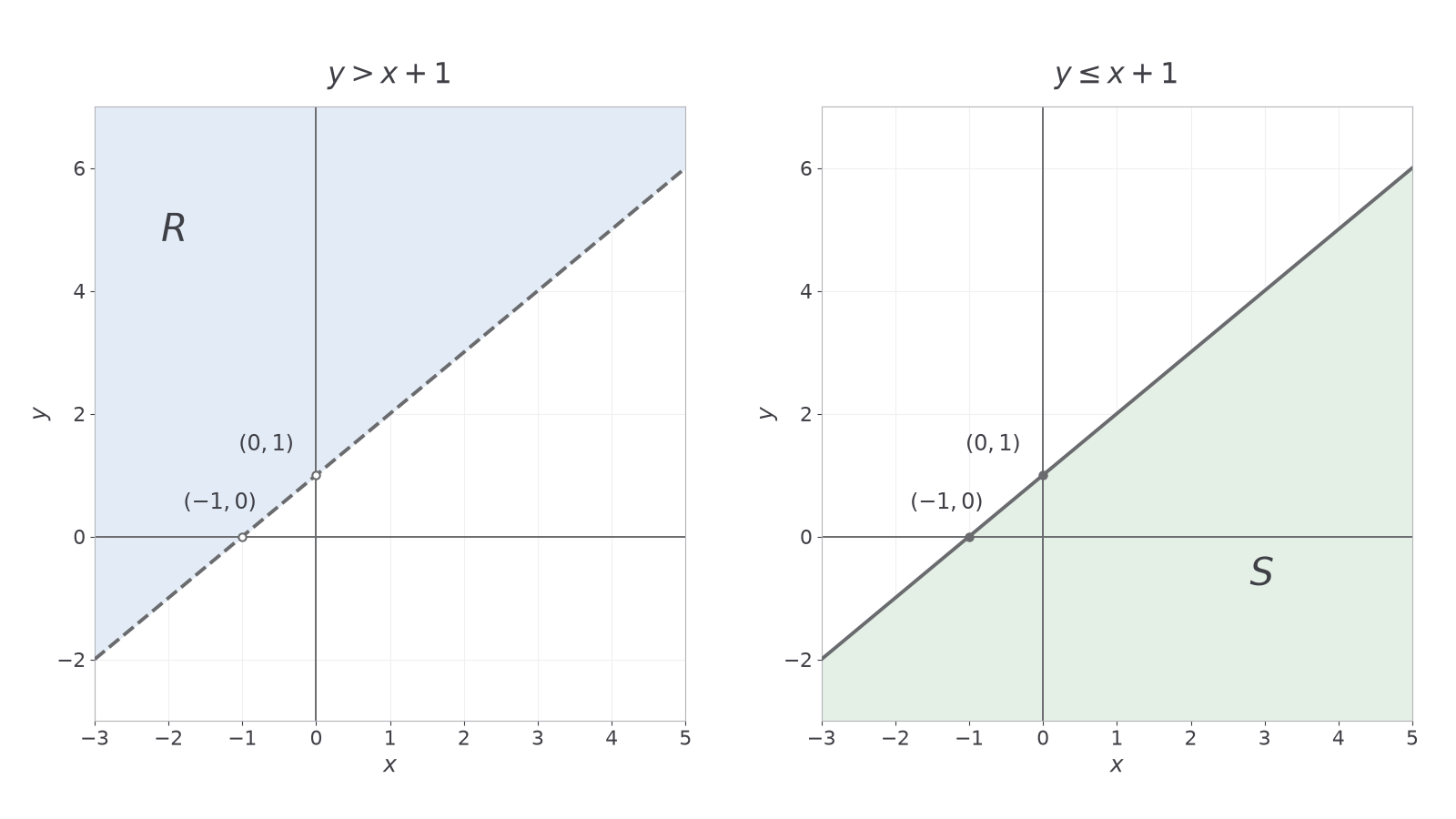
Worked example 1: a strict upper half-plane
Question. Sketch the boundary of , then shade and label its region .
Plan. Plot two points on the equality boundary, decide its style, then test a point to choose the side.
Why this step? Substituting a point off the line identifies the half-plane; testing a boundary point would only check equality.
Answer. Draw a dashed line through and . Shade above it and label this half-plane , as in the left panel.
Check. lies below the line and fails the inequality. The boundary point gives equality, so it is excluded.
Worked example 2 changes only the comparison, from to . The boundary's position stays the same; its inclusion and the selected side change together.
Worked example 2: including the opposite half-plane
Question. Sketch the boundary of , then shade and label its region .
Plan. Use the same two boundary points, draw the line solid and test the side containing the origin.
Why this step? The sign allows equality and selects smaller heights, so both the solid line and the lower half-plane belong.
Answer. Draw the solid line , shade on or below it and label , as in the right panel.
Check. is excluded because is false. Every point of the boundary satisfies equality.
Vertical boundaries require a horizontal comparison: is on or left of the solid line . Similarly, is above the dashed horizontal line . Neither axis is automatically a boundary or automatically included.
Watch out
Wrong: always use as the test point. If the boundary is , the origin lies on it and cannot distinguish its sides. Right: choose an off-boundary point such as .
The next check changes the line. Substitute each point into the complete inequality, including its equality permission.
Regions above or below a curve
A quadratic inequality compares a point's height with a parabola at the same horizontal coordinate, using exactly the same above-and-below idea as a line.
At , the boundary has height . Thus is above it even though the point lies on the horizontal axis. Above the curve does not mean above the axis.
Comparing a point with a graph
For a real-valued function , wherever is defined:
The analogous rules apply to and . The direction in which a parabola opens does not alter these comparisons.
Not in the formula booklet: learn it.
Recall the quadratic's vertex and intercepts before drawing. Completing the square identifies the vertex; factorising identifies horizontal intercepts. These quadratic methods are not supplied in the formula booklet.
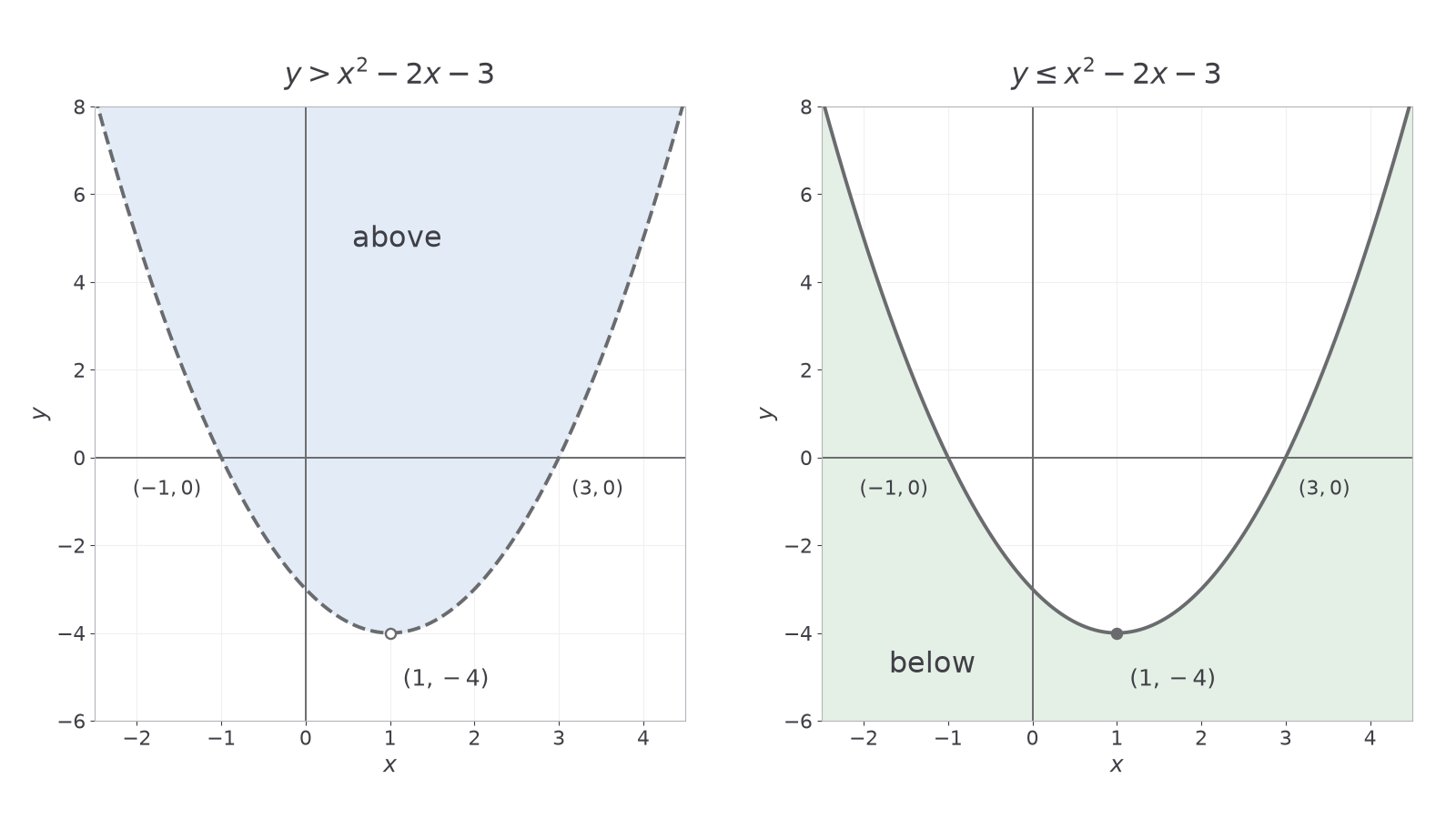
Worked example 3: above a strict quadratic boundary
Question. Sketch the region , showing the vertex and horizontal intercepts.
Plan. Complete the square and factorise to locate the curve, then draw it dashed and shade above.
Why this step? The important curve features fix the boundary's position. The inequality sign then decides its style and selected side.
Answer. Draw an upward-opening dashed parabola with vertex and intercepts , . Shade above it, as in the left panel.
Check. fails because is false. also fails because equality is excluded.
Worked example 4 changes only to . The curve does not move or turn upside down; only the allowed points change.
Worked example 4: below an included quadratic boundary
Question. Sketch the region , showing the vertex and horizontal intercepts.
Plan. Retain the curve's features, use a solid boundary and select smaller heights.
Why this step? “Below” compares heights for the same . It selects the lower side of an upward parabola, rather than its enclosed-looking side.
Answer. Draw the same parabola solid and shade on or below it, as in the right panel.
Check. At , the boundary height is ; lies above it and is excluded.
For a downward-opening parabola, the rule stays the same. For example, includes its solid boundary and every point below it, including points where both coordinates are negative. The edge of a picture's viewing window is never an extra mathematical boundary.
Watch out
Wrong: “The parabola opens downward, so means shade below.” Right: always selects heights at or above , whatever its shape.
Now change the curve to a downward parabola. Separate its geometry from the inequality's instructions.
The common region of several inequalities
A common region contains only points that satisfy every condition joined by “and”, so the permitted shading is the overlap.
For and , the point passes both tests: and . At , however, a height would need to be at least and at most , which is impossible. The overlap exists only where the lower boundary is no higher than the upper one.
You already know
To find where two boundaries meet, solve their equations simultaneously. For a line and a parabola, equating their expressions for gives a quadratic equation.
The boundary intersections determine where the vertical gap opens and closes. The common-region rule is intersection, as for number-line intervals; it is not supplied in the formula booklet.
Worked example 5: two included boundaries
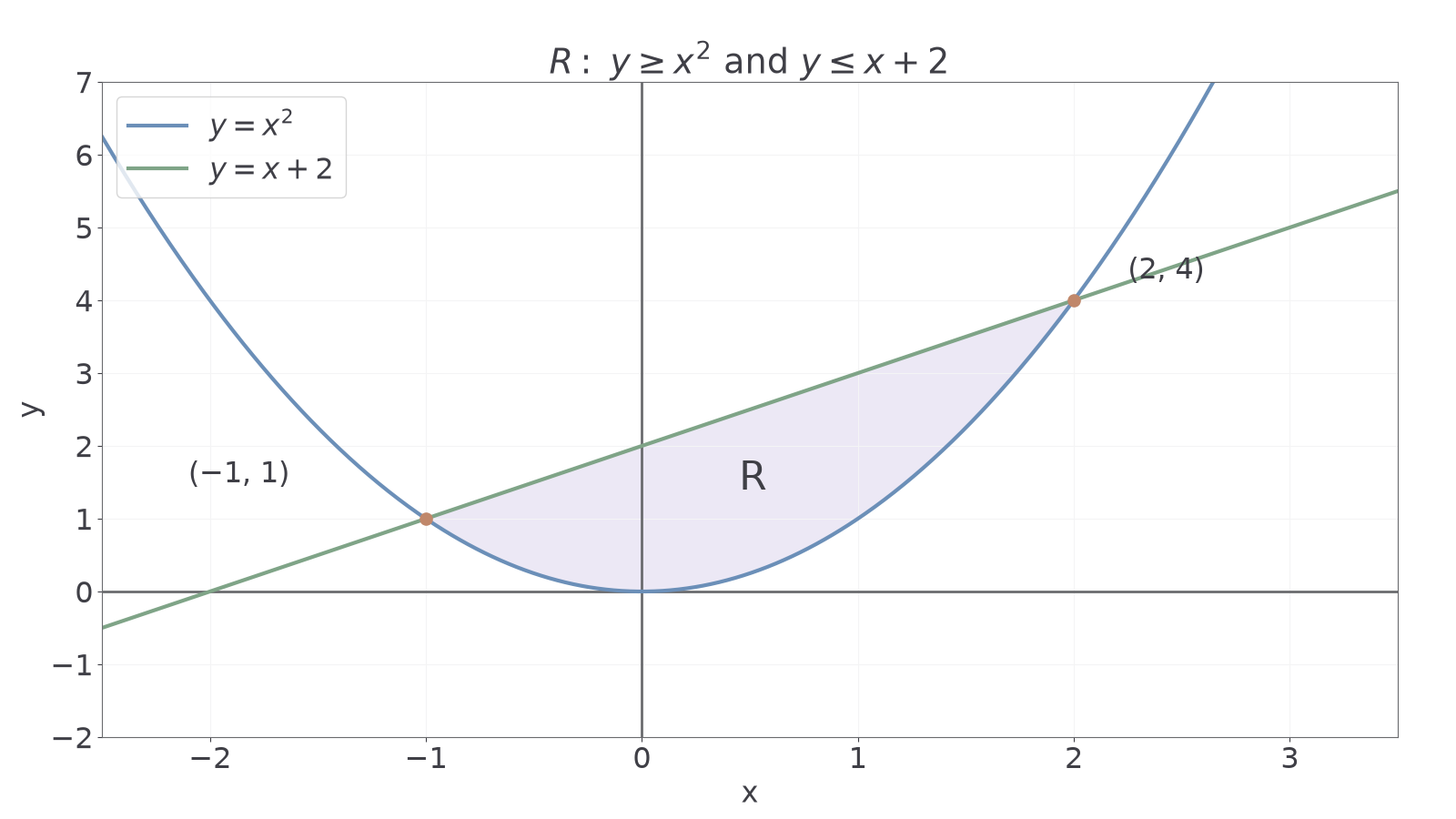
Question. Find the boundary intersections and sketch the common region defined by and .
Plan. Equate the boundaries, then retain points above the parabola and below the line.
Why this step? The intersections separate positions where a vertical gap exists from positions where the two height demands conflict.
Answer. The intersections are and . Draw both boundaries solid and shade between them for , including both meeting points.
Check. At , the allowed heights are . At , the demands have no solution.
The shaded overlap below is bounded by the two curves, not by the axes.
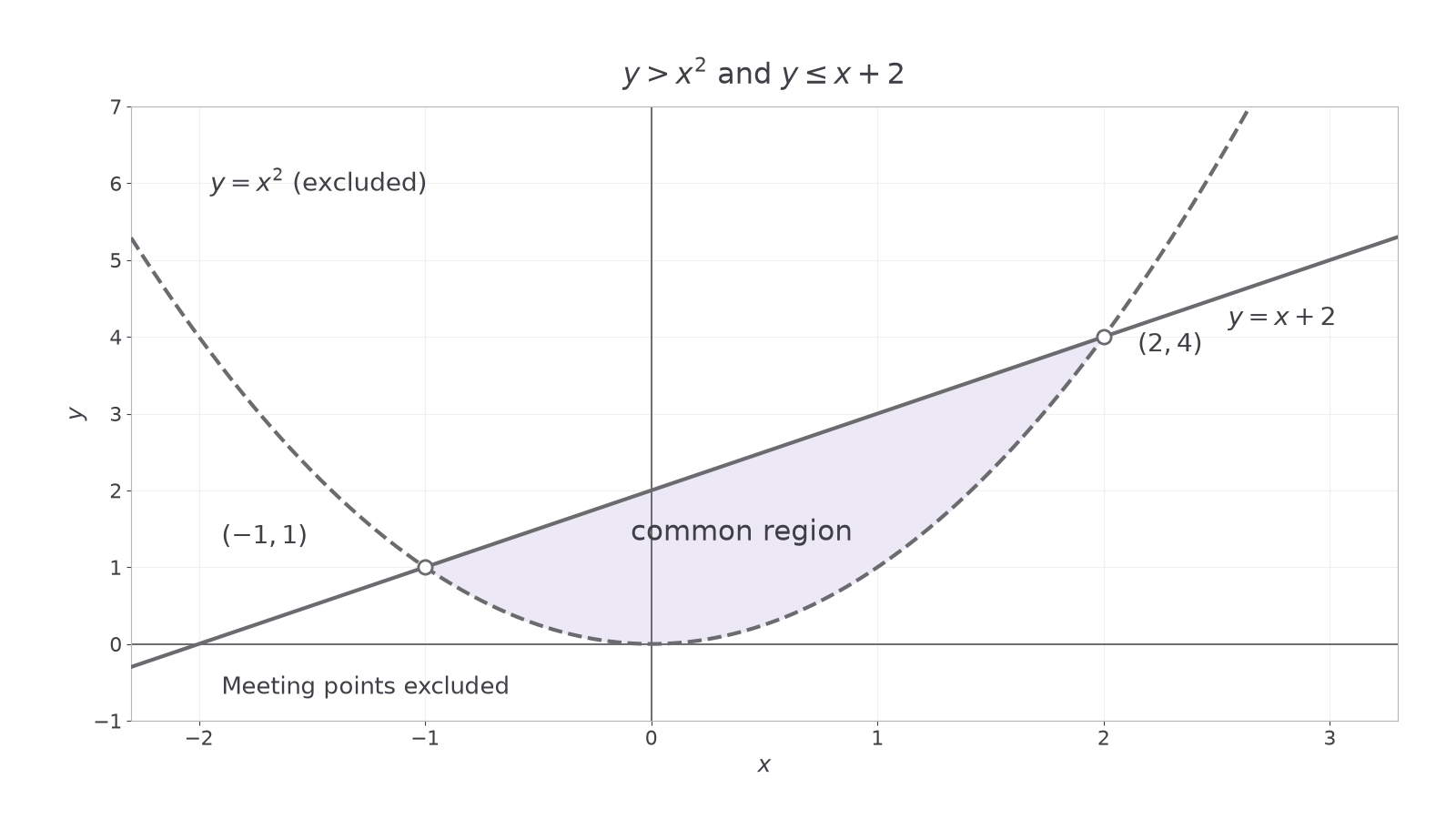
Worked example 6 changes only the lower inequality from to . The algebraic intersections remain the same, but their membership changes.
Worked example 6: one strict condition
Question. Sketch the common region defined by and , stating whether the boundary intersections belong.
Plan. Keep the previous intersection coordinates, make the parabola dashed and test equality at the meeting points.
Why this step? Every condition must hold. A solid line permits equality in its own condition but cannot override the parabola's strict condition.
Answer. Shade above the dashed parabola and at or below the solid line for . Both intersection points are excluded.
Check. belongs, even though it is on the line, because . The two meeting points do not.
Open circles make the excluded meeting points clear. The line is solid between them because those line points still pass the strict lower condition.
Changing one sign can even remove an entire common region. The conditions and allow exactly , since . Changing the first condition to leaves no point at all. Both claims follow by comparing the required lower and upper heights.
Watch out
Wrong: shade everything above the parabola or below the line when both are required. Right: keep only their overlap. A union joined by “or” would include either region, including their overlap.
For the next question, only the line changes. Find its new meeting points and test the strict condition there.
Recovering inequalities from a diagram
Recover a region's inequalities by reading each boundary equation, its selected side and its equality permission separately.
A solid line tells you that equality is permitted by that boundary's condition; it does not tell you whether points on it pass every other condition. This distinction answers the question from the start of the lesson.
Worked example 7: reading three boundaries
Question. Write the inequalities defining the shaded region .
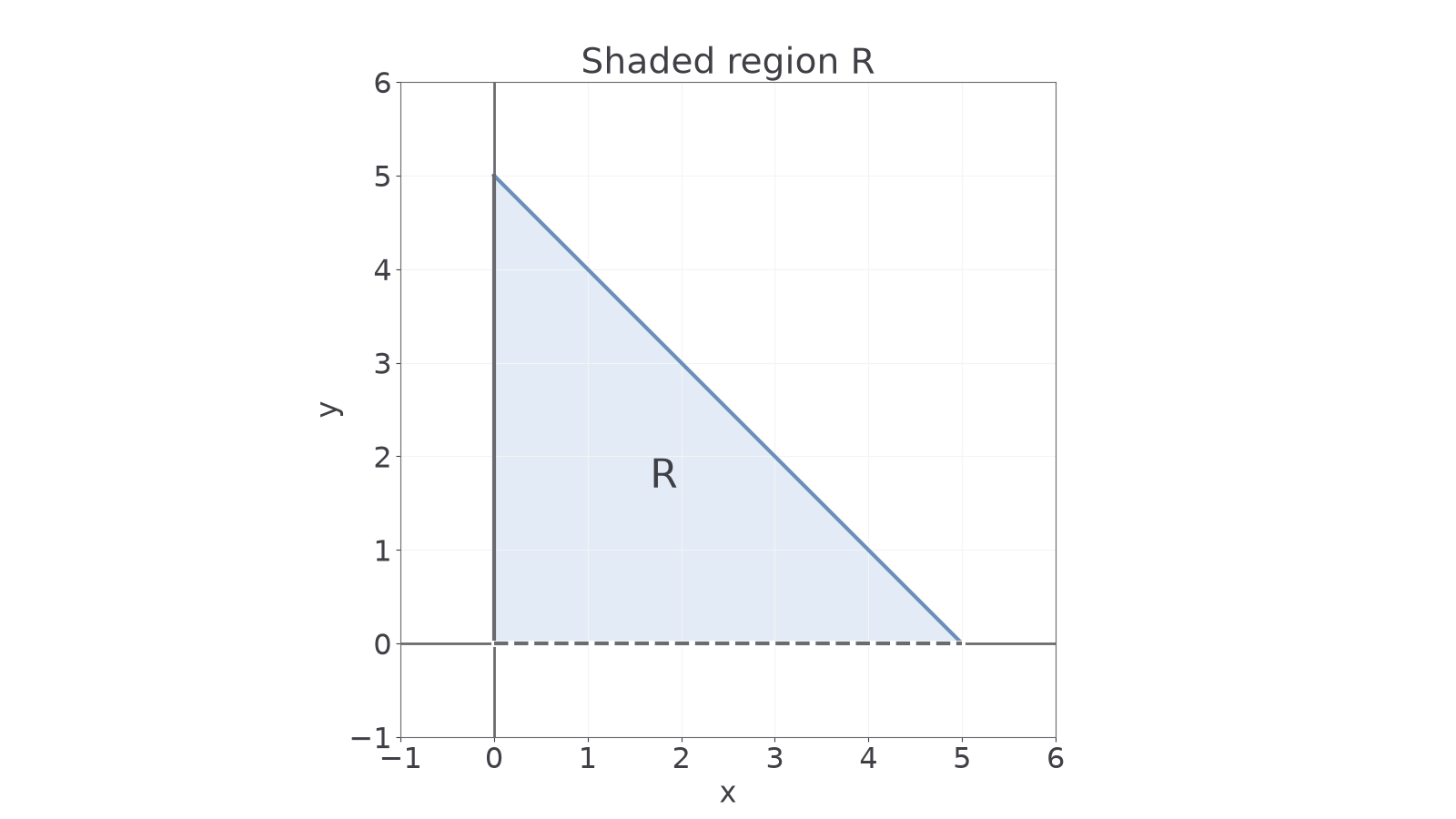
Plan. Read the two axis boundaries first, then use the sloping line's intercepts to find its equation and select its side.
Why this step? The intercepts establish the equation; a clearly interior point establishes which side is selected.
Answer. and and .
Check. passes all three conditions. is excluded because it fails , despite lying on the solid sloping line.
Worked example 8 changes only the sloping boundary from solid to dashed. Its equation and shaded side stay fixed.
Worked example 8: changing one boundary's permission
Question. Write the inequalities defining the shaded region .
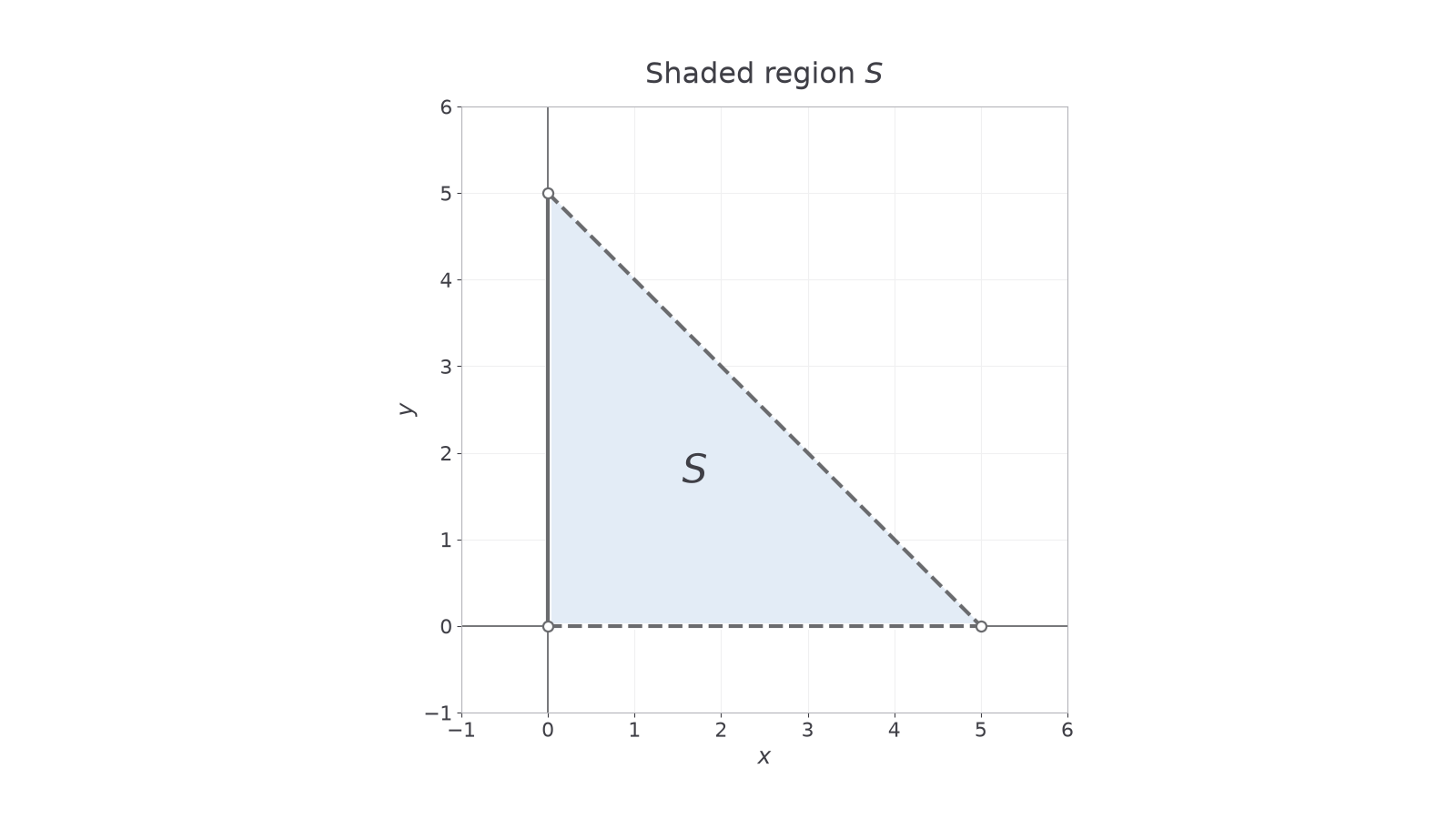
Plan. Keep the unchanged axis conditions and exclude equality on the sloping line.
Why this step? Dashed means the boundary itself is excluded. The slope and intercepts do not change when equality permission changes.
Answer. and and .
Check. remains inside, while is now excluded by the strict sloping-line condition.
Straight-line equations and boundary-reading rules are not supplied in the formula booklet. Label every boundary and keep every condition needed to describe the whole region. A viewing-window edge supplies no condition of its own.
Watch out
Wrong: the dashed line in Worked example 8 gives . A dashed boundary excludes equality, so the correct condition is . The selected side alone does not tell you whether the line belongs.
A complete description needs both the side and the equality permission for every boundary. Use the response form the question requests.
Exam tip
When AQA asks you to shade and label a region, provide the drawing and the requested region label. When asked to state inequalities, give a complete system with the correct strictness; an unexplained “inside the triangle” is incomplete.
The next diagram changes the sloping line and one axis's boundary style. Read the intercepts rather than assuming equal coefficients.
Quick Recap
- Replace an inequality by equality to find its boundary.
- Use solid boundaries for included equality and dashed or dotted boundaries for strict comparisons.
- Compare heights at the same , or substitute an off-boundary test point.
- For conditions joined by “and”, retain only the common region and check every meeting point against every condition.
Yes, a point on a solid boundary can lie outside the common region: in Worked example 7, lies on the solid line but fails .