R3 - Vertical dynamics
Model vertical motion with signed force equations, explain what a lift scale measures, and use gravity-only motion in stages. You will also distinguish mass from weight, use the local value of gravitational acceleration and decide when a simple model needs changing.
Signed vertical force equations
Why can a lift that is travelling down make you feel heavier? Imagine standing on a scale while the lift slows before reaching the ground floor. Your downward velocity is becoming less negative, so your acceleration is upwards. The floor must push harder than your weight to produce that upward resultant.
You already know
Acceleration describes a change in velocity, not the direction of travel. For constant acceleration, rearranges the supplied booklet equation . Newton's second law uses the resultant force, . Weight has magnitude and acts downwards. These two force relationships are not in the formula booklet: learn them.
Choose a positive direction before putting signs into an equation. With upwards positive, an upward support and downward weight give the following model.
Vertical resultant
For a body of mass subject only to weight and an upward support,
Here is signed upwards. The support might be a floor reaction or a cable tension, according to the situation. Not in the formula booklet: learn it.
A scale senses the contact force supporting you. This is your apparent weight; your gravitational weight remains . A downward velocity can accompany upward, downward or zero acceleration. Determine the acceleration from the velocity change before judging the scale reading.
Worked example 1: descending and slowing
Question. A person stands on a lift floor. The lift descends, and its speed decreases by in at constant acceleration. Weight and floor reaction are the only vertical forces on the person. Find the reaction using , to two significant figures.
Plan. Find the signed acceleration with upwards positive, then apply Newton's second law to the person.
Why this step? The velocity changes upwards even though the person still travels downwards. Its acceleration therefore has a positive sign in the chosen coordinates.
Answer. The reaction is , upwards.
Check. The upward resultant equals . The support exceeds weight, as the opening puzzle requires.
The two arrows act on the person. Their difference produces the acceleration; neither arrow is a separate “force of motion”.
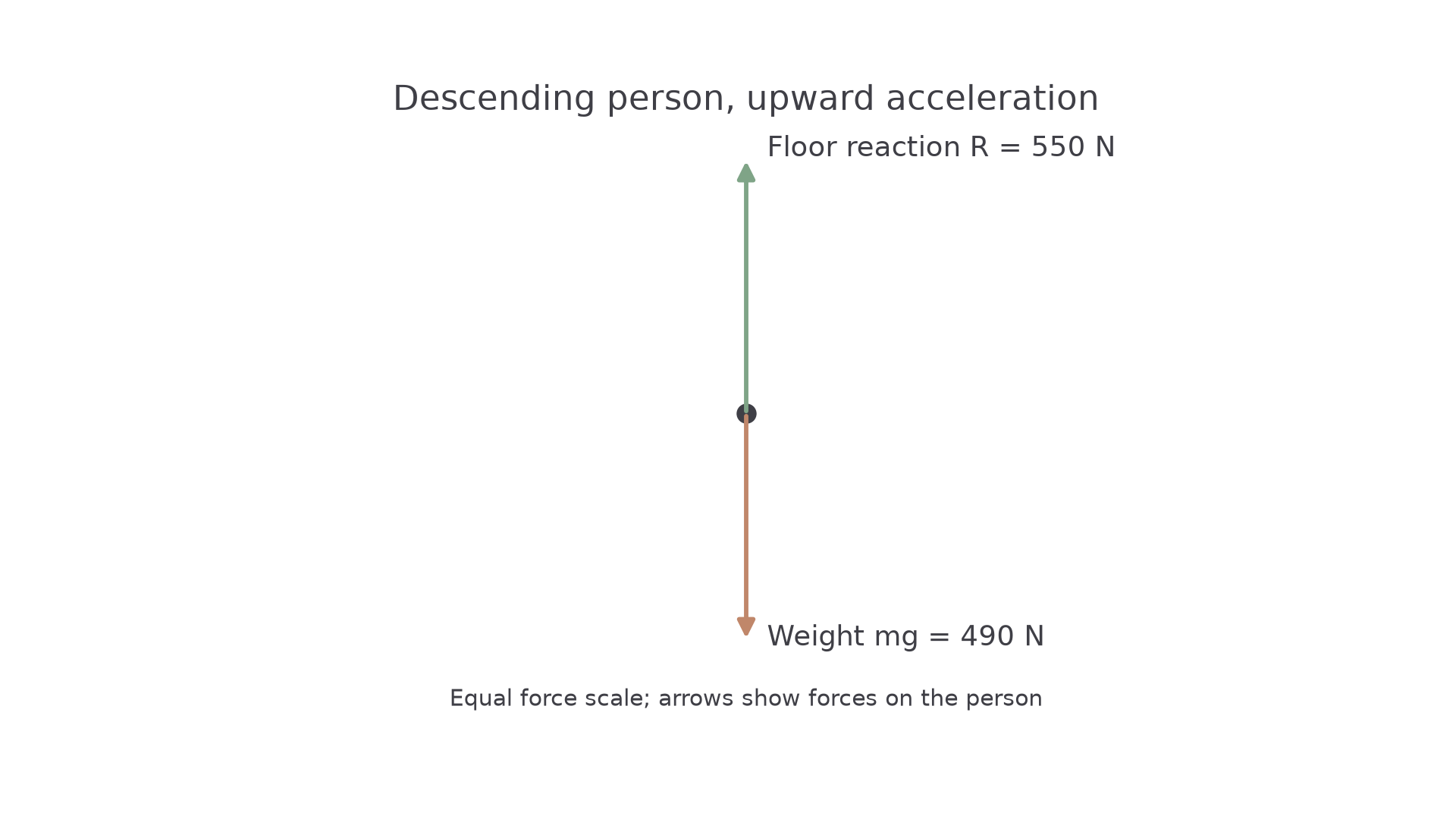
In Worked example 2, change just the sense of the speed change: the same descending lift speeds up instead. Its velocity now changes downwards.
Worked example 2: descending and speeding up
Question. The same person is in a lift descending with a speed that increases by in . Find the floor reaction using , to two significant figures.
Plan. Keep upwards positive and change the acceleration sign before forming the force equation.
Why this step? A smaller upward reaction leaves a downward resultant. There is no need to reverse the weight force when the lift changes how it moves.
Answer. The reaction is , upwards.
Check. . The reaction is positive and smaller than weight.
The same equation includes constant velocity: gives , whether the lift travels up or down. It also predicts a striking boundary: if the support and person fall with acceleration , then . They are weightless in the sense of having no supporting contact force; gravity has not disappeared. A floor cannot pull a person down, and an ordinary cable cannot push. A negative calculated reaction or tension means that assumed contact or taut-cable model cannot continue.
Watch out
Wrong: “The lift descends, so ” while also using a signed negative . This counts the downward sign twice. Right: choose upwards positive, use , and put the signed acceleration into .
For the next lift, use the change in velocity first. The word “descending” alone does not settle the answer.
Free motion under gravity
After a ball leaves your hand, there is no continuing upward “throwing force”. In a gravity-only model its weight is the only force, throughout both ascent and descent.
With upwards positive, Newton's second law gives , hence . The mass cancels. In this model, two objects released with the same initial velocity at the same place follow the same vertical motion, even if one has much greater mass. Resistance can change that prediction, but mass alone does not change gravity-only acceleration.
Free flight under gravity
A particle is in free flight under gravity when weight is its only force. Neglect resistance and treat the local as constant over the motion. A ball at the highest point is still in free flight: its velocity is zero at that instant, but its acceleration remains downwards.
Because is constant, the constant-acceleration equations apply. Position, displacement and velocity carry signs; speed is the nonnegative magnitude of velocity.
Constant-acceleration equations
For straight-line motion with constant signed acceleration ,
Use one chosen positive direction for , , and . In the formula booklet.
Set the launch point as displacement zero before deciding which height or time a question requests.
Worked example 3: an upward throw
Question. A ball is thrown vertically upwards from a point with speed . Model it as a particle under gravity alone, using . Find the time to its highest point, the greatest height above launch and its velocity after . Give final answers to two significant figures.
Plan. Use upwards positive, set only at the highest point, and keep throughout.
Why this step? Zero velocity selects the turning point. It does not turn off gravity or make the acceleration zero there.
Answer. The time is , the greatest height is , and the velocity after is downwards.
Check. At , substituting into gives . Since , the negative final velocity has the expected direction.
Continue this lesson.
You’re previewing NovaLearn without an account. Create a free account to read the rest.
Create free account