E9 - Trigonometric models and applications
Translate rotation, geometric fit, displacements and forces into trigonometric relations. Choose the appropriate method, interpret every solution in context, and identify the assumptions that make each model useful.
Modelling uniform rotation
A rider passes the same height twice in one revolution. Can both times be correct, and how do you tell which is first? Picture a point on a wheel of radius , centred above the ground. Its height ranges from to ; most intermediate heights occur once going up and once coming down.
You already know
A rotating radius has a vertical projection described by sine or cosine. One complete turn is radians. A harmonic form separates the centre height, amplitude and phase.
Uniform rotation means the angle increases by equal amounts in equal times. With period , the angular speed is radians per unit time, so the argument grows linearly.
Rotation model
A uniform-rotation model assumes a fixed circular path, constant angular speed and a point fixed relative to the rotating circle. The period is the time for one revolution. The model predicts the point's height; a real wheel's pauses, acceleration or a rider moving within a seat can make it inaccurate.
Choose the sign from the initial position. Starting at the lowest point requires a negative cosine contribution; starting at the highest requires a positive one. A different initial height needs a phase, and the initial direction distinguishes its two possible positions.
Height under uniform rotation
For centre height , radius , period and time in the same time unit as ,
when the point starts lowest. Starting highest gives . The trigonometric argument is in radians.
Not in the formula booklet: learn it.
Check the starting value and period before using a model to solve a time question.
Worked example 1: starting at the bottom
Question. A point moves on a wheel of radius , centre height , period . It starts lowest at . Construct a height model and find both times it reaches during .
Plan. Choose a negative cosine and solve its height equation over one turn.
Why this step? The time interval corresponds to a whole argument turn, so both the rising and falling crossings belong to it.
Answer. ; the times are and , with the first on the ascent.
Check. , , and both calculated argument cosines are .
Change only the initial position to the top. The centre, radius, period and target height remain the same.
Worked example 2: starting at the top
Question. The same wheel point starts highest at . Construct its height model and find both times it reaches during .
Plan. Reverse the cosine sign and solve the new target equation.
Why this step? The phase information is physical: the first crossing is now on the descent, even though the wheel has the same period.
Answer. ; the times are and .
Check. , , and the two times sum to the period .
The amplitude describes a length, while the coefficient of time inside cosine describes how quickly the angle changes.
Watch out
Wrong: a period of gives . That argument makes twenty radians pass each second. Right: use , so the argument increases by exactly in twenty seconds.
Keep the top start and change only the period to .
Modelling a tilted rectangle's width
A tilted rectangle's horizontal span is the sum of two projections. Draw the angle carefully: measured from the vertical, the long side contributes a sine term.
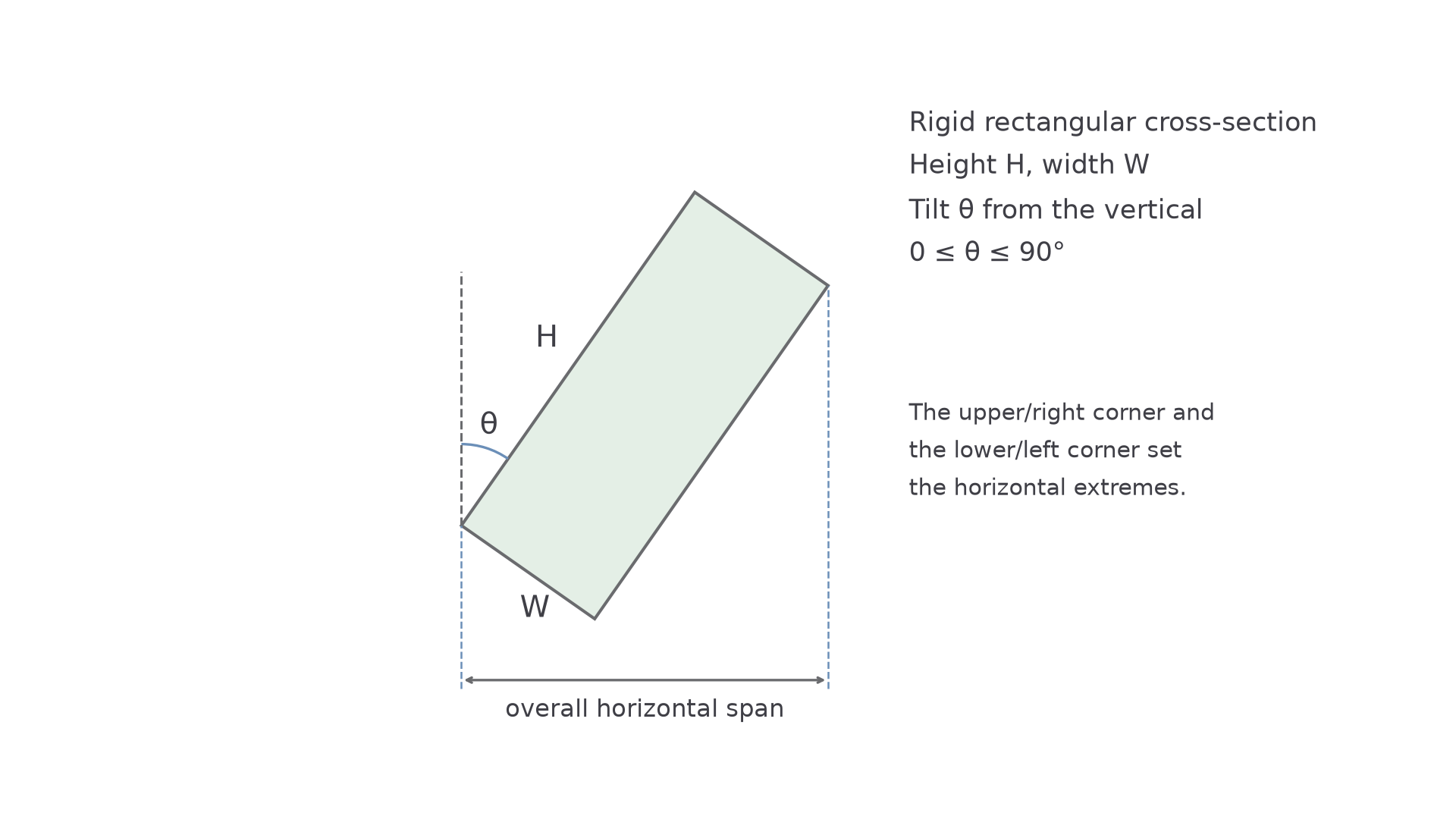
For side lengths and , the horizontal span is . Both terms are nonnegative here. This projection result is derived, not supplied in the formula booklet. Angles measured from the horizontal would exchange the sine and cosine roles.
The model assumes a rigid rectangular two-dimensional cross-section and parallel vertical gap boundaries. Thickness, protrusions, deformation or movement in a third dimension may change whether a real object fits. Equality of span and gap means contact; a greater span means that orientation cannot fit in this model.
Worked example 3: first contact
Question. A rectangular cross-section is high and wide. It is to be rotated from upright in a gap wide. Find all contact angles , to one decimal place, and interpret the orientations between them.
Plan. Add horizontal projections, combine them into one sine and search the physical interval.
Why this step? The argument interval is , which contains both crossings of the target height of this sine wave.
Answer. Contact occurs at and . The first contact from upright is . Between the unrounded roots the span exceeds the gap, so those orientations cannot fit.
Check. The maximum span is , while the endpoint spans are and . Two contacts are therefore plausible.
Change only the gap width to . One contact now occurs exactly at the closed endpoint.
Worked example 4: an endpoint contact
Question. Find all contact angles for the same rectangle in a gap wide, using . Give non-exact angles to one decimal place.
Plan. Keep the harmonic parameters and change the target span.
Why this step? A contact at the endpoint is a valid orientation because the interval includes .
Answer. , with first contact at .
Check. At , the span is exactly the height side . The maximum is still greater than the gap.
A second mathematical root may lie outside the allowed tilt interval; it must then be rejected on physical grounds.
Watch out
Wrong: for an angle from the vertical. At zero tilt this predicts width , rather than . Right: . Check the upright position before solving.
Change just the gap width once more. Check whether both branch outputs represent permitted tilts.
Continue this lesson.
You’re previewing NovaLearn without an account. Create a free account to read the rest.
Create free account