E1 - Radians, arcs and sectors
Measure rotations in radians and use them to find arc lengths, sector areas and circular boundaries. You will see why an angle measured as an arc-to-radius ratio makes circle formulae unusually simple.
Angles as arc-to-radius ratios
An arc is long on a circle of radius . Can you describe its angle without using degrees? Dividing arc length by radius gives , the angle's radian measure.
You already know
A circle of radius has circumference and area . A full turn is . These results are not in the formula booklet: learn them.
Enlarging the circle multiplies both arc and radius by the same scale factor, so their ratio is unchanged. The angle belongs to the rotation, not to the size of the circle.
Radian
One radian is the central angle subtending an arc as long as the radius. For a positive arc length on a circle of radius , its central angle in radians is .
Radians are angle measure, not a length unit. The ratio has no length dimension; may be written to make the angle unit clear. A full circumference gives . The radian definition and arc-to-radius relationship are not supplied in the formula booklet.
Converting angle measure
Not in the formula booklet: learn it.
Positive angles describe anticlockwise rotation, negative angles clockwise rotation. A rotation can exceed one turn; for example, . A single ordinary sector uses . Exact multiples of should stay exact when requested.
Worked example 1: degrees to radians
Question. Convert to radians exactly.
Plan. Multiply the degree number by .
Why this step? The conversion factor makes a half-turn, , become radians.
Answer. .
Check. is of a full turn, and .
Change only the direction of conversion. The reciprocal factor must undo the first conversion.
Worked example 2: radians to degrees
Question. Convert to degrees.
Plan. Multiply the radian number by .
Why this step? Cancelling restores the degree measure of the same rotation.
Answer. .
Check. Converting back gives .
The bare number means very different rotations in degree and radian mode. Match the calculator mode to the angle inside a trigonometric function.
Watch out
Wrong: . This applies the forward factor twice. Radians to degrees uses , giving .
Keep the direction of conversion and change the radian numerator.
Arc length and sector area
The opening arc, at radius , occupies of its full circle. That same fraction finds its sector area.
A sector is bounded by two radii and a connecting arc. With in radians, its fraction of a circle is . Multiplying this by circumference gives ; multiplying it by circle area gives . These are derived from the circle formulae, rather than new rules to guess.
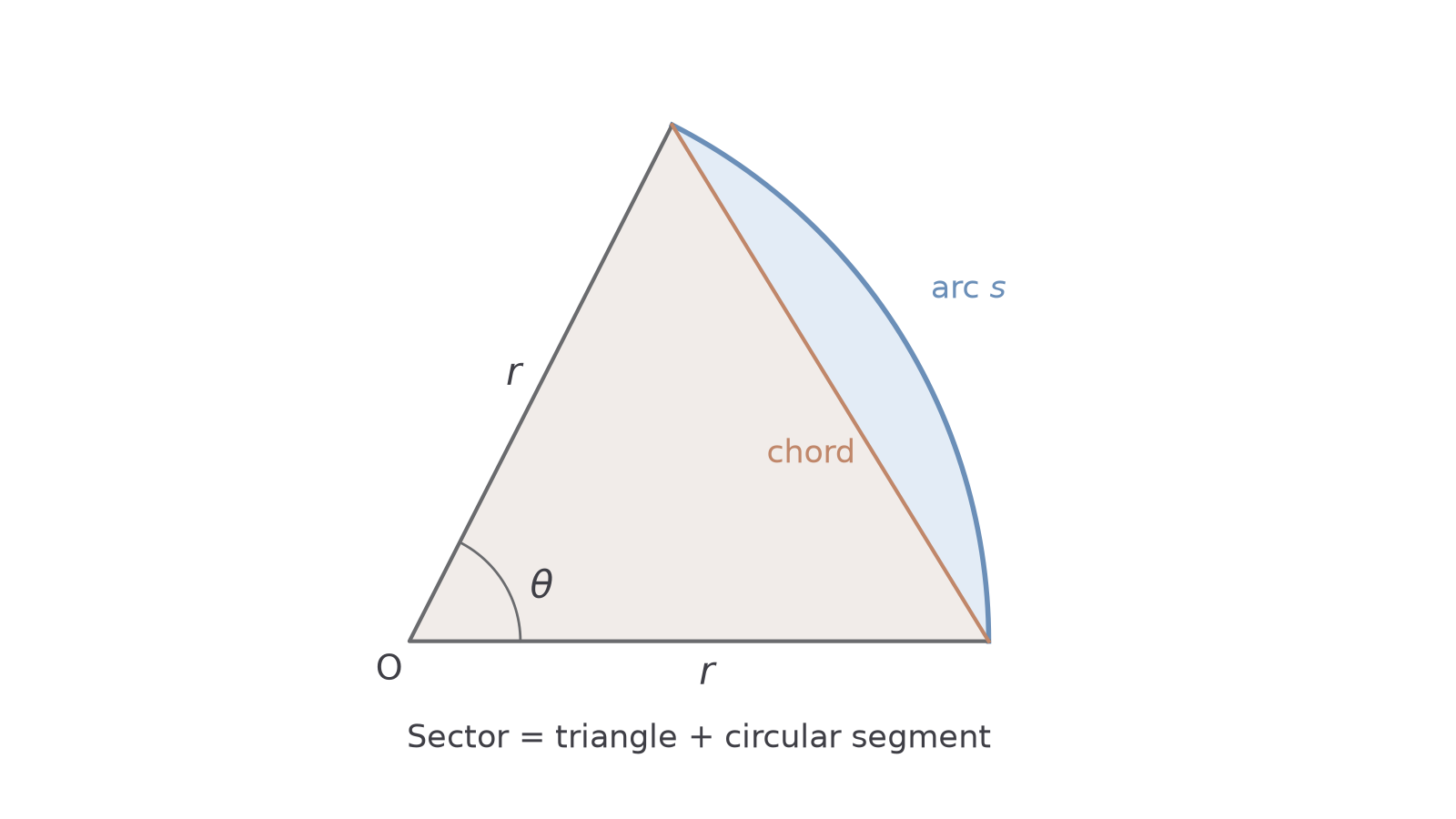
The straight chord joins the arc's endpoints; it is not the arc itself. Tracing the outside edge tells you which lengths form the perimeter.
Arc length and sector area
For and , with in radians,
For an ordinary sector with , its perimeter is
At , the whole disc has boundary , without two extra radii.
Not in the formula booklet: learn it.
Degrees can instead use a fraction . Mixing the degree number with the radian formula gives a result too large by . Rearrangements such as , and are not separately printed in the booklet; derive them from the same equations and keep the positive radius.
There is an unexpected constant hidden here: every sector of the same radius has . Changing its angle changes both area and arc length in exact proportion. This is a consequence of the formulae, not a separately supplied result.
Worked example 3: three sector measures
Question. A sector has radius and angle . Find its arc length, area and perimeter.
Plan. Use the radian angle directly and add the two straight radii to the arc.
Why this step? Perimeter measures the entire boundary; arc length measures only its curved part.
Answer. , , .
Check. .
Continue this lesson.
You’re previewing NovaLearn without an account. Create a free account to read the rest.
Create free account