R2, R4 - Resolving forces and equilibrium
Replace angled forces by signed perpendicular components (R2, R4), then use those components in equilibrium and motion equations. You will choose axes to match a surface and account for an angled pull in both the reaction and the acceleration.
Resolving a force
Can a pull lift some of a load's weight off a surface while also accelerating it along the surface? A pull at above horizontal has an upward component of , as well as a horizontal component. One force can therefore change two equations at once.
You already know
For a right-angled triangle, cosine uses the side adjacent to the stated angle and sine uses the opposite side. Newton's second law uses the signed resultant in each direction; equilibrium makes both component sums zero.
Start by sketching the force and your axes. Resolving replaces the force by perpendicular components with the same combined effect. Those components are not extra physical interactions to add alongside the original force.
Resolving from the positive horizontal
If a force of magnitude makes angle above the positive horizontal,
Use signs appropriate to the actual direction. Cosine belongs to the component adjacent to the angle; an angle measured from the vertical changes which component uses cosine.
Not in the formula booklet: learn it.
For example, an up-left force above the negative horizontal has components and . The signs come from left/up; the trigonometric functions come from the angle's reference axis.
Worked example 1: an angle from horizontal
Question. A force acts below the rightward horizontal. Find its exact signed horizontal and vertical components, taking right and up positive.
Plan. Draw the down-right direction, then use cosine horizontally and a negative sine vertically.
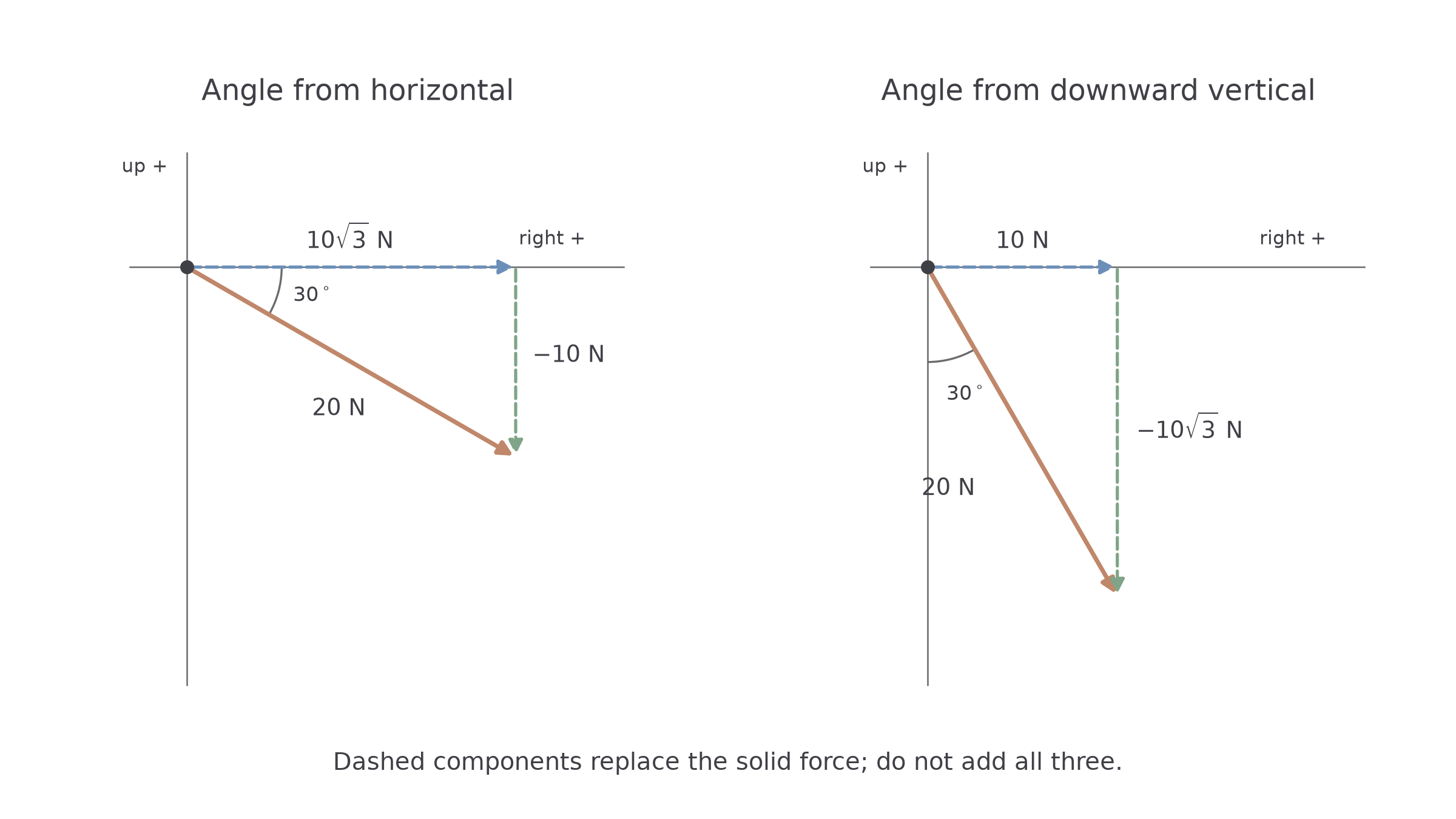
Why this step? The angle is given from horizontal, so the horizontal component is adjacent. The downward component must be negative.
Answer. The components are rightwards and downwards, or on the stated axes.
Check. , recovering the force magnitude.
Worked example 2 changes only the reference for the angle: it is now measured from the downward vertical. The force is still down-right, but the longer component is now vertical.
Worked example 2: an angle from vertical
Question. A force acts down-right at to the downward vertical. Find its exact signed components along right-positive and up-positive axes.
Plan. Make the vertical component adjacent to the angle and keep it negative.
Why this step? Sine is not permanently “vertical”. Its component depends on where the given angle is measured from.
Answer. The components are , or right and down.
Check. , so their combined magnitude is again . The signs agree with the sketch.
You can also use the complementary angle: . These are the same component, not competing methods. The elementary trigonometric ratios and this complementary-angle relation are not supplied in the formula booklet: learn them.
Watch out
Wrong: when the force is down-right and the angle is from the downward vertical. This uses the wrong reference and sign. Right: . Draw the angle before choosing sine or cosine.
The next force points up-left. Keep the vertical reference, then change the signs to match that quadrant.
Coplanar particle equilibrium
Forces can balance without forming pairs along the same lines. Two sloping strings can support a particle because their horizontal components oppose one another and their vertical components add to the weight.
Coplanar equilibrium
Forces are coplanar when they all lie in one plane. A particle is in equilibrium under those forces when their vector sum is zero, so it has zero acceleration.
For a particle at rest or moving with constant velocity, choose two perpendicular axes and impose both balances.
Two-dimensional equilibrium
These simultaneous equations refer to the same particle. For a taut string, the tension acts along the string away from the particle and has nonnegative magnitude.
Not in the formula booklet: learn it.
If an assumed taut-string arrangement requires a negative tension, the string would need to push. That arrangement is physically impossible under the model. A zero tension is the boundary at which the assumed taut support may cease to apply.
Worked example 3: one horizontal supporting string
Question. A particle of weight is held at rest by two light taut strings. One pulls up-right at above horizontal with tension ; the other pulls horizontally left with tension . Find both tensions exactly.
Plan. Use vertical balance to find , then horizontal balance to find .
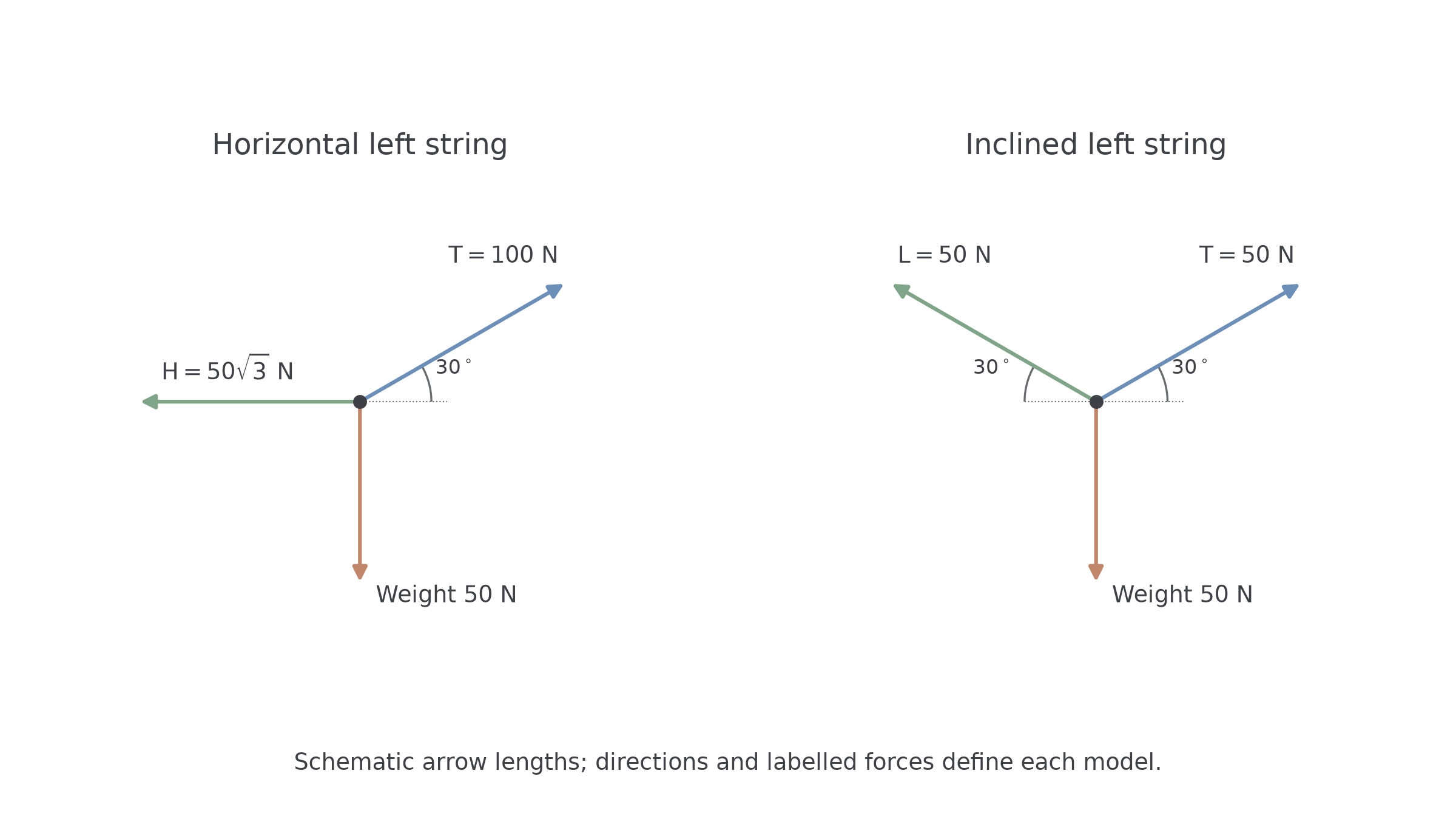
Why this step? Only the vertical component of supports the weight; its horizontal component needs a separate opposing force.
Answer. and . Both are positive, consistent with taut strings.
Check. Upward support is , and the horizontal components cancel. The angled tension exceeds the weight because only part of it acts upwards.
Worked example 4 changes only the left string's direction: it now rises at above horizontal. It contributes to vertical support as well as horizontal balance.
Worked example 4: both strings contribute support
Question. The particle remains in equilibrium. The right string still pulls at above horizontal with tension , but the left string now pulls up-left at above horizontal with tension . Find the tensions exactly.
Plan. Resolve both strings horizontally and vertically, then solve the two equations.
Why this step? Unlike the horizontal string, the inclined left string supplies upward force. Leaving out its vertical component would overestimate the right tension.
Answer. Each tension is .
Check. Their horizontal components cancel, while the upward total is . The two equal tensions do not each act vertically.
Continue this lesson.
You’re previewing NovaLearn without an account. Create a free account to read the rest.
Create free account