C1 - Straight lines and linear models
Find line equations, use coordinates to justify lengths and angles, and build straight-line models with meaningful rates and valid input ranges. You will combine these ideas to prove the shape of a quadrilateral without trusting the appearance of a sketch.
Gradient and line equations
How can you prove that a tilted quadrilateral is a square when none of its sides is horizontal? Start with a small piece of the puzzle: moving from to means moving across and up, so the side's gradient is . Coordinates give exact evidence about direction, even when a drawing is distorted.
You already know
A point has horizontal coordinate and vertical coordinate . Substituting both coordinates into an equation tests whether the point lies on its graph. Solving two line equations simultaneously finds their intersection.
The gradient measures change in the vertical coordinate per unit change in the horizontal coordinate. Subtract coordinates in the same order; reversing both differences leaves their ratio unchanged.
Gradient and line equations
For distinct points and , with ,
The line through with finite gradient has equation
A general straight-line equation is , where are not both zero. If , its gradient is .
Not in the formula booklet: learn it.
The point-gradient form comes from the constant ratio . Multiplying by gives an equation that also works at the known point. Rearranging to displays the gradient and vertical intercept. Multiplying a whole line equation by any nonzero constant leaves the line unchanged.
Worked example 1: a line through two points
Question. Find the line through and , in the form .
Plan. Calculate the gradient, use one known point, then rearrange into the requested form.
Why this step? A gradient fixes direction but allows many parallel lines; using fixes the position.
Answer. .
Check. At , ; at , .
Now change just one feature: the two points have the same horizontal coordinate. The general line form still works, but the gradient calculation does not.
Worked example 2: the vertical boundary case
Question. Find the line through and , in the form . State its gradient.
Plan. Identify the coordinate that is constant instead of dividing by zero.
Why this step? A vertical line cannot be written as with a finite ; its equation fixes , not .
Answer. . Its gradient is undefined.
Check. Both supplied points have , and every point with is on the same vertical line.
A horizontal line instead has equation and gradient zero. These horizontal and vertical forms are also not in the formula booklet: learn them. In AQA questions, any correct simplified form is acceptable unless a form is specified.
Watch out
Wrong: the gradient of is . Right: , so it is . Rearranging makes the sign visible.
Change the boundary case once more: this time the vertical coordinate is constant.
Midpoints and distances
Coordinates also measure position and length: the midpoint is halfway in each coordinate, while the segment's length comes from a right triangle.
For and , the horizontal change is and the vertical change is . The midpoint lies across and up from the first point; Pythagoras gives length .
Midpoint and distance
For and ,
A length uses the nonnegative square root. These are coordinate forms of averaging and Pythagoras.
Not in the formula booklet: learn it.
Compare squared lengths when you only need to decide whether lengths are equal. This avoids unnecessary surds without losing information, because lengths are nonnegative.
Worked example 3: an exact segment length
Question. Find the midpoint and length of the segment joining to .
Plan. Average each coordinate and use Pythagoras on the coordinate changes.
Why this step? Horizontal and vertical changes are perpendicular, so they are the two shorter sides of a right triangle.
Answer. Midpoint , length .
Check. From to either endpoint, the squared distance is , one quarter of .
The next example changes the unknown: one endpoint is missing, while the midpoint is known. Doubling the midpoint reverses the averaging operation.
Worked example 4: recovering an endpoint
Question. The midpoint of is and . Find and the length .
Plan. Solve the two midpoint equations, then calculate the distance.
Why this step? The midpoint is the average of the endpoints, so it determines the missing endpoint uniquely once the other is known.
Answer. , and .
Check. to and to both have change .
You can use this reversal later to find missing vertices and circle diameters.
Watch out
Wrong: average an coordinate with a coordinate to find a midpoint. Right: average the two horizontal coordinates together and the two vertical coordinates together. For a missing endpoint, reverse each average separately.
The next question varies the coordinates while keeping the same midpoint reversal.
Parallel and perpendicular lines
A gradient tells you a line's direction; comparing gradients tells you whether two directions agree or meet at a right angle.
Two distinct nonvertical lines with gradient are parallel. With gradients and , they are perpendicular. Equal gradients can also describe the same line, so check the intercepts when you need distinct parallel lines. Distinct vertical lines are parallel too; their gradients are undefined, so compare their equations instead.
Direction tests
Distinct nonvertical lines are parallel exactly when .
For two lines with finite gradients, perpendicularity is equivalent to
Thus the perpendicular gradient to a nonzero gradient is . A horizontal line and a vertical line are perpendicular; the finite-gradient product test does not apply to that pair.
Not in the formula booklet: learn it.
The negative reciprocal has a geometric reason. A direction with horizontal and vertical changes turns through a right angle to . When , their gradients are and , whose product is .
Worked example 5: a parallel line
Question. Find the line through parallel to .
Plan. Read the given gradient, retain it, and use the supplied point.
Why this step? Parallel lines have the same direction; changing the intercept moves the line without turning it.
Answer. .
Check. The gradients agree, the intercepts and differ, and .
Change only the required relationship from parallel to perpendicular. Now keep the point but change the gradient to its negative reciprocal.
Worked example 6: a perpendicular line
Question. Find the line through perpendicular to .
Plan. Replace the given gradient by its negative reciprocal, then use point-gradient form.
Why this step? Merely changing the sign would give , whose product with is not .
Answer. .
Check. , and at the required point.
If the given line is horizontal, use a vertical answer directly. No fraction involving an undefined gradient is needed.
Watch out
Wrong: a line perpendicular to has gradient . Right: is horizontal, so its perpendicular through is the vertical line .
The next question changes the given line's gradient while retaining the perpendicular construction.
Coordinate quadrilateral reasoning
To identify a quadrilateral, calculate enough properties to force the conclusion. A shape looking square, or having just one familiar property, is insufficient.
For a simple, nondegenerate quadrilateral , with vertices given in order, these sufficient conditions are useful. They are not supplied in the formula booklet: learn the properties and justify their use.
| Shape | Sufficient coordinate evidence |
|---|---|
| Parallelogram | Both opposite side pairs parallel, or diagonals with the same midpoint |
| Rectangle | A parallelogram with one right angle |
| Rhombus | A parallelogram with two adjacent sides equal |
| Square | A rectangle with two adjacent sides equal |
| Kite | Two equal adjacent side pairs, such as and |
| Trapezium | A pair of opposite sides parallel; show the other pair is not parallel if exactly one pair is required |
These are necessary as well as sufficient under the inclusive definitions used here: for example, every rectangle is a parallelogram with a right angle, and that combination forces a rectangle. Squares also satisfy the rectangle and rhombus definitions. To distinguish a kite from a rhombus, show the two pair-lengths differ. Equal diagonals alone do not prove a rectangle; perpendicular diagonals alone do not prove a square.
Worked example 7: a tilted square
Question. Prove that consecutive vertices form a square.
Plan. Establish a parallelogram, a right angle and equal adjacent lengths.
Why this step? Parallel opposite sides give a parallelogram; the right angle makes it a rectangle; equal adjacent lengths then make it a square.
Answer. is a square.
Check. The diagonal midpoints are both , independently confirming the parallelogram structure.
Here is a pleasing surprise: all four vertices have integer coordinates, yet every side has length . A square need not line up with the grid to be exact. The squared-length calculation above proves it.
The next example changes only one decisive feature: the adjacent lengths are unequal. The direction tests still prove a rectangle.
Worked example 8: a rectangle that is not a square
Question. Prove that , in that order, form a rectangle but not a square.
Plan. Repeat the direction tests, then compare squared adjacent lengths.
Why this step? The unequal lengths rule out a square only after the direction evidence has established the rectangle.
Answer. It is a rectangle, and it is not a square because .
Check. Both diagonals have midpoint , and both have squared length , consistent with a rectangle.
The equal axis scales show the geometry faithfully, but the proof comes from the calculations.
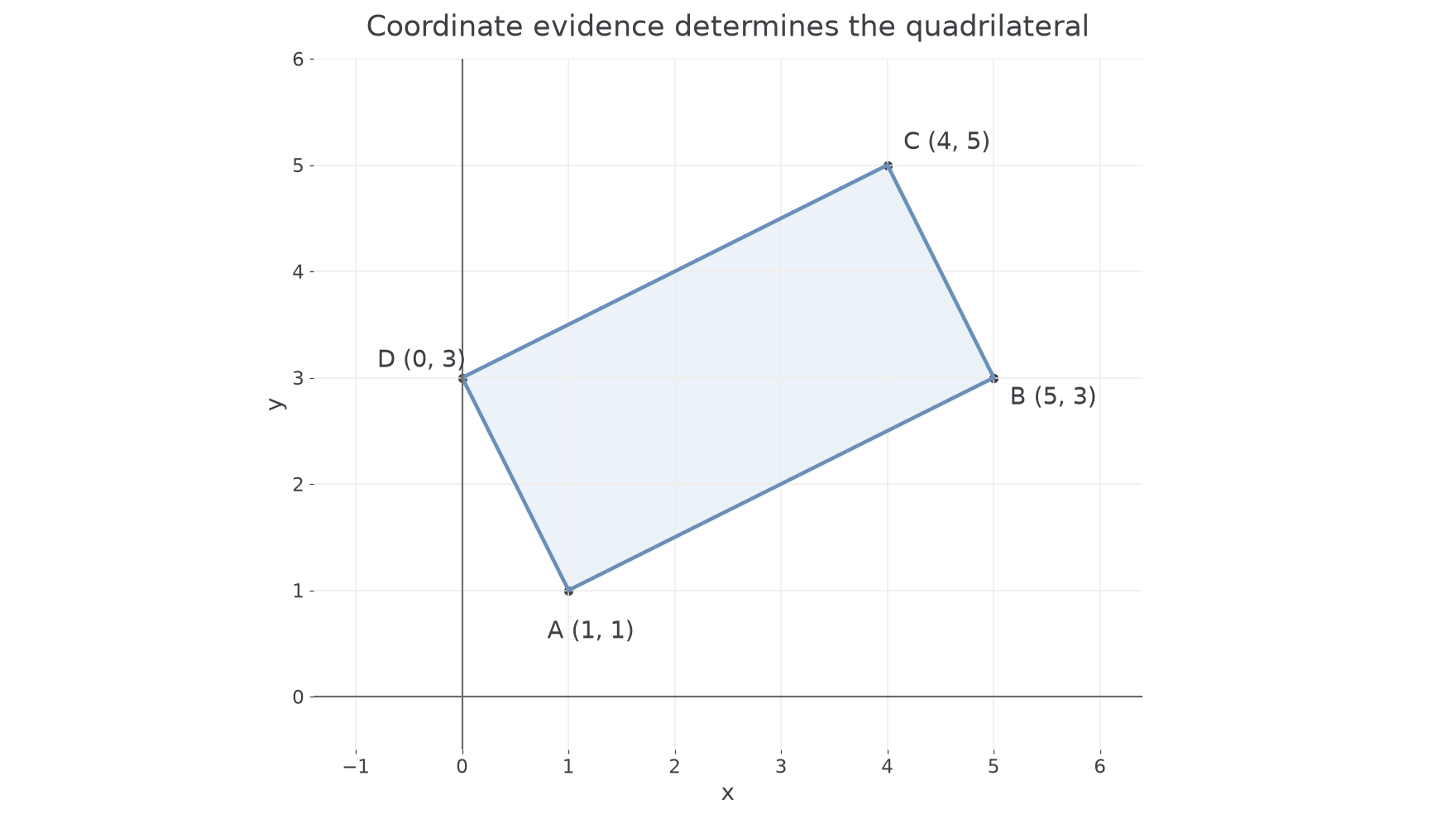
One suggestive property rarely settles the classification. Length evidence and direction evidence answer different questions.
Watch out
Wrong: four equal sides prove a square. Right: they prove a rhombus, which may have no right angle. Establish perpendicular adjacent sides as well. Equal diagonals alone are also insufficient to prove a rectangle.
For the next rectangle, change the coordinates again. You still need both a direction argument and a length comparison.
Constructing linear models
A straight-line model assumes a constant change in one quantity for each unit increase in another, over a stated range.
A hire charge rising from £19 for two hours to £39 for seven hours increases by £20 over five hours. A constant rate therefore means £4 per hour. The intercept accounts for the rest of the charge.
Linear model
A model has rate , the output change per input unit, and intercept , the predicted output at . For example, a fixed charge plus a constant hourly rate gives a linear cost model. A price that changes its hourly rate after a threshold needs a different rule or separate pieces.
Define variables and units before fitting a line. Time may vary continuously, while a number of parcels is restricted to whole numbers; state whichever domain the context permits. A model can fit two observations exactly without being valid for every input. Interpolation uses inputs between observations; extrapolation goes beyond them and needs further justification. The linear model form and the coefficient calculations below are not in the formula booklet: learn the method.
Worked example 9: a hire charge
Question. A company charges a fixed fee plus a constant hourly fee for hires from one to eight hours. Two hours cost £19 and seven hours cost £39. Find a cost model, interpret its coefficients and predict the cost for five hours.
Plan. Use the change in cost to find the hourly rate, then substitute one observation to find the fixed fee.
Why this step? Taking differences removes the fixed fee, leaving just the cost of the extra hours.
Answer. , for , with in hours and in pounds. The rate is £4 per hour, the fixed fee is £11, and five hours cost £31.
Check. , matching the second quote.
The next example changes the sign of the rate: the quantity decreases at a constant rate. A negative gradient is meaningful, provided you interpret the variables correctly.
Worked example 10: a draining tank
Question. A tank contains after two minutes of draining and after eight minutes. Assume a constant draining rate until it empties. Find in terms of elapsed time , and the time at which the model predicts an empty tank.
Plan. Fit the line from the observations, then solve to locate the model's end.
Why this step? Negative volume is impossible, so the algebraic line must stop at the emptying event.
Answer. , for , with volume in litres and time in minutes. The predicted emptying time is minutes. The intercept is the model's initial .
Check. At eight minutes, . At the endpoint, .
The emptying time is extrapolated beyond the measured times: it is a conditional prediction of constant flow. Real drainage may slow as the level falls, so another observation would test that assumption. A temperature-conversion line gives another interpretation: its gradient changes the scale, while its intercept shifts the zero point.
Watch out
Wrong: two matching readings prove the rate stays constant. Right: the readings determine the fitted line; the constant-rate assumption and the valid range still need contextual support.
The next tank has a different constant decrease. Keep the event that ends the model in your answer.
Quick Recap
- A finite gradient and a point give ; the general form also includes vertical lines.
- Use coordinate averages for midpoints and Pythagoras for lengths.
- Equal gradients establish parallel directions; finite perpendicular gradients multiply to .
- Prove quadrilaterals using sufficient direction and length conditions, with vertices in order.
- A linear model needs defined variables, a rate, an intercept and a justified input range.
The tilted quadrilateral from the opening question is proved square by parallel opposite sides, one right angle and equal adjacent lengths; no judgement by eye is needed.