G3 - Stationary points and optimisation
Classify stationary points and inflections using evidence from derivatives. Distinguish local from global extrema, compare boundaries and construct a constrained volume model whose optimum is physically possible.
Classifying stationary points
How large a box can you make from an by card by cutting equal corner squares and folding up the sides? A cut of gives volume , while gives . The best cut lies somewhere between: derivatives can locate it, but an equation alone will not prove the answer is the largest possible box.
You already know
A horizontal tangent has . Positive derivative means increasing and negative derivative decreasing. The second derivative measures change of gradient. These criteria are not supplied as formulae in the booklet.
A stationary point has derivative zero. A local maximum has no larger values in a sufficiently small neighbourhood; a local minimum has no smaller ones. A turning point reverses the increasing/decreasing direction. A stationary point need not turn.
Stationary-point tests
At a stationary input , with :
- A change in from positive to negative gives a local maximum.
- A change from negative to positive gives a local minimum.
- For the smooth functions here, gives a local maximum and a local minimum.
- If , the second-derivative test is inconclusive; inspect nearby signs.
Not in the formula booklet: learn it.
The second-derivative test only classifies an input already shown to be stationary. Coordinates then need substitution into the original function, rather than into either derivative.
Worked example 1: two stationary points
Question. Find and classify the stationary points of . Fully justify your answer.
Plan. Solve , find the two heights and use the second derivative at each input.
Why this step? The sign of the second derivative classifies the zero first derivative; it does not supply the point's height.
Answer. is a local maximum and a local minimum.
Check. The factored first derivative has signs , confirming both reversals.
Change only the constant term, adding . This changes stationary heights but cannot change their inputs or nature.
Worked example 2: stationary points after a vertical shift
Question. Find and classify the stationary points of , with justification.
Plan. Reuse the derivative calculations, then evaluate the shifted original function.
Why this step? A vertical translation preserves slopes and changes only the coordinates' second entries.
Answer. Local maximum ; local minimum .
Check. Each height is greater than in Worked example 1, while the derivative sign pattern is unchanged.
At zero, both and have first and second derivatives zero. Yet stays positive on both sides, giving no extremum for , while changes from negative to positive, giving a minimum for . For , the signs reverse and give a maximum. A zero second derivative leaves all these possibilities open.
Watch out
Wrong: “, so there is no maximum or minimum.” Zero means this test cannot decide. Right: examine either side; has a minimum at zero despite .
Change the constant again. Keep coordinates and classification as separate steps.
Testing points of inflection
An inflection changes curvature between convex and concave. A turning point instead changes between increasing and decreasing. These are different tests, so an inflection can have a sloping tangent.
For the smooth functions here, solve to find candidates, then check the second derivative's sign on both sides. A stationary inflection also has ; a non-stationary inflection has . These criteria are not in the formula booklet.
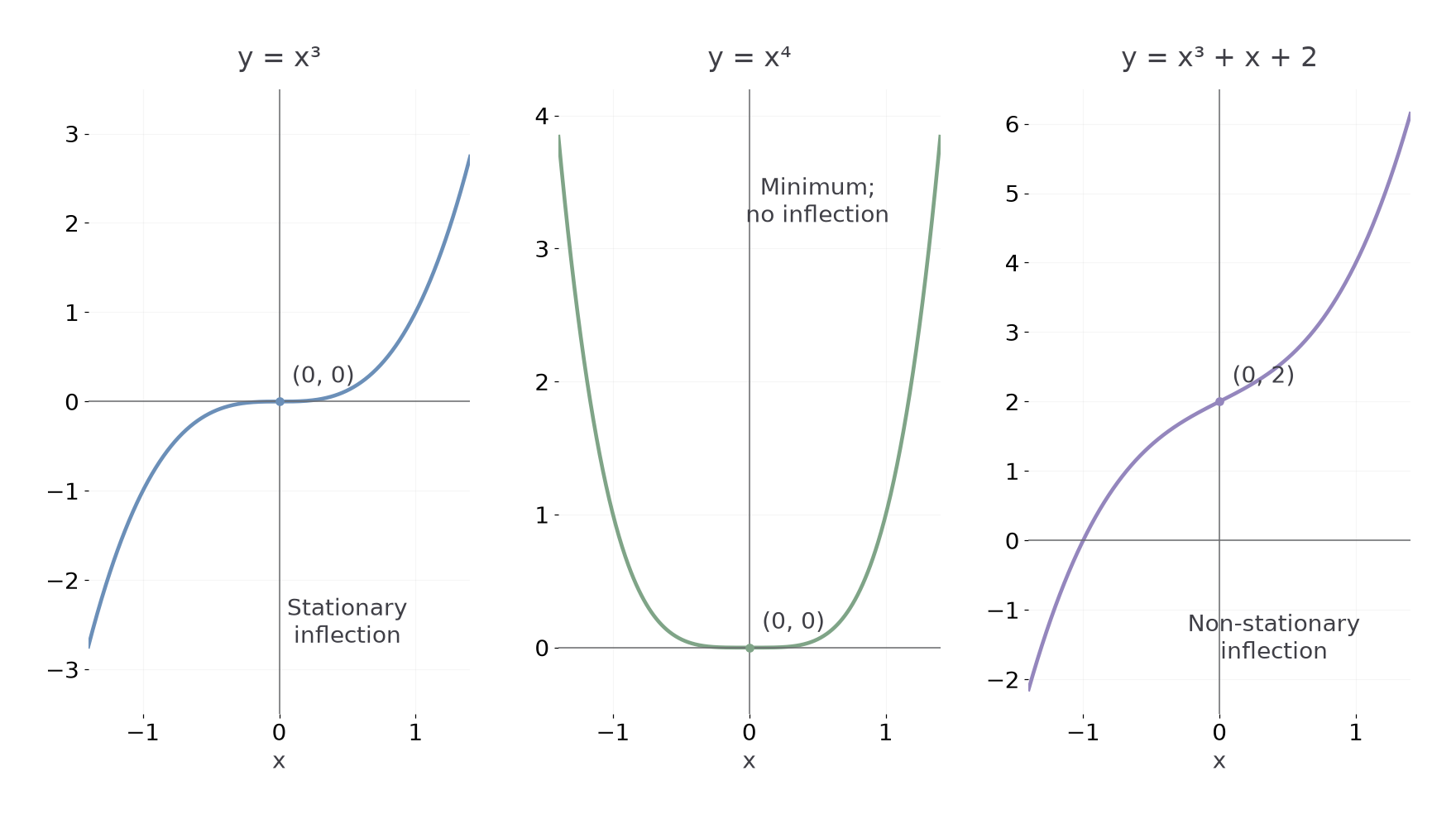
In particular, has on both sides of zero: its zero second derivative is not an inflection. The neighbouring signs, not equality alone, decide.
Worked example 3: a stationary inflection
Question. Find the inflection of , justify it and decide whether it is stationary.
Plan. Check curvature across the zero of , then evaluate the separate height and tangent gradient.
Why this step? The second derivative establishes a curvature change; the first derivative establishes whether the tangent is horizontal.
Answer. is a stationary inflection, from concave to convex.
Check. , , but is positive on both sides: no turning point.
Change only one feature by adding the linear term . It changes the tangent gradient without changing the second derivative.
Worked example 4: an inflection with a sloping tangent
Question. Find the inflection of , justify it and decide whether it is stationary.
Plan. Repeat the curvature test, then check the new first derivative at the candidate.
Why this step? Adding a linear term changes every slope by a constant, whose derivative is zero, so the curvature stays the same.
Answer. is a non-stationary inflection with tangent gradient .
Check. everywhere, so the curve keeps increasing through its change of curvature.
A striking consequence is that changing a curve's tilt by adding can turn a stationary inflection into a non-stationary one without moving its curvature change at all. The derivative calculation, rather than a special picture, explains it.
Watch out
Wrong: “There is no inflection because .” A nonzero first derivative excludes a stationary point, not an inflection. Right: changes sign, so there is a non-stationary inflection.
Change only the linear coefficient to ; the height and second derivative are unchanged.
Global extrema and boundaries
A local optimum compares nearby inputs; a global maximum or global minimum compares every allowed input. A stationary point can be locally smallest while an endpoint is globally largest.
Continue this lesson.
You’re previewing NovaLearn without an account. Create a free account to read the rest.
Create free account