RP10 - Animal responses in a choice chamber or maze
In this required practical you test how one environmental variable affects an animal's movement, using either a choice chamber or a maze. Chi-squared then shows whether the difference could be chance, and the evidence sets how much you can claim about behaviour.
Taxis, kinesis and what counts can show
A count shows where animals ended up, not how they got there, and that gap shapes this practical.
A valid question names the condition you change and a response you can measure: does humidity affect the proportion of woodlice in each equal-sized half after 10 minutes?
A choice chamber offers regions with different conditions and lets animals move between them. A maze records movement at a junction, such as entry into an illuminated or shaded arm. Neither proves conscious preference: simple responses alone can build up animals in one region.
Two simple responses
Both of these, from 3.6.1.1, can keep a mobile animal in a favourable environment.
- A taxis is movement in a direction relative to a stimulus. Consistent orientation away from a light source is negative phototaxis; towards it, positive phototaxis.
- A kinesis is a non-directional change in speed or turning rate with stimulus intensity. Slower movement in humid air can keep woodlice there for longer, which reduces water loss.
Counts record where, tracks record how
An endpoint count, taken at a fixed end time, records a distribution. Video tracks record movement. So an accumulation without tracks can't tell you which mechanism caused it. But if a question states directional movement away from light, name negative phototaxis; don't write kinesis just because a choice chamber was used.
Exam tip
Common wrong answers to AQA's 2025 question on directional shrimp movement were kinesis and phototropism, which is a plant growth response.
Match any advantage to the animal and be specific. Darkness may reduce a freshwater shrimp's exposure to visual predators; humidity reduces water loss from a woodlouse on land. The examiners' report called “to ensure survival” too general.
Choice chamber method for humidity
To test humidity you have to change the air and not the floor, and this design shows how.
Follow the diagram from the bottom up. Damp filter paper humidifies the air on one side, and a desiccant (a drying agent) such as silica gel dries it on the other.
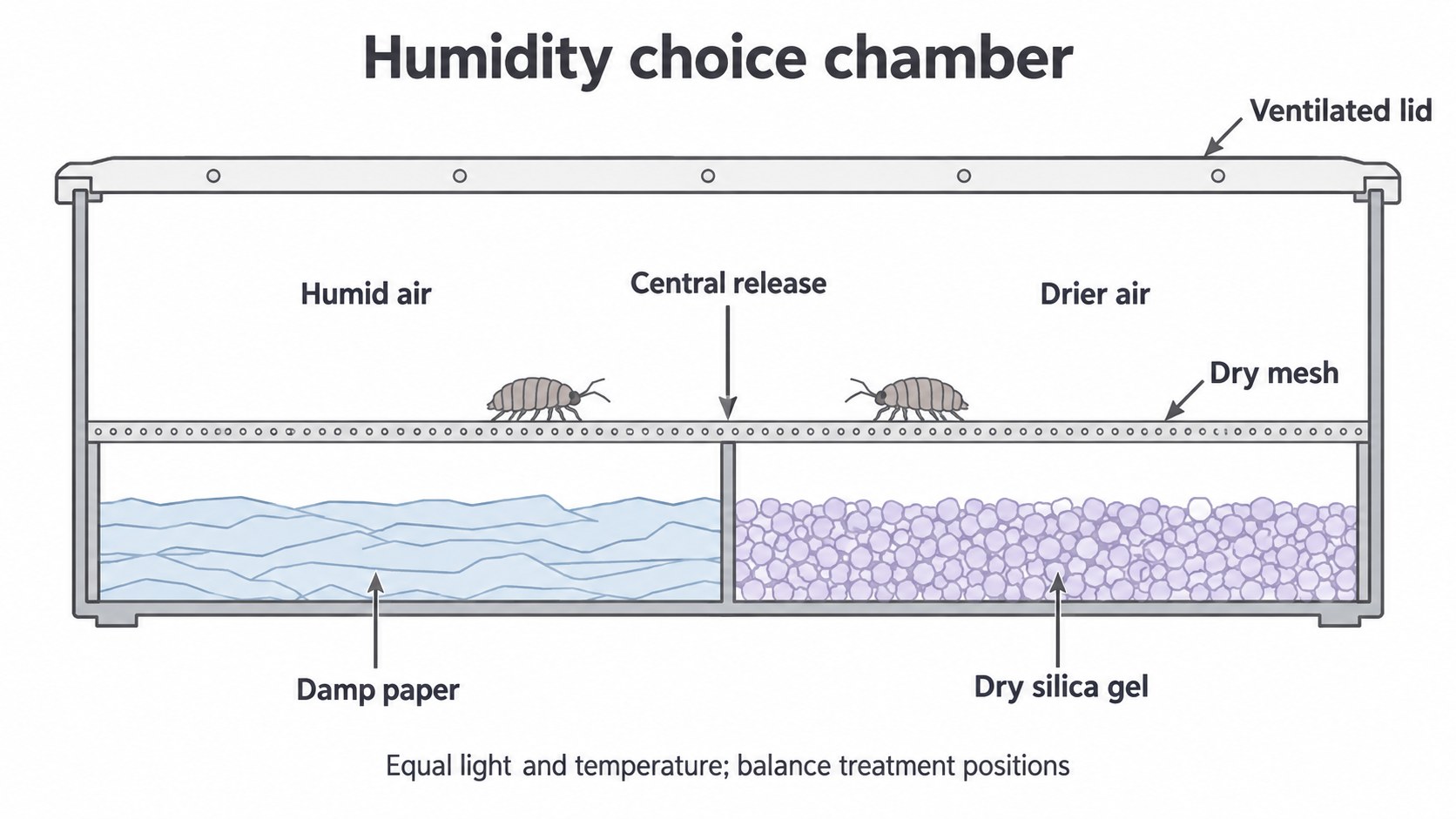
A dry mesh floor above both gives the same dry surface throughout and keeps the woodlice off the wet paper and desiccant, so surface wetness can't explain their movement. The lid is ventilated and the two areas are equal.
Running the trials
- Run equal-condition controls: animals in the chamber, same conditions on both sides. This reveals position bias, where animals favour one side whatever the conditions, for example because of a draught or a slight tilt.
- Stabilise the humidity contrast and check it on each side with a probe, because adding water doesn't guarantee one. Keep light and temperature equal.
- Acclimatise the animals for a set time, so handling stress doesn't dominate their behaviour.
- Release them at the centre, so neither region is closer.
- Count after a set time, treating central or motionless animals by a rule decided in advance.
- Swap the sides for a balanced number of trials. Animals that follow the treatment, not one physical side, make position bias less plausible.
- Repeat independently with fresh or rested animals, keeping species, approximate size, start point, duration and group size consistent.
One animal or a group
Testing one animal per trial gives independent results, as long as each animal is used once.
A group can behave more normally, and AQA's 2025 question tested one group of 30 shrimps, but aggregation (animals clustering, so one animal's position affects another's) can weaken the independence that the chi-squared test relies on. Counting the same group every minute doesn't create new samples.
Maze method for light
A maze turns movement into one clear result per animal: which arm did it enter?
Use a symmetrical T-junction with one arm shaded and one illuminated. The independent variable is the light condition, and the outcome is entry into either arm, not simply “movement”. A maze with no changed environmental condition tests turning behaviour, which misses this practical's aim.
Running a maze trial
- Fix the apparatus: the same safe low-heat illumination, arm dimensions and surface in every trial. Measure temperature in both arms, because warming one arm confounds light with temperature: the two change together, so their effects can't be separated.
- Acclimatise the animal, then place one individual at a consistent start point.
- Set rules in advance: define arm entry, such as the whole animal crossing a marked boundary, and a maximum time.
- Record every outcome: shaded entry, illuminated entry or no response. Selectively discarding non-responders would bias the result, so report their number.
- Clean and dry the maze between trials, removing chemical trails. A scented cleaner would add a new stimulus.
- Balance the sides, randomising the illuminated arm with left and right equal overall, so a habit of turning one way isn't mistaken for a response to light.
- Add equal-light trials to check for a built-in turning bias.
- Test different individuals, because repeated runs from one animal aren't independent.
What a consistent turn shows
A consistent turn towards shade after balancing the sides supports a directional response to light. Video gives stronger evidence of orientation than endpoint counts alone.
Variables, controls, and ethics
A controlled variable and an equal-condition control sound alike but do different jobs, so name the one you mean.
- Independent variable: the environmental condition you deliberately change.
- Dependent variable: the movement you measure, such as a count in each region after a fixed time, or mean speed from track length divided by time.
- Controlled variables: conditions you deliberately hold constant.
- Equal-condition control: a separate comparison with the same conditions on both sides, which detects apparatus or side bias.
“Keep everything constant” isn't enough: name each variable. For humidity, hold light, temperature and surface texture constant; for light, hold humidity and temperature constant. Use the same species and a defined size range, because species and life stages may respond differently.
Match conditions to the normal habitat: freshwater animals need suitable water and oxygen, not a dry mesh chamber. Water from their own stream keeps behaviour normal and holds oxygen and pH steady.
Exam tip
To explain why a feature makes a conclusion valid (a fair test of the named variable), give the feature and its reason. In AQA's 2025 shrimp question, a central release needed a reason such as “same distance to each segment”, and a 10-minute wait needed a reason such as time to acclimatise or distribute, not just time to move.
Continue this lesson.
You’re previewing NovaLearn without an account. Create a free account to read the rest.
Create free account