3.3.1 - Surface area to volume ratio
An amoeba takes in oxygen straight through its surface; you could not survive that way. Respiratory gases, nutrients, excretory products and heat all cross an organism's surface, and as size increases, volume outgrows that surface. This one relationship explains flattened bodies, lungs and blood systems, and why small mammals use more oxygen per gram than large ones.
Why volume outgrows surface area
Scale a body up to twice the length and its surface area grows fourfold, but its volume grows eightfold.
Materials cross an organism's surface, but they are used or produced by the cells that fill its volume. So the useful question is not how much surface there is, but how much surface each unit of volume gets.
Surface Area to Volume Ratio
The surface area to volume ratio (SA:V) is the relationship between the total external surface area of an object and its volume. Divide surface area by volume. Use consistent length units before calculating; the quotient has inverse-length units, although school questions often request its numerical value as a ratio to 1.
As an object gets bigger and keeps a similar shape, its volume increases faster than its surface area, so SA:V decreases. Surface area increases with the square of the linear dimensions, while volume increases with the cube.
This applies to a cell, an organ or a whole organism. Scaling up a cube shows the effect:
| Edge length / cm | Surface area / cm² | Volume / cm³ | SA:V ratio |
|---|---|---|---|
| 1 | 6 | 1 | 6.0 : 1 |
| 2 | 24 | 8 | 3.0 : 1 |
| 3 | 54 | 27 | 2.0 : 1 |
| 4 | 96 | 64 | 1.5 : 1 |
| 5 | 150 | 125 | 1.2 : 1 |
| 6 | 216 | 216 | 1.0 : 1 |
The graph plots the last column against edge length. Notice that the curve falls steeply at small sizes, then flattens.
[DIAGRAM: asset_name: 3.1 - Surface area to volume ratio - Diagram 1; asset_slug: 3.1 - Surface area to volume ratio - Diagram 1; recommended_method: retained_png; caption: Surface area divided by volume falls as cube edge length increases, all lengths in centimetres.; description: Surface area divided by volume falls as cube edge length increases; all lengths in centimetres.]
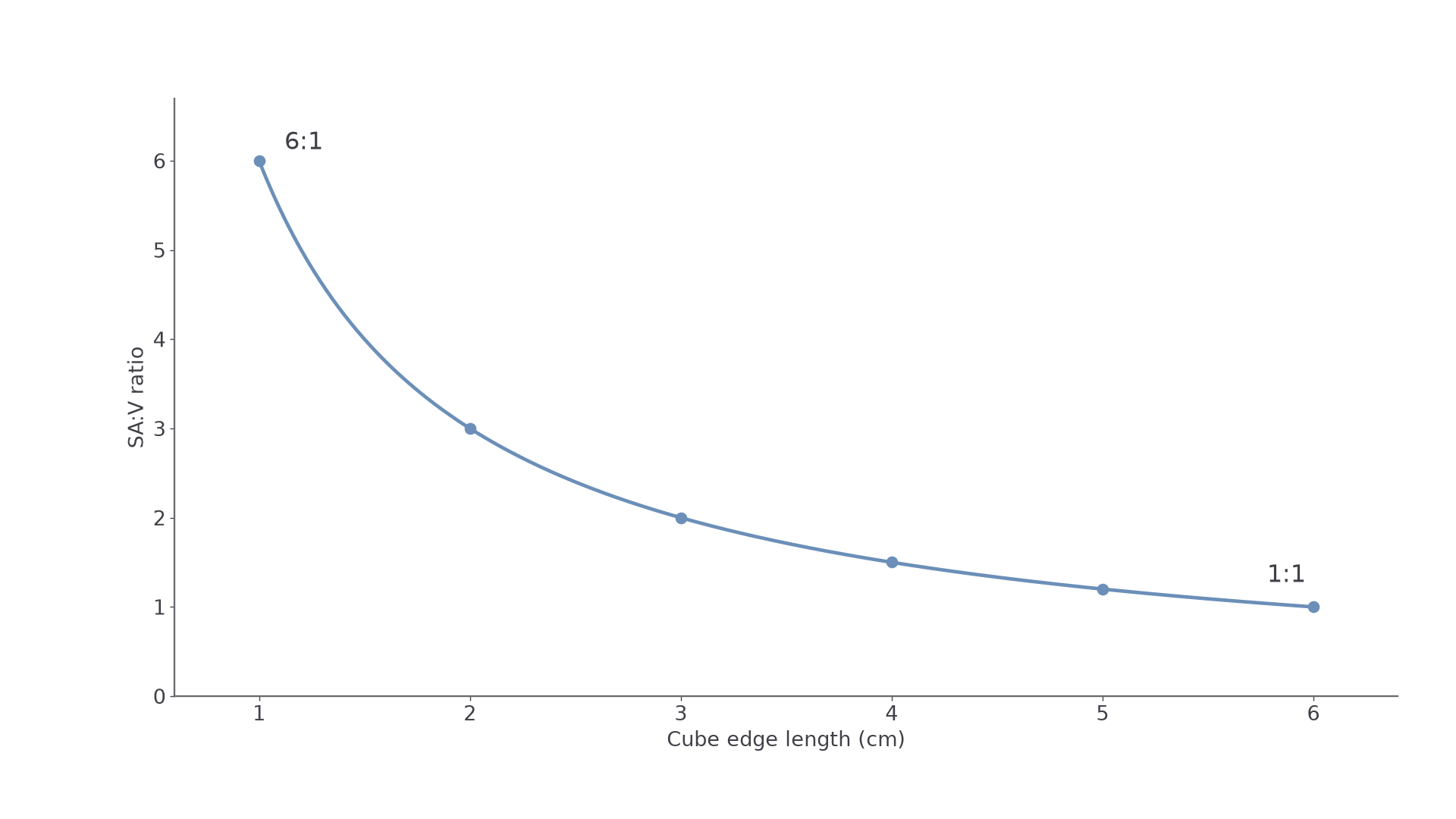
When the edge doubles from 1 cm to 2 cm, surface area is multiplied by 4 but volume by 8, so the SA:V ratio halves from 6:1 to 3:1. By the time the edge reaches 6 cm, the ratio has fallen to 1:1.
Watch out
Don't write that a small organism has a "larger surface area" when you mean a larger SA:V ratio. The 6 cm cube has far more surface than the 1 cm cube (216 cm² against 6 cm²). But each cm³ of the 6 cm cube has only 1 cm² of surface to serve it, while each cm³ of the 1 cm cube has 6 cm².
So as size increases, each unit of volume has less surface supplying it, and exchange across that surface is less able to meet the needs of the cells inside. To compare two sizes, calculate both ratios, then say what the change means for surface per unit volume.
Calculating surface area to volume ratios
You can find SA:V for any regular cell shape, once you treat the cell as a simple geometric model.
State the model: real cells are rarely perfect spheres or cylinders, and only surfaces exposed to the exchange medium contribute directly to exchange. In the formulas below, is the radius, half the diameter. They build on the circle, which has circumference and area .
| Shape | Surface area | Volume |
|---|---|---|
| Sphere | ||
| Closed cylinder of length | ||
| Rectangular prism |
Worked example: SA:V of a spherical cell
A spherical cell has a diameter of 10 μm. Calculate its SA:V, using .
Plan: halve the diameter, find surface area and volume separately, then divide.
- Radius μm
- Surface area μm²
- Volume μm³
- μm⁻¹
Answer: 0.60 μm⁻¹, conventionally written 0.60:1 when lengths are in micrometres.
Check: cancelling common factors gives for a sphere, and .
Because area and volume have different units, the value depends on the length unit: the same cell has mm⁻¹. So compare ratios only after using the same length unit.
Cylinders: remember the ends
Unroll the curved surface of a closed cylinder and you get a rectangle: its width is the circumference and its height is . Then add the two circular ends. For a model cell with radius 2 μm and length 10 μm:
- Circumference and end area: 12.56 μm and 12.56 μm²
- Curved area: 12.56 × 10 = 125.6 μm²
- Total surface area, adding both ends: 150.72 μm²
- Volume: 125.6 μm³, so μm⁻¹
Exclude the ends only if the question states that they do not exchange material.
Rectangular prisms: why shape matters
A block 4 × 2 × 1 mm has mm² and mm³, so mm⁻¹. A cube of the same volume has edge 2 mm and mm⁻¹.
So the flatter shape has an exchange advantage over a cube of equal volume: more exchange area per unit volume, and a shorter path to central cells. Keep extra digits during a calculation and round only the final answer, for example to two significant figures.
Exchange in small and large organisms
An amoeba has no lungs, gills or blood: diffusion across its surface supplies its oxygen.
Diffusion
Diffusion is the net movement of molecules or ions from a region of higher concentration to a region of lower concentration, down a concentration gradient. It is a passive process requiring no metabolic energy.
Small organisms such as Amoeba, other single-celled protists and bacteria have a SA:V ratio large enough for exchange by simple diffusion across the body surface. Every part of the cell is close to the cell-surface membrane, so the diffusion pathway is extremely short, and they need no specialised exchange surfaces or transport systems.
Larger, multicellular organisms have a lower SA:V ratio, which causes two linked problems:
- Insufficient surface area: the outer body surface cannot absorb or release materials fast enough to serve the much greater volume of metabolically active tissue.
- Increased diffusion distance: even if enough material crossed the surface, diffusion alone would take far too long to reach cells deep in the body.
Size is not the only factor: an elongated or flattened shape can keep the diffusion path short even in a relatively large organism. And large organisms still use diffusion at their exchange surfaces. What falls short is diffusion across the outer body surface alone.
| Small single-celled organism | Large multicellular organism | |
|---|---|---|
| SA:V ratio | Large | Small |
| Distance from surface to innermost parts | Very short | Long |
| Diffusion across the outer surface | Meets demand | Usually too slow |
| Exchange and transport | Cell-surface membrane only | Specialised surfaces and transport systems |
Cover the table, then explain the difference from memory.
Continue this lesson.
You’re previewing NovaLearn without an account. Create a free account to read the rest.
Create free account