RP09 - Respiration rate in single-celled organisms
You can't see yeast respire, but you can time a blue dye losing its colour as respiration reduces it. This required practical investigates how a named variable affects the respiration rate of cultures of single-celled organisms, with yeast and temperature as the worked case.
How methylene blue tracks respiration
Respiration is invisible in a test tube, so this practical tracks it with a dye that loses its colour.
Yeast is a single-celled fungus that can respire aerobically and anaerobically. Here it is mixed with glucose and methylene blue, a blue dye.
You already know
In glycolysis and the Krebs cycle, dehydrogenase enzymes remove hydrogen from respiratory substrates, and NAD accepts it to form reduced NAD.
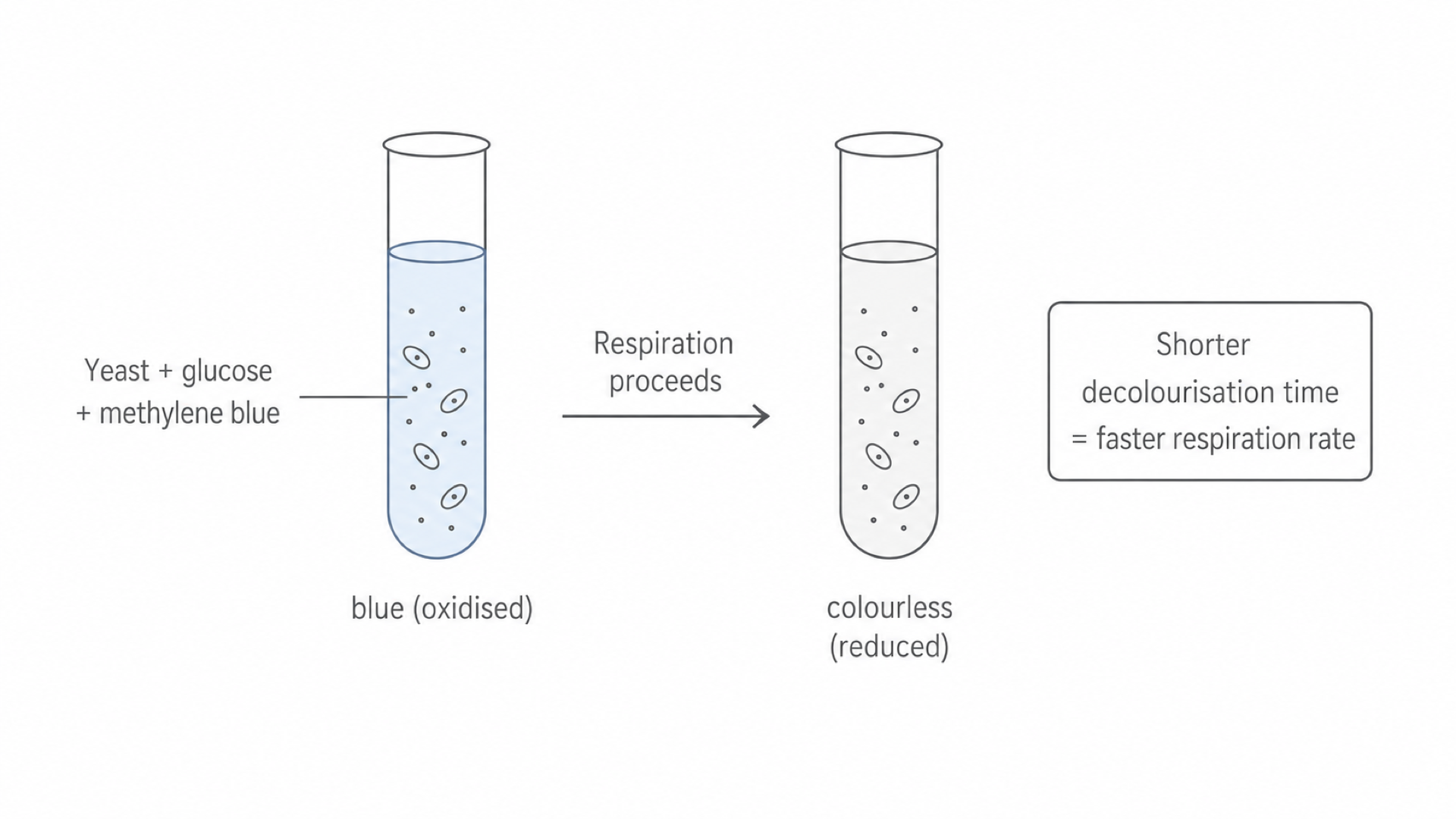
Methylene blue can also accept hydrogen from this pathway. Gaining hydrogen with its electrons reduces the dye, so it loses its blue colour. The faster the dehydrogenases work, the faster the blue disappears.
Redox indicator
A substance that changes colour when it is reduced or oxidised. In this practical, methylene blue is blue when oxidised and colourless when reduced.
Follow the diagram from left to right: respiration turns the mixture from blue to colourless, and the box gives the rule you will use.
[DIAGRAM: asset_name: RP 09 - Investigation into the effect of a named variable on the rate of respiration of cultures of single-celled organisms - Diagram 1; asset_slug: RP 09 - Investigation into the effect of a named variable on the rate of respiration of cultures of single-celled organisms - Diagram 1; recommended_method: retained_png; caption: Methylene blue loses its blue colour when reduced during the yeast assay, under matched conditions a shorter endpoint time indicates faster relative activity.; description: Methylene blue loses its blue colour when reduced during the yeast assay; under matched conditions a shorter endpoint time indicates faster relative activity.]
Why time can stand in for rate
The endpoint is the moment the blue colour disappears, and the time taken to reach it is the decolourisation time. With the same yeast concentration, dye amount, pH and oxygen exposure, faster reduction gives a shorter time.
This is an indirect, relative measure of respiratory activity, not a direct measurement of ATP or oxygen consumption.
The yeast suspension can remain cloudy when the dye becomes colourless, so look for loss of blue, not a clear liquid. Oxygen can reoxidise reduced methylene blue, so shaking or opening tubes differently can change the endpoint independently of respiration.
The named variable can be temperature, substrate concentration, pH or another suitable factor. AQA's example changes temperature, and so does this lesson.
Method and aseptic technique
Keep unwanted microbes out and treat every tube identically, so only your variable changes the time.
Aseptic technique with a yeast culture
Yeast in glucose solution is a liquid (broth) culture, so AQA's skill AT i applies.
Aseptic technique
Working in a way that reduces contamination of cultures, equipment, and the surrounding area by unwanted microorganisms.
In this practical, that means:
- washing hands and disinfecting the bench before and after work
- labelling tubes before adding the yeast mixture
- using sterile vessels and pipettes, with separate pipettes for the yeast mixture and methylene blue, and a pipette filler rather than mouth pipetting
- avoiding contact with the inside of test tubes or the ends of pipettes
- keeping tubes open for as short a time as possible
- dealing with spills as instructed, and sterilising or disposing of cultures by the approved procedure
These steps keep the culture as yeast and reduce the release of organisms to the surroundings.
Timing the dye at one temperature
AQA's method needs active yeast, which bubbles in the glucose solution, and dye dilute enough to decolourise within about 5 minutes at 35 °C.
- Set up a water bath at 35 °C, and monitor it with a thermometer because the temperature can drift.
- Label five replicate test tubes, so you can calculate a mean.
- Shake the yeast-glucose mixture. Yeast settles, so an unshaken mixture gives tubes different numbers of cells.
- Add 2 cm³ of the mixture to each tube, so the amounts of yeast and glucose stay constant.
- Stand the tubes in the bath until their contents equilibrate at 35 °C, so the yeast is at the test temperature before timing starts. Check a representative tube rather than assuming it matches the bath. Warm the methylene blue too, because 2 cm³ of cooler dye would lower the mixture's temperature.
- Add 2 cm³ of methylene blue to tube 1, starting the timer as you add it, so timing starts at the same point in each tube.
- Immediately shake the tube for 10 seconds and return it to the bath. Don't shake it again, because shaking adds oxygen, which reoxidises the dye.
- Record the time for the blue colour to disappear, working on one tube at a time so you can judge each endpoint.
- Repeat steps 6 to 8 for the other tubes.
- Repeat the whole procedure at other temperatures.
Hazards and how to reduce the risk
A good safety answer gives the precaution and the risk it reduces.
| Hazard | Risk | Precaution |
|---|---|---|
| Methylene blue | Splashes in the eyes or on skin | Wear eye protection and clean splashes promptly |
| Hot water | Scalds or burns | Take care with the water bath and hot glassware |
| Glassware | Cuts from breakages | Keep tubes away from the bench edge and report breakages |
| Yeast culture | Microorganisms transferred from hands | Use a teacher-approved strain, wash hands after handling, and don't culture unknown environmental samples |
| Gas from the culture | Pressure builds in a sealed container | Use an open-topped vessel, and don't seal cultures in a rigid airtight vessel |
Variables and controls
A fair test changes one variable, and a negative control shows that living yeast causes the colour change.
| Variable type | In the temperature investigation |
|---|---|
| Independent variable | Temperature of the water bath |
| Dependent variable | Time taken for methylene blue to become colourless |
| Controlled variables | Volume of yeast-glucose mixture, volume of methylene blue, concentration of solutions, pH, equilibration time, shaking time, and the same strain and freshness of yeast |
Time is what you measure directly; rate is calculated from it. Each controlled variable can change that time by itself: more dye takes longer to reduce, more yeast cells reduce it faster, and more shaking adds oxygen.
Making up the yeast-glucose mixture in a buffer solution rather than water keeps pH constant. Carbon dioxide released in respiration dissolves and lowers the pH, and a pH change would alter enzyme activity alongside the variable you are testing.
Boiled yeast as a negative control
Boil some yeast, cool it to the test temperature, then treat it in the same way as the living yeast. Boiling denatures its enzymes, so respiration should not occur and the methylene blue should stay blue.
That supports the conclusion that the colour change in the other tubes is due to metabolic activity in living yeast.
Exam tip
Give both halves of a control: what it is, with all other conditions the same, and what it shows. Each half earned a mark in a 2024 Paper 3 respirometer question.
Contamination as a hidden variable
Bacteria or other fungi in a tube may also respire, use glucose or reduce methylene blue, so the time no longer reflects the yeast culture alone. That lowers validity, which is how suitable the procedure is for answering the question asked. Aseptic technique controls this hidden variable.
Continue this lesson.
You’re previewing NovaLearn without an account. Create a free account to read the rest.
Create free account