3.1.8 - Inorganic ions
Inorganic ions occur in solution in the cytoplasm and body fluids of organisms, some in high concentrations and others in very low concentrations. In human blood plasma, sodium ions outnumber hydrogen ions by over three million to one. Each type of ion has a specific role, depending on its properties, such as its charge. You need four: hydrogen ions in pH, iron ions in haemoglobin, sodium ions in co-transport of glucose and amino acids, and phosphate ions in DNA and ATP.
Hydrogen ions and pH
Hydrogen ions occur at tiny concentrations, yet a small change can reduce enzyme activity.
pH
A measure of hydrogen ion concentration in a solution.
A high concentration means a low pH, and a low concentration means a high pH. The scale is logarithmic, so one pH unit is a tenfold change in concentration.
Why pH changes enzyme activity
The effect runs through the charges on amino acids:
- Hydrogen ions are positive, so they attach to or leave some amino acid side chains, changing their charge. In acid, for example, a negative side chain gains and loses its charge.
- Changed charges disrupt ionic bonds and hydrogen bonds.
- These bonds maintain tertiary structure, so the shape of the active site can change.
- The active site may no longer be complementary to its substrate, so fewer enzyme-substrate complexes form.
Cells and body fluids therefore need careful control of concentration.
Calculating pH
pH from hydrogen ion concentration
Use concentration in . The reverse is .
On a calculator, press log, enter the entire concentration, then change the sign. To compare solutions, divide their concentrations.
Worked example: finding pH and comparing solutions
Solution X has and solution Y has . Find the pH of X, and how many times greater its is than Y's.
Plan: substitute X into the formula, then divide X by Y.
Answer: pH 4.70 (no unit); X has 20 times the of Y.
Check: lies between and , so the pH must lie between 5 and 4.
The reverse formula compares pH values. A fall from pH 7 to pH 5 takes from to : a -fold increase, not a twofold one.
Iron ions in haemoglobin
Too little iron can leave a person tired, even with plenty of oxygen in the air.
The reason is that iron ions are components of haemoglobin, the protein that transports oxygen in red blood cells.
You met haemoglobin's four polypeptide chains in 3.1.4.1. Each contains a haem group with an ion at its centre. Each haem group can bind one oxygen molecule, so one haemoglobin molecule can carry four.
The key property is that oxygen binds to the iron ion reversibly, so it can attach and later detach:
- In the lungs, oxygen concentration is high, so oxygen loads onto haemoglobin.
- In respiring tissues, oxygen concentration is low, so oxygen is released.
With too little iron, less haemoglobin can be made, so less oxygen reaches tissues for aerobic respiration.
Sodium ions in co-transport
Your small intestine absorbs glucose even when its cells already hold more than the gut does.
A sodium ion gradient drives that uptake.
Co-transport
The linked movement of one substance down its concentration gradient with another substance, which can move against its concentration gradient, through the same membrane protein.
Sodium ions are charged, so they barely cross the hydrophobic centre of cell membranes (3.1.3) and pass through proteins instead. A cell can therefore maintain a sodium ion gradient, and a protein can link sodium movement to another substance.
This happens in the ileum, the last section of the small intestine, which is lined by epithelial cells. The space inside the gut is the lumen. In the diagram, start at the pump, cross to the co-transporter, then finish at the carrier at bottom right.
[DIAGRAM: asset_name: 1.8 - Inorganic ions - Diagram 1; asset_slug: 1.8 - Inorganic ions - Diagram 1; recommended_method: retained_png; caption: An epithelial cell from the ileum showing sodium ions actively transported out of the cell on one side, and sodium ions returning through a co-transporter with glucose on the side facing the gut lumen.; description: An epithelial cell from the ileum showing sodium ions actively transported out of the cell on one side, and sodium ions returning through a co-transporter with glucose on the side facing the gut lumen.]
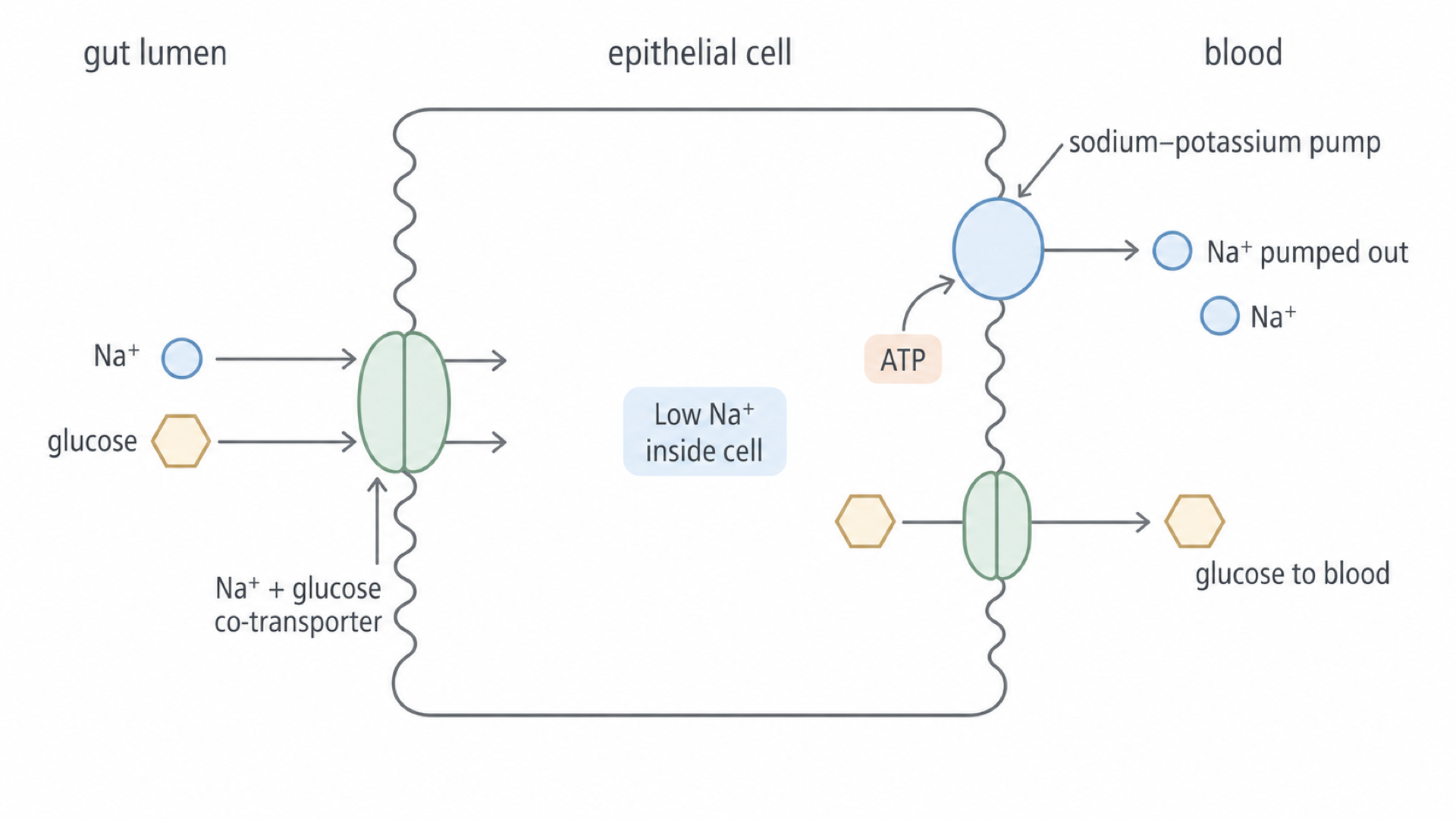
- The sodium–potassium pump in the blood-facing membrane uses ATP to move sodium ions out of the cell and potassium ions in (not shown). This is active transport: movement against concentration gradients, using ATP.
- So the sodium ion concentration stays lower inside the cell than in the gut lumen.
- Sodium ions therefore move back in down their concentration gradient, through a co-transport protein in the lumen-facing membrane.
- Glucose moves through the same protein, even against its own gradient. The sodium ion gradient provides the energy.
- Glucose is now more concentrated in the cell than in the blood, so it leaves through a separate carrier by facilitated diffusion: movement down a gradient through a transport protein, with no ATP used. You study this in 3.2.3.
Watch out
Don't write that sodium ions are actively transported in from the lumen, or that the co-transporter uses ATP. ATP is used only at the pump, which moves sodium ions out, so glucose uptake depends indirectly on ATP.
Amino acids are absorbed the same way, through their own sodium-dependent co-transport proteins rather than the glucose co-transporter.
A full answer gives the first four steps in order.
Phosphate ions in DNA and ATP
Phosphate ions are components of two very different molecules: DNA and ATP.
Free in solution, the ion is inorganic phosphate, . Bonded into a molecule, it is a phosphate group.
In DNA, each nucleotide contains a phosphate group. These link nucleotides by phosphodiester bonds, creating the sugar-phosphate backbone of each strand (3.1.5.1). The phosphate stays in place, so its role is structural.
ATP contains three phosphate groups. When it is hydrolysed to ADP and inorganic phosphate, energy is released for cellular processes. The released phosphate can also be transferred to other molecules (phosphorylation), often making them more reactive. ADP and then rejoin to form ATP, so here phosphate is removed and added back repeatedly.
Quick Recap
| Ion | Property that matters | Role |
|---|---|---|
| Positive charge, so it changes the charges on side chains | Determines pH, which affects protein shape and enzyme activity | |
| Binds oxygen reversibly | Component of haemoglobin; oxygen transport | |
| Charged, so it barely crosses the bilayer and a gradient can be held | Its gradient drives co-transport of glucose and amino acids | |
| Phosphate in DNA | Stays bonded between sugars | Links nucleotides into the sugar-phosphate backbone |
| Phosphate in ATP | Removed by hydrolysis and added back | Energy transfer; phosphorylation of other molecules |
Cover the table, then give each ion's role and the property behind it from memory.