3.1.7 - Water
Most of a cell's mass is water. Its dipole and the hydrogen bonds between its molecules explain why water can act as a solvent, a temperature buffer and a coolant, and why it holds together in plants and at water-air surfaces.
Why water has unusual properties
A water molecule is lighter than an oxygen molecule, yet at body temperature oxygen is a gas and water is a liquid.
Water molecules must attract each other, and this explains the properties of the main component of cells, 70% or more of their mass.
One oxygen atom is covalently bonded to two hydrogen atoms, and oxygen attracts the shared electrons more strongly than hydrogen. So the oxygen end has a slight negative charge () and the hydrogen ends have slight positive charges (). Water is therefore dipolar.
These are partial charges, not full ionic charges: each molecule is neutral overall. Opposite charges still attract, so a slightly positive hydrogen atom of one molecule is attracted to the slightly negative oxygen atom of another. This weak attraction is a hydrogen bond.
Hydrogen bond
In water, a hydrogen bond is a weak attraction between the slight positive charge on a hydrogen atom of one water molecule and the slight negative charge on the oxygen atom of another water molecule.
In the diagram, solid lines are covalent bonds within a molecule; the dotted line is a hydrogen bond between molecules.
[DIAGRAM: asset_name: water-hydrogen-bonds; asset_slug: water-hydrogen-bonds; recommended_method: retained_png; caption: Two water molecules with a hydrogen bond from a partially positive hydrogen to a partially negative oxygen on the other molecule.; description: Two water molecules with a hydrogen bond from a partially positive hydrogen to a partially negative oxygen on the other molecule.]
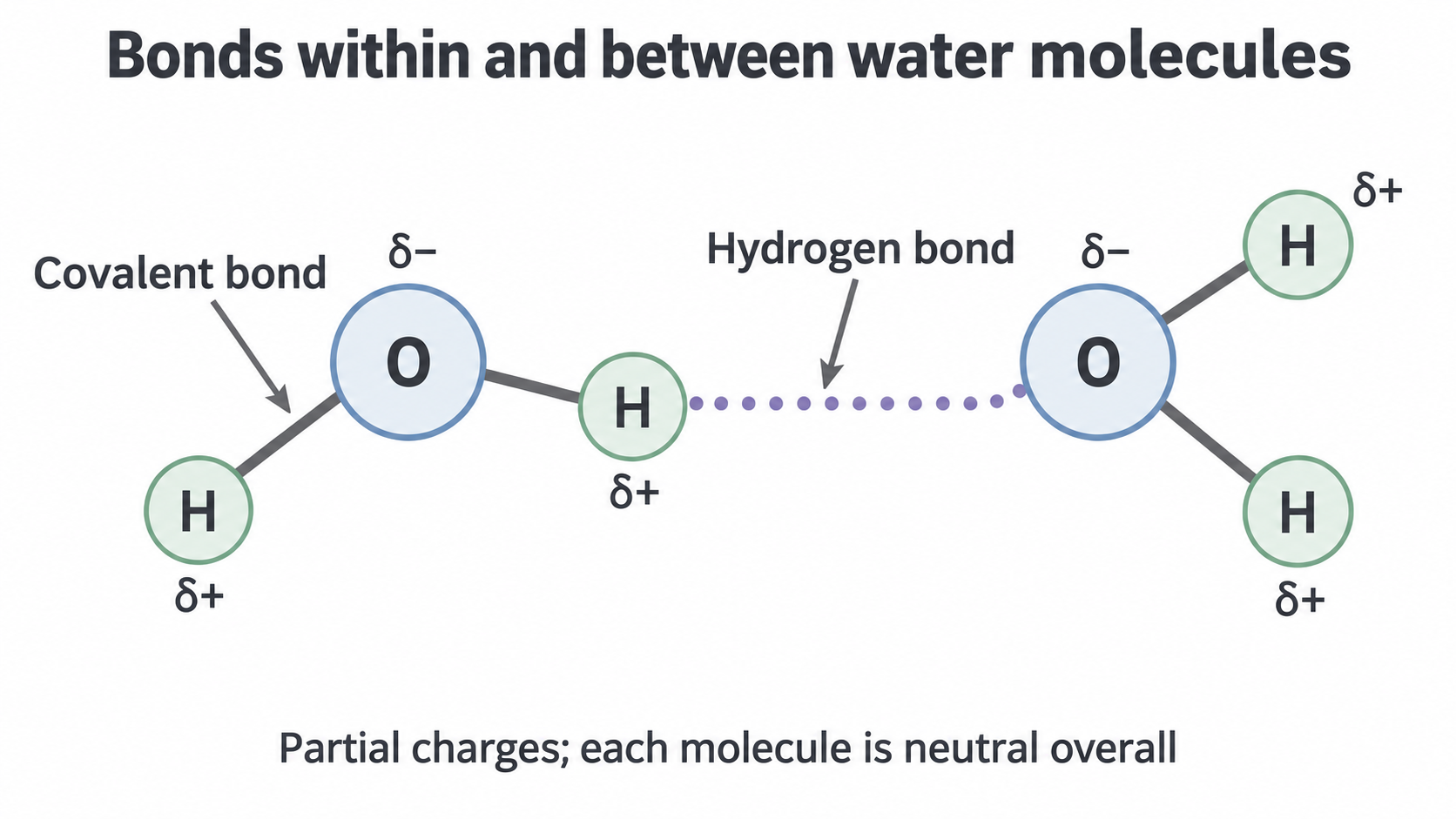
Each hydrogen bond is weak, but huge numbers form and re-form continuously in liquid water, and together they explain its thermal properties and cohesion.
Water as a metabolite
Digesting a protein uses up water.
Breaking each peptide bond takes one water molecule, and that water's atoms end up in the products.
A substance that takes part directly in a metabolic reaction, as a reactant or product, is a metabolite. Water is a metabolite in many reactions, including the two you met in 3.1.1:
- Hydrolysis adds water to break a covalent bond. Hydrolysis of one maltose molecule uses one water molecule and produces two glucose molecules.
- Condensation forms a covalent bond between smaller molecules and releases a molecule of water. It builds polysaccharides, polypeptides and polynucleotides, and it forms the ester bonds in triglycerides.
Water's role as a solvent is different: there it is the medium in which other molecules react. Both roles can occur at once: a hydrolysis reaction uses water from the liquid its reactants are dissolved in.
Water as a solvent
Stir salt into water and it disappears; pour in oil and the two stay separate.
Water's partial charges attract ions and polar molecules, but barely attract non-polar ones.
Water molecules surround each dissolved particle:
- Around a positive ion such as sodium, the partially negative oxygen ends orient towards it.
- Around a negative ion such as chloride, the partially positive hydrogen ends orient towards it.
- Polar molecules such as glucose, amino acids and urea form hydrogen bonds with water.
This hydration separates and disperses the particles, so they dissolve.
Why dissolving matters
Many metabolic reactions happen in aqueous solution inside cells, because dissolved enzymes and substrates can move, collide and react. Water also transports dissolved substances in blood, tissue fluid and plant sap.
Water is not a universal solvent. Non-polar lipids have limited solubility, and oxygen dissolves only in small amounts, which helps explain the need for haemoglobin in larger animals.
High specific heat capacity
Water takes far more energy to warm up than ethanol does.
It takes about 4.2 kJ to warm 1 kg of water by 1 °C, but only about 2.4 kJ for 1 kg of ethanol. So water buffers temperature changes.
Specific heat capacity
The amount of energy needed to raise the temperature of 1 kg of a substance by 1 °C.
Water's relatively high specific heat capacity comes from hydrogen bonds. Temperature reflects the kinetic energy of molecules. When water is heated, some energy disrupts hydrogen bonds rather than raising kinetic energy, so the temperature rises less. When water cools, hydrogen bonds re-form and release energy, so the temperature falls less.
A given energy gain or loss therefore produces a relatively small temperature change:
- Much of an organism's mass is water, so it is protected from sudden internal temperature changes. This helps enzymes operate within a suitable range.
- Aquatic habitats heat and cool slowly, so their temperatures stay relatively stable.
Large latent heat of vaporisation
Evaporating just one gram of sweat carries away a lot of heat.
It removes about 2.4 kJ of heat, enough to cool more than 500 g of water by 1 °C.
Latent heat of vaporisation
The energy needed per unit mass to change a liquid into a gas without changing its temperature.
Water has a relatively large latent heat of vaporisation because hydrogen bonds must be broken before molecules can escape from the liquid. Evaporation breaks the hydrogen bonds between water molecules, not the covalent O–H bonds within them, so water leaves as intact molecules, not as hydrogen and oxygen gases. Evaporation cools in three steps:
- The molecules with the most kinetic energy leave the surface, taking heat energy with them.
- The molecules left behind have less kinetic energy on average, so the remaining water is cooler.
- This cooler water takes in heat from the skin and the blood near it, which lowers body temperature.
Because a large amount of energy is lost per gram of water evaporated, cooling happens with relatively little water loss. Evaporation inside leaves cools them in the same way.
Watch out
Don't write that sweat cools you because of water's high specific heat capacity. Evaporative cooling comes from the change from liquid to gas, so write latent heat of vaporisation.
A full answer names the property, the source of the heat and the effect on body temperature.
Cohesion and surface tension
A redwood lifts water to its top leaves with no pump, and a pond skater stands on a pond.
In the tallest redwoods, water climbs more than 100 m through the xylem. Both depend on hydrogen bonds attracting water molecules to each other.
Cohesion
The attraction between molecules of the same substance.
Each hydrogen bond is weak, but so many form that cohesion in water is strong. Adhesion is attraction between water and a different material, such as a vessel wall.
Water columns in xylem
Xylem vessels are narrow, tube-like transport cells that carry water up a plant. Cohesion supports the column of water inside them:
- During transpiration, water evaporates from the leaves.
- Hydrogen bonds pull the next molecules up behind those that leave.
- This pull is transmitted down the column, which stays continuous under tension because the molecules cohere.
Cohesion only transmits the pull from transpiration: it is not a pump or an energy source.
Surface tension
A molecule inside the water is attracted equally in all directions. A molecule where water meets air has no water molecules above it, so its attractions are unbalanced and the molecules below and beside it pull it inwards.
The surface therefore behaves like a stretched skin, and this surface tension supports small organisms such as pond skaters. It is a property of the water-air boundary, not a separate solid membrane.