3.1.6 - ATP
A pump moving ions and a muscle contracting both run on energy from one small molecule. ATP's structure explains how it passes on that energy, and why a cell must keep remaking it.
Structure of ATP
An RNA nucleotide containing adenine, which you met in 3.1.5.1, has ribose, adenine and one phosphate group.
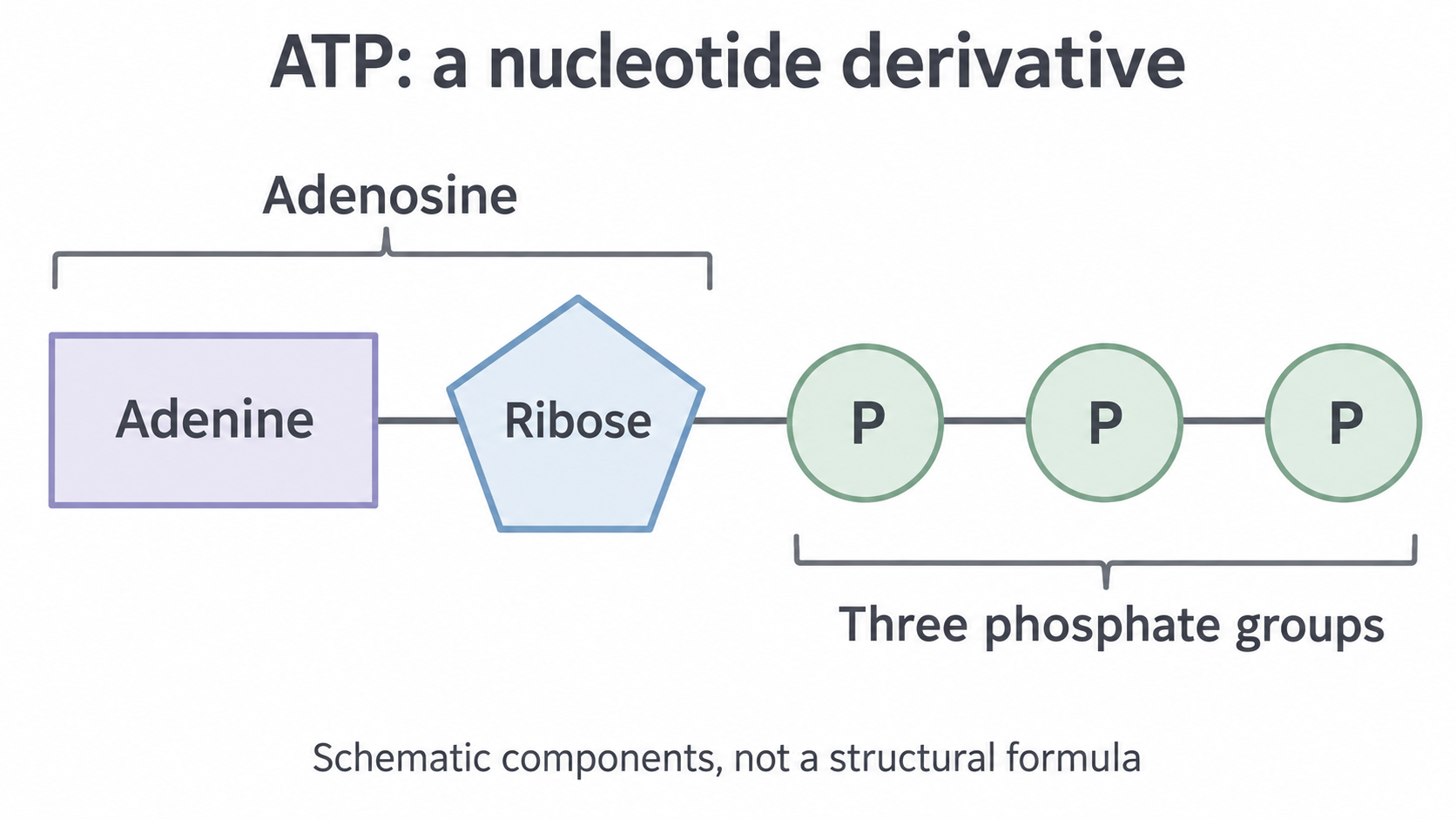
Give it two more phosphate groups and you have adenosine triphosphate (ATP): one molecule of the nitrogen-containing base adenine, one of the five-carbon sugar ribose and three phosphate groups.
ATP is therefore a nucleotide derivative, built like a nucleotide with a pentose sugar, a base and phosphate, but with three phosphate groups instead of one.
In the diagram, the bracket shows that adenine joined to ribose is called adenosine. The sugar is always ribose, never deoxyribose, and the base is always adenine.
[DIAGRAM: asset_name: atp-components; asset_slug: atp-components; recommended_method: local_png; caption: ATP contains adenine, ribose and three phosphate groups. The shapes identify components and connections, this is not an atom-by-atom structural formula.; description: ATP contains adenine, ribose and three phosphate groups. The shapes identify components and connections; this is not an atom-by-atom structural formula.]
Exam tip
For the components of ATP, write “ribose, adenine and three phosphates” or “adenosine and three phosphates”. “Pentose sugar” alone can lose the mark, so name ribose. “Adenine and three phosphates” misses the ribose, and “adenosine, ribose and three phosphates” counts ribose twice, so both can lose marks.
Removing the end phosphate by hydrolysis gives adenosine diphosphate (ADP), which keeps the adenine, the ribose and two phosphate groups. The phosphate lost becomes inorganic phosphate, written .
Hydrolysis of ATP
Cells release energy from ATP by hydrolysis, with water as a reactant.
ATP hydrolase, also called an ATPase, catalyses the reaction, converting ATP to ADP and inorganic phosphate.
The overall reaction releases energy that can be transferred to a cell process. Breaking a bond alone requires energy, so the release comes from the whole reaction: forming the products releases more energy than the bond breaking takes in.
Watch out
A common exam error is writing that ATP hydrolysis or respiration “produces” energy. Energy cannot be created, so “make”, “create” and “produce” can lose marks here. Write that ATP hydrolysis releases energy, and that respiration releases energy and produces ATP.
Why ATP suits immediate energy transfer
Three features make ATP useful for immediate energy transfer:
- Speed: hydrolysis is a single reaction, so energy is available rapidly, whereas releasing the energy in glucose takes many steps.
- Location: ATP is hydrolysed at the site where a cell process needs energy.
- Quantity: each hydrolysis releases a small, manageable amount, so less energy is lost as heat than if a large amount were released at once.
ATP is a link between processes, not a store. A cell holds only a limited supply and continually recycles it, so if demand exceeds resynthesis, available ATP falls. Glycogen and lipids are the longer-term stores, and their breakdown supplies energy for ATP resynthesis.
Coupling and phosphorylation
An energy-requiring reaction does not proceed just because ATP happens to be nearby.
Coupling links ATP hydrolysis to that reaction through an enzyme or a shared sequence of chemical changes, so the energy released by hydrolysis supplies the energy the reaction takes in.
An ATP-driven membrane pump shows this. It moves ions against their concentration gradient, which requires energy:
- Ions bind to the pump protein, which hydrolyses ATP.
- The energy released changes the protein's conformation (shape).
- The shape change carries the ions across the membrane.
This is active transport, covered in 3.2.3. Muscle proteins also use ATP in the cycles responsible for contraction.
Phosphorylation and reactivity
Hydrolysis also releases inorganic phosphate, which can phosphorylate other compounds. Phosphorylation means adding a phosphate group to a compound. The compound gains energy and becomes less stable, so it is often more reactive.
Early in respiration, for example, phosphorylating glucose makes it reactive enough to be split in the next steps. The effect varies, though: not every phosphorylated compound becomes more reactive.
Keep the two apart in an answer: energy is coupled to a reaction; phosphate is added to a compound. Name what receives it and say what changes.
Resynthesis of ATP
You turn over about your own body mass of ATP every day.
Yet you never hold that much at once, because the same molecules are hydrolysed and remade again and again.
ATP resynthesis joins ADP and inorganic phosphate by condensation, releasing water. Hydrolysis releases energy, so this reverse reaction requires an energy input.
Watch out
Don’t swap these reactions by writing that hydrolysis produces water and condensation uses it. It is the other way round: hydrolysis uses water to split ATP, and condensation releases water as ADP and join.
ATP synthase catalyses ATP resynthesis during respiration and during photosynthesis. In respiration, the energy ultimately comes from the oxidation of organic molecules; in photosynthesis, it comes from light.
ADP and phosphate are reused, but energy takes a different route: it enters during synthesis, passes to cell processes during hydrolysis, and some is dissipated as heat.
In an exam, name the reaction type as well as the enzyme: write “hydrolysis”, not just “ATP hydrolase”.
| Hydrolysis of ATP | Resynthesis of ATP | |
|---|---|---|
| Change | ATP to ADP and | ADP and to ATP |
| Reaction type | Hydrolysis | Condensation |
| Water | Used | Released |
| Enzyme | ATP hydrolase | ATP synthase |
| Energy | Released for cell processes | Required, from respiration or photosynthesis |
Cover the table, then rebuild each row from memory.