3.2.4 - Cell recognition and immune responses
Your immune system identifies cells and invaders by their surface molecules. Follow how phagocytes, T cells and B cells respond, and how antibodies and memory cells protect you.
Antigens and antigen variability
Measles usually strikes once, yet flu can return year after year, and surface molecules explain the difference.
Each type of cell has specific molecules on its surface that identify it. These molecules include proteins, and they act as antigens.
Antigen
An antigen is a molecule recognised specifically by antibodies or lymphocyte receptors and capable of stimulating an immune response.
Antigens let your immune system identify:
- pathogens, which carry foreign proteins
- cells from other organisms of the same species, such as transplanted cells
- abnormal body cells, which carry altered molecules
- toxins, where the toxin itself is the antigen, not a living cell
An antibody is different: it is a protein made as part of the response.
Lymphocytes are white blood cells, each carrying receptors for one specific antigen. During their development, many that react strongly against self molecules are destroyed or inactivated, so most normal body cells are tolerated as self.
How antigen variability affects disease and vaccines
Antigenic variability occurs when the antigens of a pathogen differ between strains or change following mutation. Protection from earlier infection or vaccination relies on antibodies and long-lived memory cells complementary to the original antigen:
- A mutation can change the amino acid sequence of a surface protein, altering its tertiary structure.
- Antibodies and memory-cell receptors are now less complementary to the antigen, so they bind poorly.
- Fewer pathogens are bound, so more survive and reproduce.
Watch out
A pathogen does not change its antigens deliberately to escape immunity. Mutations arise by chance, and variants that evade recognition can spread.
So a previous infection or vaccination may protect less. Mutations keep altering flu's surface proteins, so people can catch flu repeatedly and vaccine composition is reviewed yearly. Measles virus has one antigenic type, so memory cells stay complementary and immunity usually lasts.
Phagocytosis
Phagocytes destroy pathogens quickly, then show pieces of them to the cells that start the specific response.
Phagocytes provide a rapid defence by engulfing pathogens. Their response is non-specific: it does not depend on first selecting a lymphocyte matched to one antigen. Follow the six stages from left to right.
[DIAGRAM: asset_name: 2.4 - Cell recognition and the immune system - Diagram 1; asset_slug: 2.4 - Cell recognition and the immune system - Diagram 1; recommended_method: retained_png; caption: Phagocytosis from attachment through engulfment, lysosome fusion, digestion and antigen presentation.; description: Phagocytosis from attachment through engulfment, lysosome fusion, digestion and antigen presentation.]
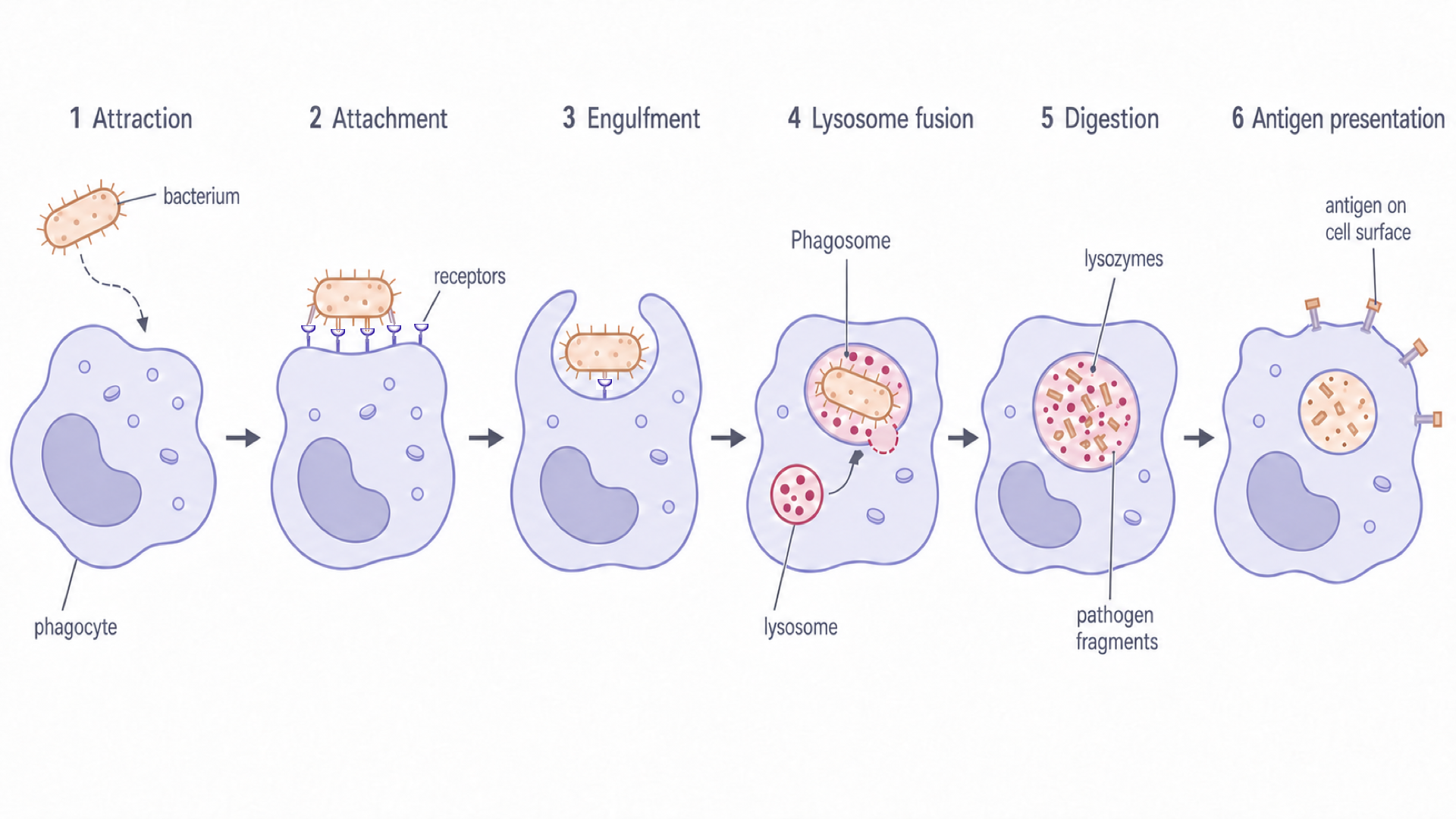
- Attraction. Chemicals from pathogens or damaged tissue attract a phagocyte. Movement towards a chemical source is chemotaxis.
- Attachment. Receptors bind molecules on the pathogen surface. Antibodies already attached to a bacterium can make this easier.
- Engulfment. The cell-surface membrane surrounds the pathogen, still closing at stage 3, then encloses it in a vesicle, the phagosome.
- Lysosome fusion. Lysosomes fuse with the phagosome and release digestive enzymes, including lysozyme, into it.
- Digestion. Lysozyme hydrolyses murein in bacterial cell walls; other hydrolytic enzymes digest other pathogen molecules. A lysosome is an organelle, whereas lysozyme is an enzyme.
- Antigen presentation. Soluble products can enter the cytoplasm. Some antigen fragments are displayed on the surface, making the phagocyte an antigen-presenting cell.
Helper T cells can recognise those fragments, which links this defence to the specific response.
T lymphocytes and cell-mediated immunity
A helper T cell that recognises a presented antigen can set off B cells, cytotoxic T cells and phagocytes.
T lymphocytes mature in the thymus. They recognise antigens presented on body-cell surfaces, rather than free antigen. This is the cellular response, or cell-mediated immunity.
How a helper T cell is selected and cloned
Follow the arrows from the left to the clone. You need not name the MHC molecule.
[DIAGRAM: asset_name: helper-t-cell-response; asset_slug: helper-t-cell-response; recommended_method: retained_png; caption: Antigen presentation selects a complementary helper T cell, mitosis expands the clone, helper T cells stimulate B cells, cytotoxic T cells and phagocytes.; description: Antigen presentation selects a complementary helper T cell; mitosis expands the clone; helper T cells stimulate B cells, cytotoxic T cells and phagocytes.]
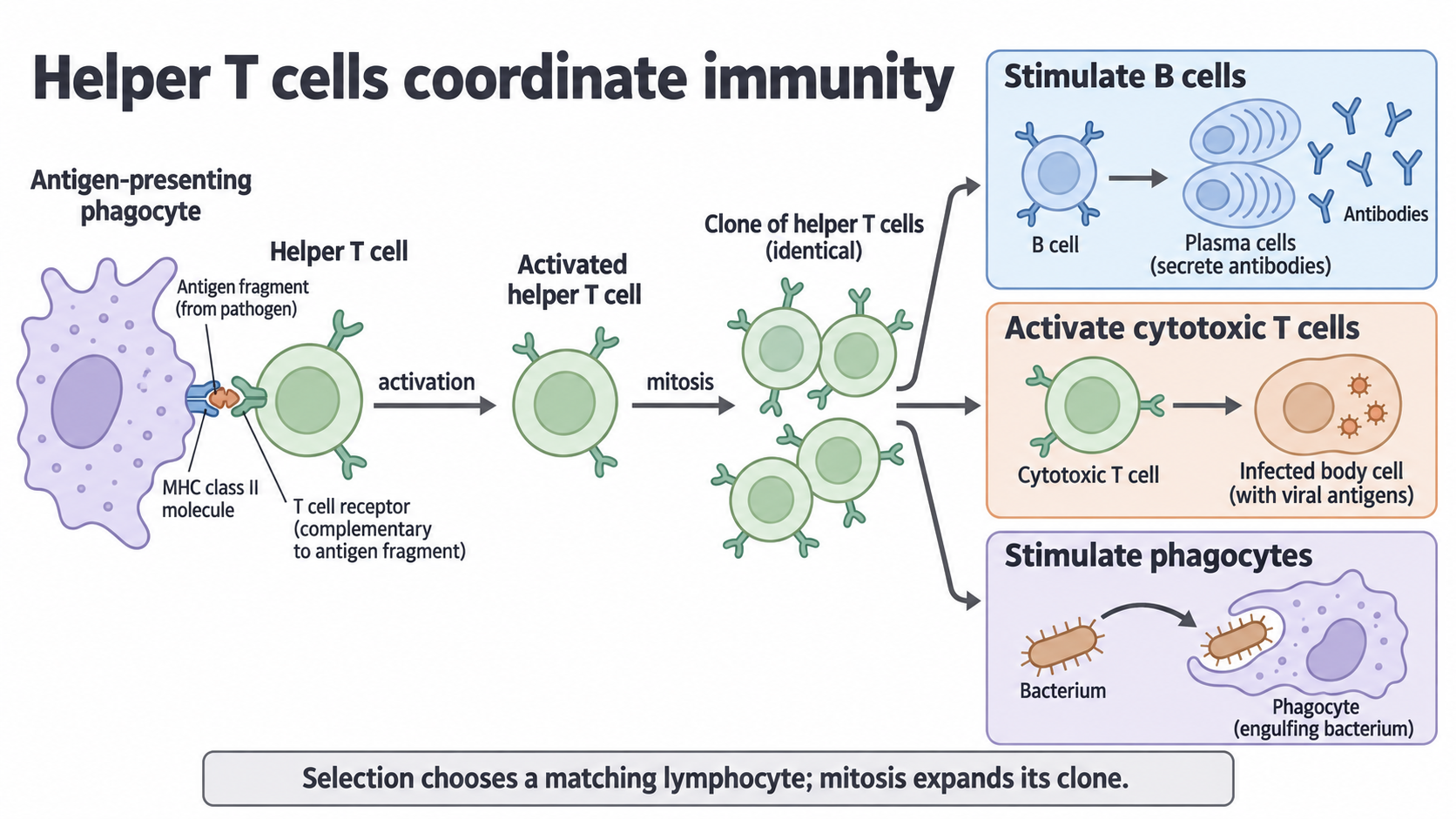
- An antigen-presenting phagocyte displays fragments from a digested pathogen.
- A helper T cell whose receptor is complementary to the presented antigen binds and becomes activated. Selecting the matching cell is clonal selection.
- The activated cell divides repeatedly by mitosis, forming a clone. This is clonal expansion, a separate stage from selection.
What helper T cells stimulate
Activated helper T cells ( cells) coordinate the response through the diagram's three branches, stimulating:
- B cells, which divide and develop into antibody-secreting plasma cells.
- Cytotoxic T cells ( cells), which recognise and kill infected or abnormal body cells, limiting the production of new viruses.
- Phagocytes, increasing pathogen engulfment and destruction.
Infected cells display viral antigens, which cytotoxic T cells recognise.
Continue this lesson.
You’re previewing NovaLearn without an account. Create a free account to read the rest.
Create free account