3.1.1 - Monomers and polymers
Learn how shared molecular units join into polymers, and how condensation and hydrolysis make and break the bonds between them.
Shared biochemical building blocks
Human insulin for medicine has been made in E. coli bacteria since 1982.
That works because bacteria and humans use the same amino acids and the same genetic code.
The variety of life, both past and present, is extensive, but its biochemical basis (the molecules and reactions that cells depend on) is similar for all living things. Bacteria, oak trees and humans share the same main types of molecular building block.
Monomer and polymer
A monomer is a smaller molecular unit from which larger molecules can be made. A polymer contains a large number of monomers joined by covalent bonds. It is one large molecule, not a mixture.
Polymers can be unbranched or branched. Three types of monomer are important in biology.
| Monomer | Polymer | Biological example |
|---|---|---|
| Monosaccharide | Polysaccharide | Glucose units in starch |
| Amino acid | Polypeptide | A chain that folds to form a protein |
| Nucleotide | Polynucleotide | A strand of DNA or RNA |
Size alone does not make a polymer. A triglyceride contains one glycerol and three fatty acids, not a long chain of monomers. Two joined sugar units make a disaccharide, not a polysaccharide.
Read each row of the diagram left to right: one monomer, then a chain. The symbols are schematic, and each chain repeats one symbol for simplicity.
[DIAGRAM: asset_name: 1.1 - Monomers and polymers - Diagram 1; asset_slug: 1.1 - Monomers and polymers - Diagram 1; recommended_method: retained_png; caption: Three types of monomer and the corresponding polymers, represented by schematic units.; description: Three types of monomer and the corresponding polymers, represented by schematic units.]
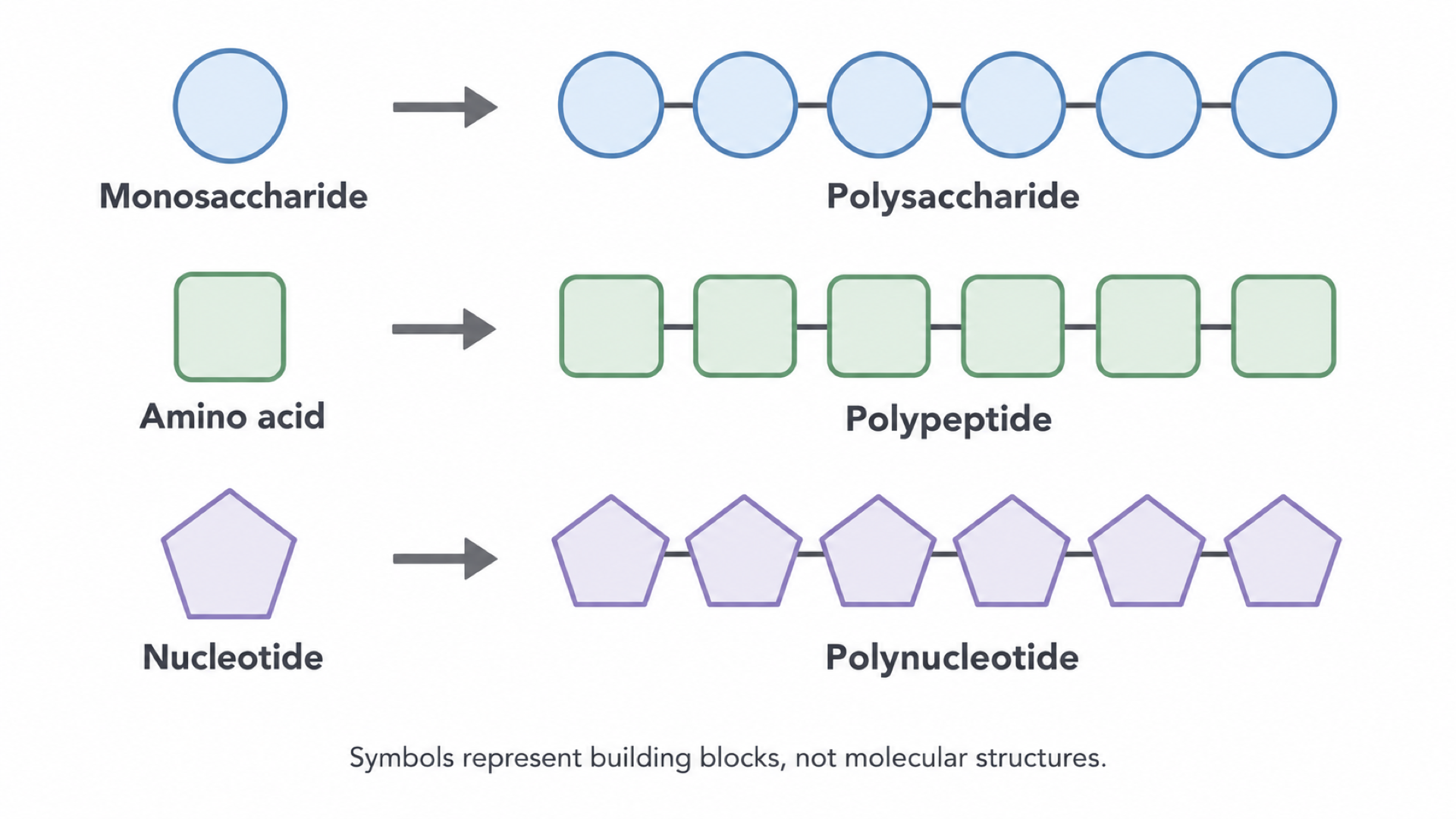
The monomers in a real polymer need not be identical: starch contains only glucose units, whereas a polypeptide can contain many different amino acids in varied sequences. Different numbers, sequences and arrangements of monomers give molecules with different properties. So a shared biochemical basis does not mean all organisms contain identical proteins or DNA.
Condensation reactions
Monomers do not simply stick together: atoms leave as water each time two join.
Condensation reaction
A condensation reaction joins two molecules by forming a covalent bond and eliminating one molecule of water.
Follow the diagram from left to right.
[DIAGRAM: asset_name: 1.1 - Monomers and polymers - Diagram 2; asset_slug: 1.1 - Monomers and polymers - Diagram 2; recommended_method: retained_png; caption: Schematic condensation: two molecular groups join by a new covalent bond and release one water molecule.; description: Schematic condensation: two molecular groups join by a new covalent bond and release one water molecule.]
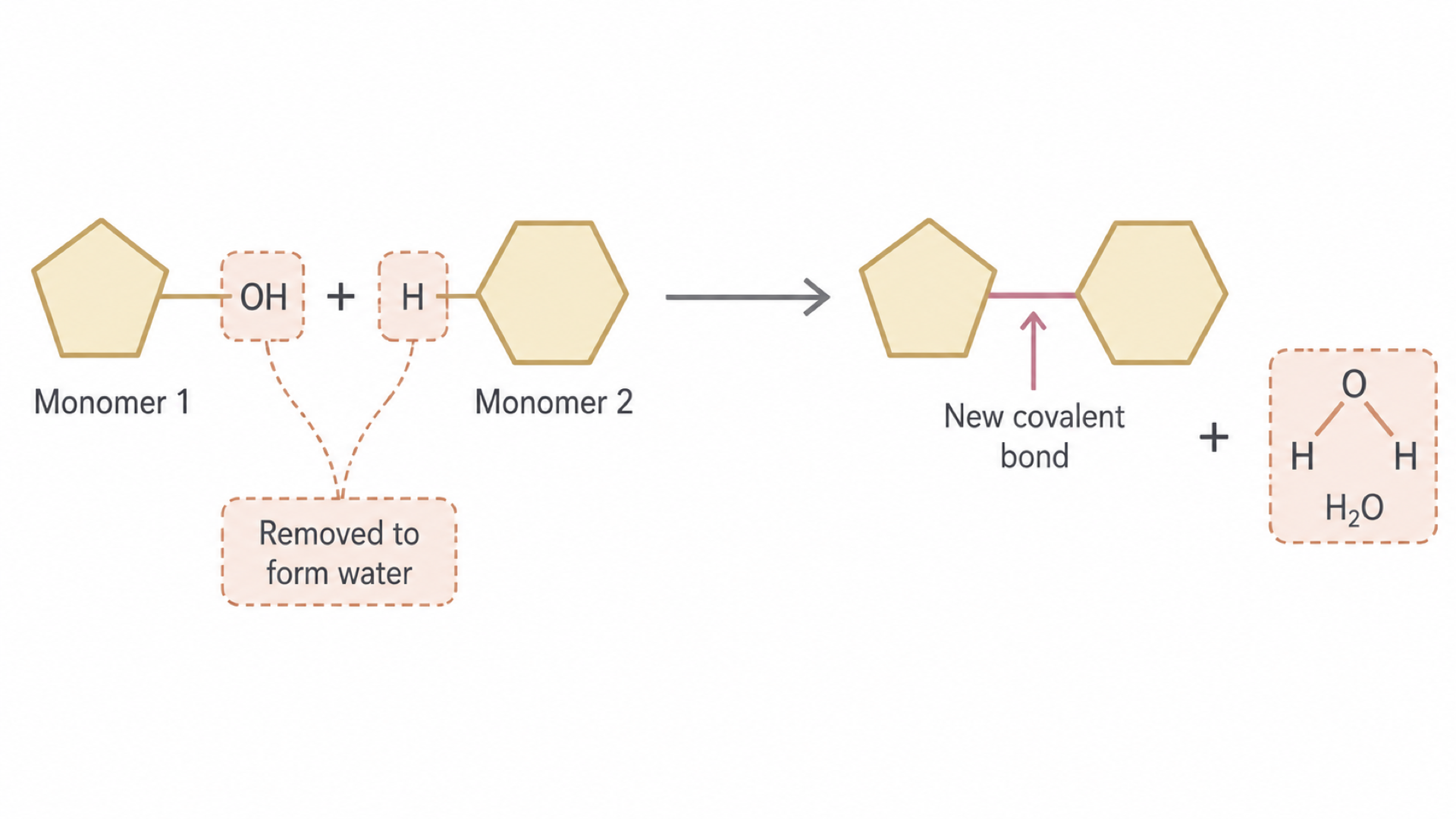
- One monomer loses an OH group and the other loses an H.
- These atoms leave together as one water molecule.
- A new covalent bond joins the two monomers.
The shapes are schematic, because the bond's structure and name depend on the molecules joined:
- Monosaccharides form glycosidic bonds.
- Amino acids form peptide bonds.
- Nucleotides in a strand form phosphodiester bonds.
Repeating this reaction joins many monomers into a polymer. The monomer units remain recognisable, but they are now residues, because they have lost atoms as water.
Counting bonds and water
To make one chain of four monomers, the first two join, then a third and a fourth are added. That is three bonds, and each releases one water molecule.
For one unbranched chain of monomers, bonds form and water molecules are released. This assumes no extra bonds join the chain's ends into a loop or link one part of it to another.
Hydrolysis reactions
Your small intestine cannot absorb a starch molecule, but it can absorb glucose. Hydrolysis gets from one to the other.
Hydrolysis reaction
A hydrolysis reaction breaks a covalent bond between two molecular groups using one water molecule. H and OH from water become attached to the separated products.
Hydrolysis is the reverse of condensation: condensation forms a bond and releases water, whereas hydrolysis breaks a bond and uses water. A full description of either reaction states both changes.
One water for each bond
One hydrolysis reaction breaks one bond, so a single cut inside a long chain produces two shorter chains. Complete hydrolysis breaks every joining bond: an unbranched chain of four monomer residues needs three hydrolysis reactions, using three water molecules, to release four monomers.
Hydrolysis in digestion
Food polymers are too large to cross the cell-surface membranes of the cells lining the small intestine. Enzymes catalyse successive hydrolysis reactions: breaking glycosidic bonds ultimately turns starch into glucose, and breaking peptide bonds turns polypeptides into amino acids.
These small molecules can be absorbed, then used as respiratory substrates or building blocks. Dissolving a polymer or breaking food into smaller pieces is not hydrolysis, because neither breaks covalent bonds.
| Change | Condensation | Hydrolysis |
|---|---|---|
| Joining bond | Formed | Broken |
| Water | Released | Used |
| Molecular size | Smaller molecules join | A molecule splits into smaller products |
Cover the table, then state the three differences from memory.