3.8.2.2 - Regulating transcription and translation
A cell can control a gene at several stages, from access to its DNA to the survival of its mRNA. Learn each control, then use data to separate observation from mechanism and genes from environment.
Transcriptional factors regulate genes
Cells with the same genes make different proteins, and transcriptional factors are one reason.
To start transcription, RNA polymerase and other transcription machinery must attach at the gene's promoter, a DNA sequence just before the gene.
Transcriptional factor
A transcriptional factor (also called a transcription factor) is a protein that binds a specific DNA sequence and regulates transcription of a target gene.
An activator helps this machinery bind and start transcription; a repressor inhibits this. A factor's DNA-binding site is complementary to a particular base sequence, so it acts on genes with that sequence.
In the route AQA specifies, a signal activates a factor in the cytoplasm. The factor enters the nucleus through a nuclear pore and binds its target sequence, stimulating or inhibiting transcription. Other factors are already in the nucleus and are regulated there.
Transcriptional control changes how much RNA is made. For a protein-coding gene this may change how much protein is produced, not its amino acid sequence. More mRNA for a membrane carrier may allow more carrier protein to be synthesised, not a carrier with a new binding site.
Exam tip
When gene expression increases, write “more mRNA, so more protein”. On an AQA 2025 carrier-protein question, answers describing a mutation and a changed protein shape earned no mark.
The factors present, their activation state and the accessibility of their target DNA help determine which genes are expressed.
Oestrogen initiates transcription
A signal outside a cell can change transcription inside its nucleus, and oestrogen shows how.
Oestrogen is a lipid-soluble steroid hormone, so it can cross the phospholipid bilayer of a cell.
In the simplified cytoplasmic model, its receptor is a transcriptional factor in the cytoplasm. Follow the diagram from left to right.
[DIAGRAM: asset_name: 8.2.2 - Regulation of transcription and translation - Diagram 1; asset_slug: 8.2.2 - Regulation of transcription and translation - Diagram 1; recommended_method: local_png; caption: The simplified oestrogen pathway: intracellular receptor activation, nuclear entry and target-DNA binding stimulate transcription.; description: The simplified oestrogen pathway: intracellular receptor activation, nuclear entry and target-DNA binding stimulate transcription.]
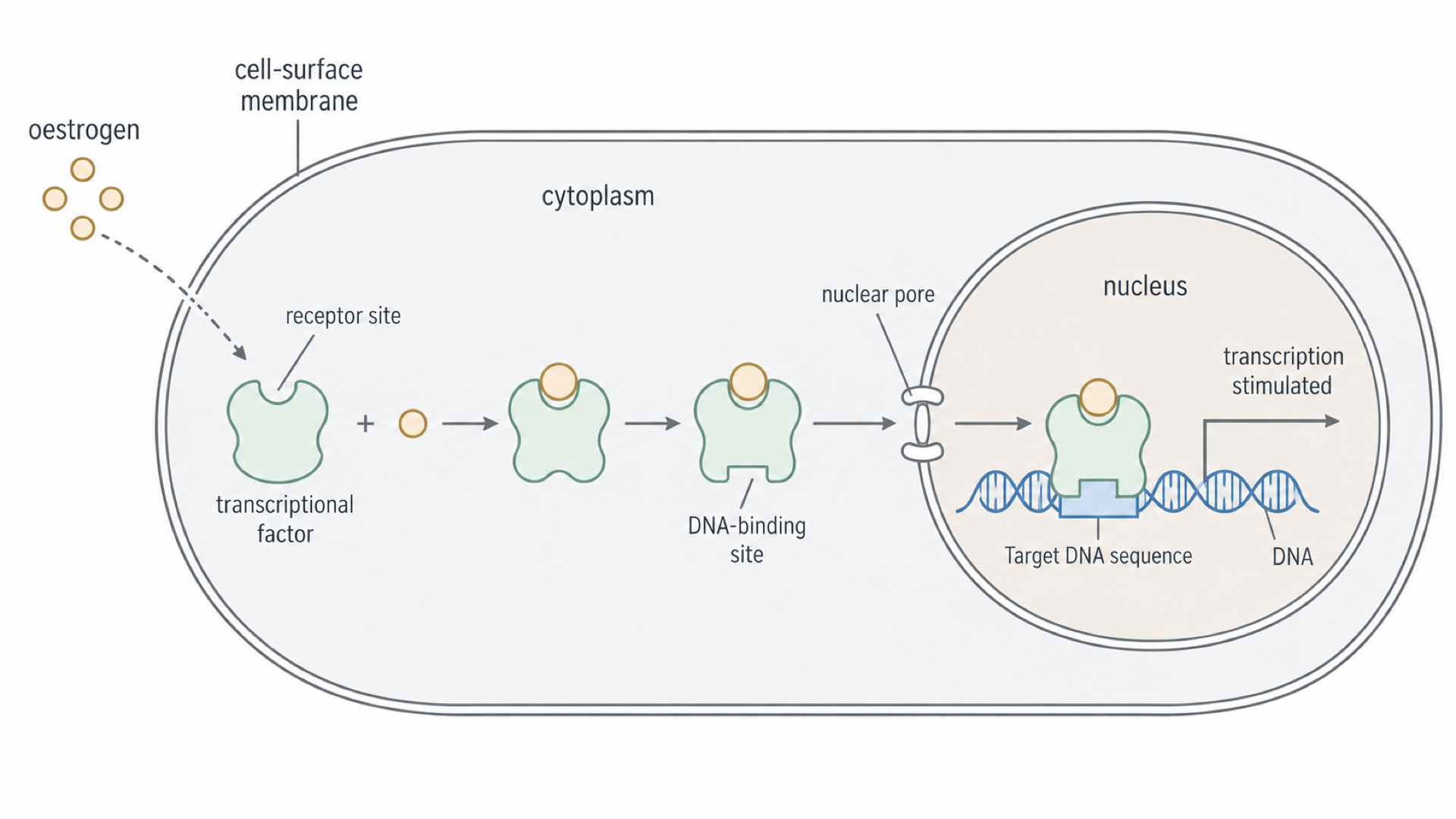
- Oestrogen diffuses through the cell-surface membrane.
- It binds a complementary site on the factor, labelled the receptor site.
- Binding changes the factor's conformation. This activates it: its DNA-binding site now has a shape complementary to the target base sequence.
- The activated complex passes through a nuclear pore into the nucleus.
- It binds the target DNA sequence and stimulates transcription of the target gene.
Oestrogen receptors can also be present in the nucleus.
Only cells with the appropriate receptor and regulatory machinery respond in this way. More transcription can produce more mRNA and more protein, but the hormone does not change the DNA base sequence.
In cells that depend on this pathway, an inhibitor that prevents receptor activation could reduce the response even when the hormone is present.
Epigenetics and chromatin
Two cells can carry the same DNA yet use it differently, and can keep that difference when they divide.
Epigenetics
Epigenetics concerns heritable changes in gene function without a change in the DNA base sequence.
Heritable can mean that the altered state is maintained through cell division, so daughter cells keep it. A stable pattern of gene expression can therefore persist in a cell lineage, which helps explain cell specialisation.
Heritable does not mean every acquired epigenetic change is passed from a parent to an offspring. A mutation is different: it changes the base sequence itself.
The epigenome includes chemical modifications of DNA and associated proteins that influence gene activity. Development and environmental conditions can change these modifications. For AQA, the key point is that a change in the environment can inhibit transcription through increased DNA methylation (more methyl groups on DNA) or decreased histone acetylation (fewer acetyl groups on histones).
People conceived during the Dutch famine of 1944–45 had slightly lower DNA methylation at one gene, IGF2, about six decades later than their unexposed siblings. This is an association, not proof of cause: siblings differ in some alleles and may have had other environmental differences. It still suggests an early environment can leave a lasting mark.
How chromatin controls access
Chromatin consists of DNA associated with histone proteins. DNA winds around histones, allowing a long molecule to be packaged. DNA's phosphate groups are negatively charged and regions of histones are positively charged, so the two attract.
Tightly packed chromatin generally makes a regulatory DNA sequence less accessible to transcriptional factors; more open chromatin can permit access. Chemical modification of histones can change the attraction, and so how tightly chromatin packs.
Methylation and histone acetylation
Two chemical changes can inhibit transcription, one made to DNA and the other to its histones.
Increased DNA methylation
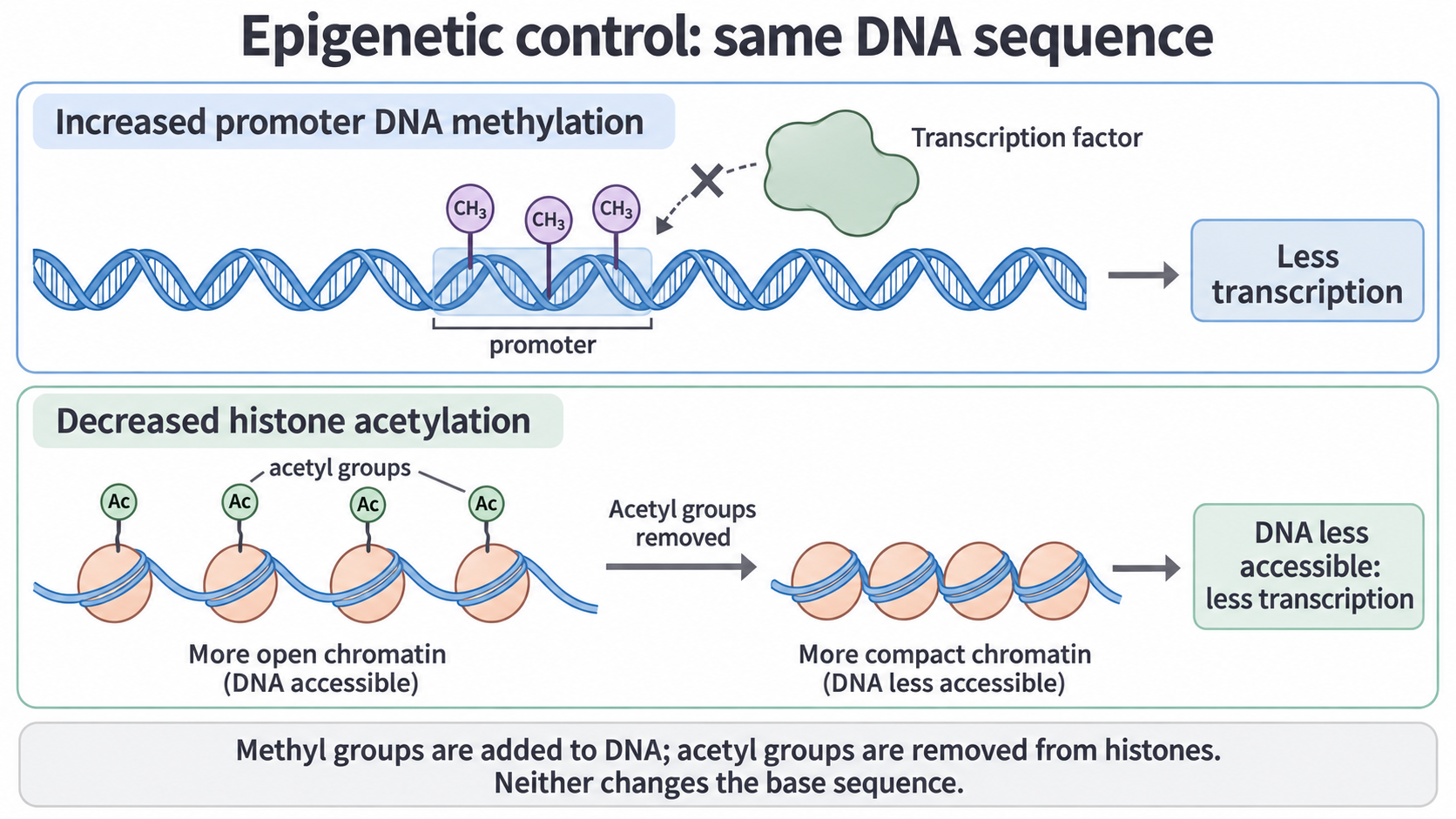
DNA methylation adds methyl groups, , to DNA bases, commonly cytosine. Increased methylation of a promoter can stop transcriptional factors binding and recruit proteins that make chromatin less accessible, so less of the gene's RNA is made. The base sequence remains the same.
Exam tip
Say what methylation does, such as preventing transcriptional factors binding. On one AQA paper “switching off” alone was ignored and “causes a mutation” was rejected.
Decreased histone acetylation
Histone acetylation adds acetyl groups to histones, reducing their positive charge at those sites, so DNA is held less tightly. Removing acetyl groups reverses this:
- Fewer acetyl groups leave histones more positively charged.
- Histones attract negatively charged DNA more strongly.
- Chromatin becomes more compact.
- Transcriptional factors have less access, so transcription is inhibited.
In the diagram, the upper panel modifies DNA and the lower panel modifies histone proteins.
[DIAGRAM: asset_name: epigenetic-control-v2; asset_slug: epigenetic-control-v2; recommended_method: local_png; caption: Promoter DNA methylation and loss of histone acetylation can each reduce transcription without changing the DNA base sequence.; description: Promoter DNA methylation and loss of histone acetylation can each reduce transcription without changing the DNA base sequence.]
Watch out
Don't assume the two changes run in the same direction. “Increased acetylation inhibits transcription” is wrong, because acetyl groups reduce the histones' positive charge. Increased methylation of DNA and decreased acetylation of histones inhibit transcription.
These relationships depend on context: not every methylated gene is off, and histone acetylation does not guarantee activity. The reverse changes, reduced promoter methylation or increased histone acetylation, can help make a silenced gene accessible again.
Continue this lesson.
You’re previewing NovaLearn without an account. Create a free account to read the rest.
Create free account