3.5.2 - Respiration
Respiration transfers energy from glucose and other substrates to ATP, one controlled step at a time. Glycolysis comes first, pyruvate then follows an aerobic or an anaerobic route, and most ATP in aerobic respiration is made at the very end, by oxidative phosphorylation.
Glycolysis
Glycolysis earns a small ATP profit from glucose, and it works with or without oxygen.
Respiration transfers chemical energy from substrates into ATP through a sequence of enzyme-controlled reactions. It does not create energy. ATP hydrolysis then releases energy for processes such as active transport and synthesis. Respiration is common to all organisms, which provides indirect evidence for evolution.
Glycolysis
The first stage of respiration in which glucose is split into pyruvate in the cytoplasm. It is an anaerobic process and happens in both aerobic and anaerobic respiration.
No step of glycolysis uses oxygen, so it can run whether oxygen is available or not.
Four stages from glucose to pyruvate
- Glucose is phosphorylated to glucose phosphate using ATP. Two phosphate groups are added, making the molecule more reactive.
- The phosphorylated hexose (a 6-carbon sugar) splits into two molecules of triose phosphate, each with 3 carbons.
- Each triose phosphate is oxidised. Hydrogen is removed and accepted by NAD, forming reduced NAD.
- Each triose phosphate is converted to pyruvate, also with 3 carbons. Phosphate groups pass to ADP along the way, making 2 ATP per triose phosphate.
The net yield per glucose
Two triose phosphates go through stages 3 and 4, giving 4 ATP and 2 reduced NAD. Subtract the 2 ATP spent in stage 1 to get the net yield.
| Product from one glucose molecule | Gross | Used | Net |
|---|---|---|---|
| ATP | 4 | 2 | 2 |
| Reduced NAD | 2 | 0 | 2 |
| Pyruvate | 2 | 0 | 2 |
The ATP in stage 4 forms by substrate-level phosphorylation: the direct transfer of a phosphate group from a phosphorylated intermediate to ADP. It needs no electron transfer chain or proton gradient. Keep it apart from stage 1, where glucose is phosphorylated and ATP is used, not made.
Dehydrogenases catalyse the removal of hydrogen in stage 3. NAD is a coenzyme: a small non-protein molecule that helps an enzyme, here by carrying hydrogen away. Oxidised NAD must be replenished for glycolysis to continue.
The link reaction and Krebs cycle
In aerobic respiration, pyruvate's carbon leaves as carbon dioxide and its hydrogen is loaded onto coenzymes.
Pyruvate enters the mitochondrial matrix from the cytoplasm by active transport. The link reaction and Krebs cycle both happen there.
The link reaction
Link reaction
The conversion of pyruvate to acetylcoenzyme A in the mitochondrial matrix. Pyruvate is oxidised, carbon dioxide is released, and NAD is reduced.
For each pyruvate molecule:
- Pyruvate, a 3-carbon molecule, loses carbon dioxide (decarboxylation) and becomes a 2-carbon acetate.
- As this happens, pyruvate is oxidised: hydrogen removed from it reduces NAD.
- Acetate combines with coenzyme A to form acetylcoenzyme A (acetyl CoA).
Each glucose produces two pyruvate molecules, so the link reaction happens twice per glucose.
The Krebs cycle
Krebs cycle
A cycle of oxidation-reduction reactions in the mitochondrial matrix in which acetyl CoA combines with a 4-carbon compound and is gradually broken down, producing reduced coenzymes, ATP, and carbon dioxide.
Start at the top of the diagram and go clockwise, matching it to the steps below. It summarises one turn's outputs, not which reaction makes each one.
[DIAGRAM: asset_name: 5.2 - Respiration - Diagram 1; asset_slug: 5.2 - Respiration - Diagram 1; recommended_method: retained_png; caption: One Krebs-cycle turn regenerates a four-carbon acceptor and produces three reduced NAD, one reduced FAD, one ATP and two carbon dioxide molecules.; description: One Krebs-cycle turn regenerates a four-carbon acceptor and produces three reduced NAD, one reduced FAD, one ATP and two carbon dioxide molecules.]
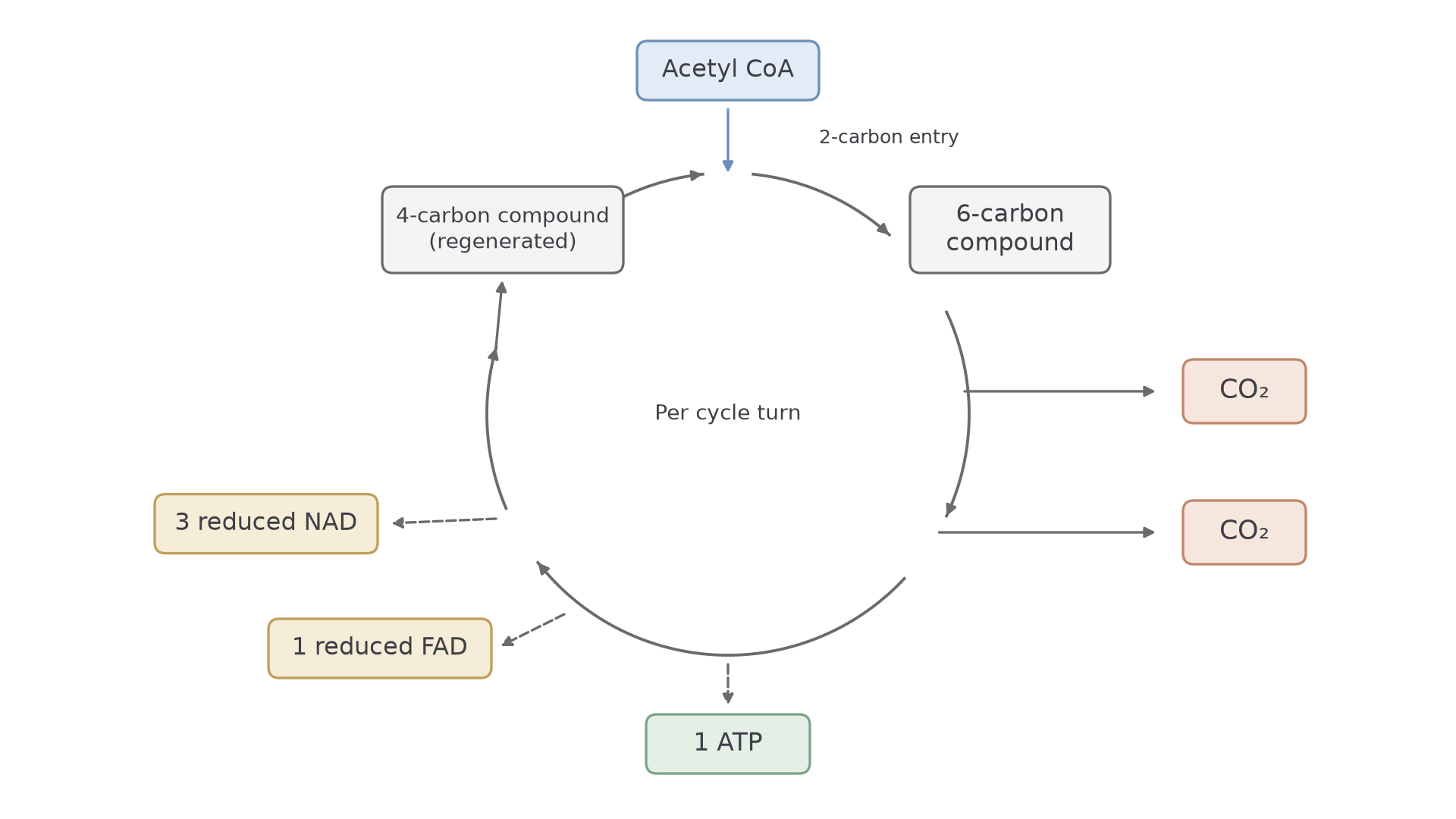
- Acetyl CoA donates its 2-carbon acetyl group to the 4-carbon compound, releasing coenzyme A for reuse. This forms a 6-carbon compound.
- In a series of oxidation-reduction reactions, it loses two carbons as carbon dioxide, returning to 4 carbons.
- Hydrogen removed in these reactions is accepted by NAD and by FAD, a second hydrogen-carrying coenzyme.
- ATP is made by substrate-level phosphorylation.
- The 4-carbon compound is regenerated. It can then accept the next acetyl group, so the cycle continues.
One glucose gives two acetyl CoA, so the cycle turns twice per glucose:
| Product | Per turn | Per glucose |
|---|---|---|
| Reduced NAD | 3 | 6 |
| Reduced FAD | 1 | 2 |
| ATP | 1 | 2 |
| 2 | 4 |
The link reaction adds 2 more , so one glucose gives 6, one per carbon. To explain that total in an exam, give the source: one from the link reaction and two from the Krebs cycle, each happening twice.
The Krebs cycle makes only a small amount of ATP directly. Its main importance is producing reduced NAD and reduced FAD for oxidative phosphorylation.
Oxidative phosphorylation
Most ATP in aerobic respiration is made here, as protons flow back across a membrane.
Reduced coenzymes from glycolysis, the link reaction and the Krebs cycle carry hydrogen to the inner mitochondrial membrane.
Oxidative phosphorylation
The production of ATP using energy released from electrons passing along an electron transfer chain and from protons moving through ATP synthase across the inner mitochondrial membrane.
From reduced coenzymes to ATP
Start at the bottom left of the diagram, where reduced NAD and reduced FAD feed the chain. Follow the electrons across to oxygen, then the protons up and back down through ATP synthase.
[DIAGRAM: asset_name: respiration-chemiosmosis; asset_slug: respiration-chemiosmosis; recommended_method: imagegen; caption: Electrons from reduced NAD and FAD drive proton pumping from matrix to intermembrane space, proton return through ATP synthase produces ATP in the matrix and oxygen accepts electrons to form water.; description: Electrons from reduced NAD and FAD drive proton pumping from matrix to intermembrane space; proton return through ATP synthase produces ATP in the matrix and oxygen accepts electrons to form water.]
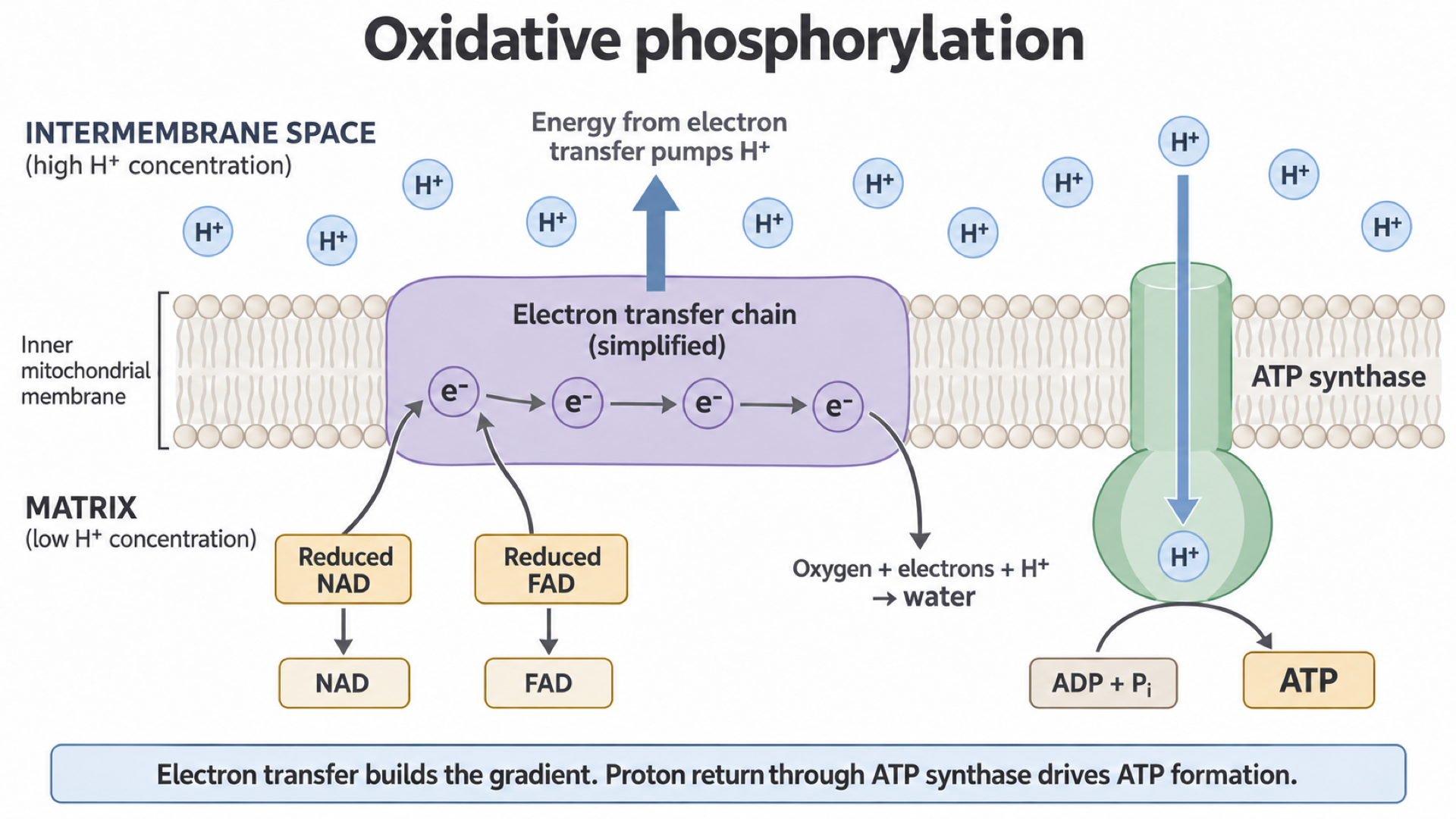
- Reduced NAD and reduced FAD give up their hydrogen, which splits into protons () and electrons.
- The electrons pass along the electron transfer chain, a series of carriers in the inner membrane, and release energy.
- That energy, not ATP, pumps protons from the matrix across the membrane into the intermembrane space.
- The proton concentration is now higher in the intermembrane space than in the matrix. This is a proton gradient.
- The phospholipid bilayer is almost impermeable to protons, so they diffuse back down their gradient through ATP synthase, an enzyme embedded in the inner membrane.
- This flow provides the energy for ATP synthase to catalyse the formation of ATP from ADP and inorganic phosphate.
- At the end of the chain, electrons combine with oxygen and protons to form water.
This explanation is the chemiosmotic theory, which you met across thylakoid membranes in 3.5.1. Oxidative phosphorylation means the ATP production itself, not just building the gradient. Cristae provide a large surface area for chain carriers and ATP synthase. Bacteria have no mitochondria, so their chain sits in the cell-surface membrane.
Why oxygen is essential
Oxygen is the final electron acceptor. Without it, electrons cannot leave the chain, so proton pumping stops, the gradient cannot be maintained, and ATP synthesis by oxidative phosphorylation stops.
Continue this lesson.
You’re previewing NovaLearn without an account. Create a free account to read the rest.
Create free account