3.8.3 - Using genome projects
Genome projects read an organism's complete DNA base sequence. See how it is rebuilt from fragments, how a simple genome can lead to a vaccine, and why a human genome is much harder to turn into a proteome.
Genome projects and sequencing
A human genome is far too long to read in one go, so it is cut into fragments and rebuilt by computer.
A genome project determines the complete DNA base sequence of an organism and maps genes onto chromosomes. Sequencing projects have now read the genomes of a wide range of organisms, including humans.
Genome
The complete set of DNA base sequences of an organism, including coding and non-coding DNA.
The bacterium E. coli has about 4.6 million base pairs and the human genome over 3 billion. Sequencing on that scale requires automated instruments, and computers to store, organise and analyse the data. This is bioinformatics.
Bioinformatics
The use of computers and mathematical methods to collect, store, and analyse biological data.
Rebuilding a genome from fragments
A common method is whole-genome shotgun sequencing:
- Copies of the DNA are cut at random into many small fragments.
- Each fragment is sequenced. The base sequence from one fragment is called a read.
- Computer algorithms identify overlaps, where the end of one read matches the start of another.
- Overlapping reads are assembled into the full sequence.
Using copies creates the overlaps, because each copy breaks in different places. Cutting a single molecule would give neighbouring pieces, with nothing to match.
In the diagram, each read overlaps the next by four bases. Align the identical bases and count each overlap once: ATGCCG plus GCCGTA gives ATGCCGTA, and CGTACC extends this to ATGCCGTACC.
[DIAGRAM: asset_name: 3.8.3-sequence-overlap; asset_slug: 3.8.3-sequence-overlap; recommended_method: retained_png; caption: Matching overlaps reconstruct the ten-base sequence ATGCCGTACC.; description: Matching overlaps reconstruct the ten-base sequence ATGCCGTACC.]
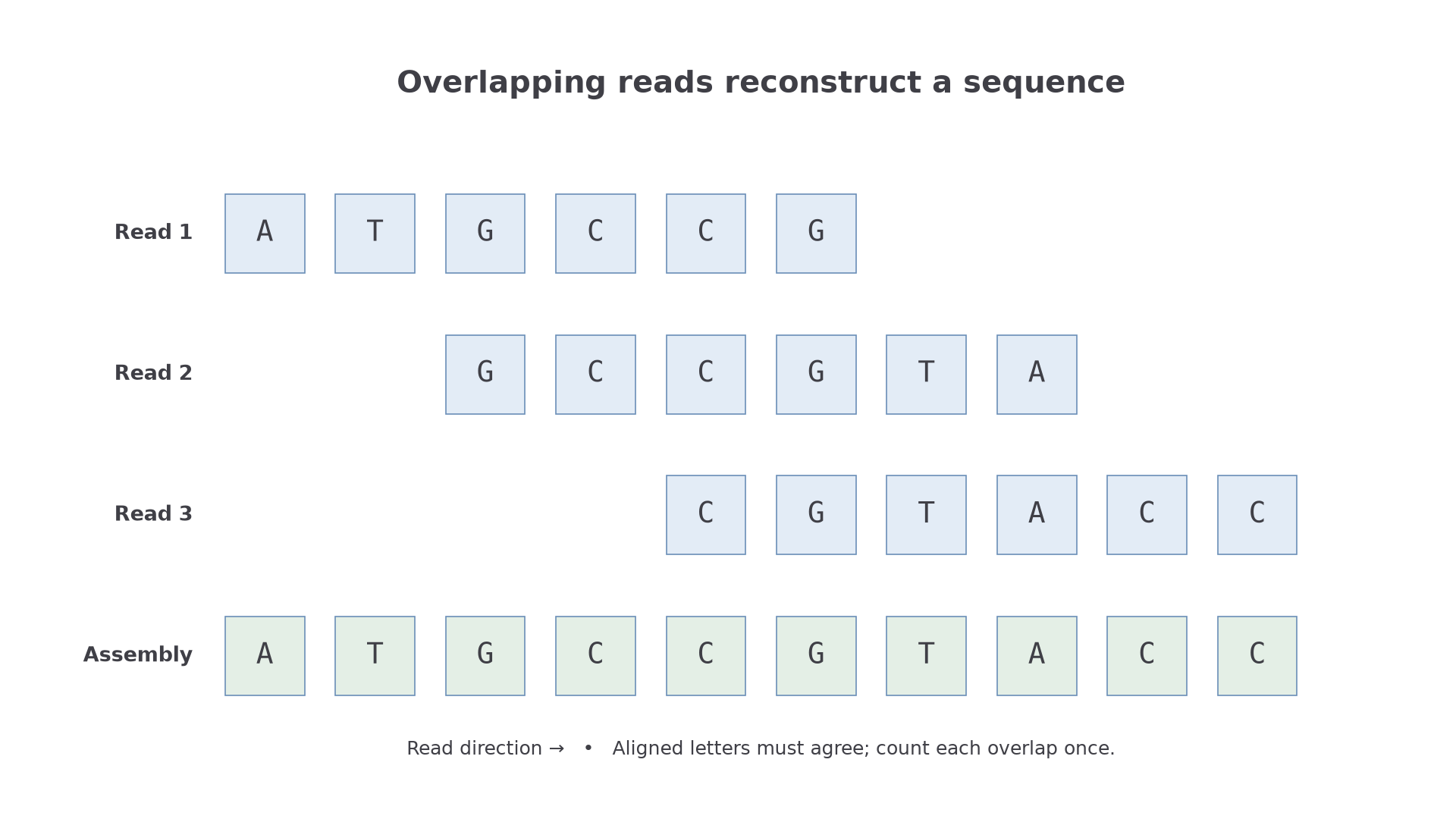
Real genomes make assembly harder: a read from inside a repeated region could fit in many places, so additional reads and checking are needed.
Why sequencing keeps getting faster
Sequencing methods are continuously updated and the process has become automated. Newer methods read bases more quickly, and computers assemble overlapping reads rapidly.
The first human genome took 6 to 8 years of active sequencing, and the project finished in 2003. By 2013, a human genome could be sequenced in two or three days, and by 2020 in about a day.
Genome and proteome
Knowing an organism's DNA sequence doesn't tell you which proteins any one of its cells is making.
The genome is a store of information. Its output is the set of proteins, the proteome.
Proteome
The complete range of proteins that can be produced by the genome of an organism, or the proteins being produced by a particular cell at a particular time.
The definition has two scopes because the two questions differ: what could this genome produce, and what is this cell producing now?
In 3.4.2 you met AQA's wording: the genome is the complete set of genes in a cell, and the proteome is the full range of proteins that a cell is able to produce. This lesson's definitions are wider because genome projects read all of an organism's DNA. For a plain definition, use AQA's wording.
A pancreatic beta cell and a nerve cell normally contain the same genes. The beta cell expresses the insulin gene strongly, whereas the nerve cell has a different set of active genes, so the two cells have different proteomes.
| Genome | Proteome | |
|---|---|---|
| Made of | DNA base sequences | Proteins |
| Between cell types | Normally the same | Differs |
| Over time | Relatively fixed | Depends on which genes are expressed |
Simpler organisms and vaccine antigens
In many bacteria, the DNA gives a protein's amino acid sequence almost directly, and that can lead to vaccines.
From genome to proteome
Determining the genome of a simpler organism, especially a prokaryote, allows the sequences of many of its proteins to be determined. Three features make this much easier than in a human:
- Mostly coding DNA: about 88% of the E. coli genome codes for proteins.
- Few introns: bacterial genes generally have no introns, so a gene's coding bases run on without interruption.
- Fewer regulatory genes: there are fewer developmental and tissue-specific controls to account for.
Continue this lesson.
You’re previewing NovaLearn without an account. Create a free account to read the rest.
Create free account