3.4.1 - DNA, genes and chromosomes
DNA stores the instructions for polypeptides in its base sequence, yet most of a human cell's DNA does not code for polypeptides. This lesson covers how DNA is organised, packaged and read.
DNA in prokaryotic and eukaryotic cells
Your own cells hold two kinds of DNA: very long linear molecules in the nucleus and short circular ones in mitochondria.
Read the diagram from left to right.
[DIAGRAM: asset_name: dna-organisation-v2; asset_slug: dna-organisation-v2; recommended_method: local_png; caption: Circular prokaryotic and organelle DNA compared with linear, histone-associated nuclear DNA, simplified and not to scale.; description: Circular prokaryotic and organelle DNA compared with linear, histone-associated nuclear DNA; simplified and not to scale.]
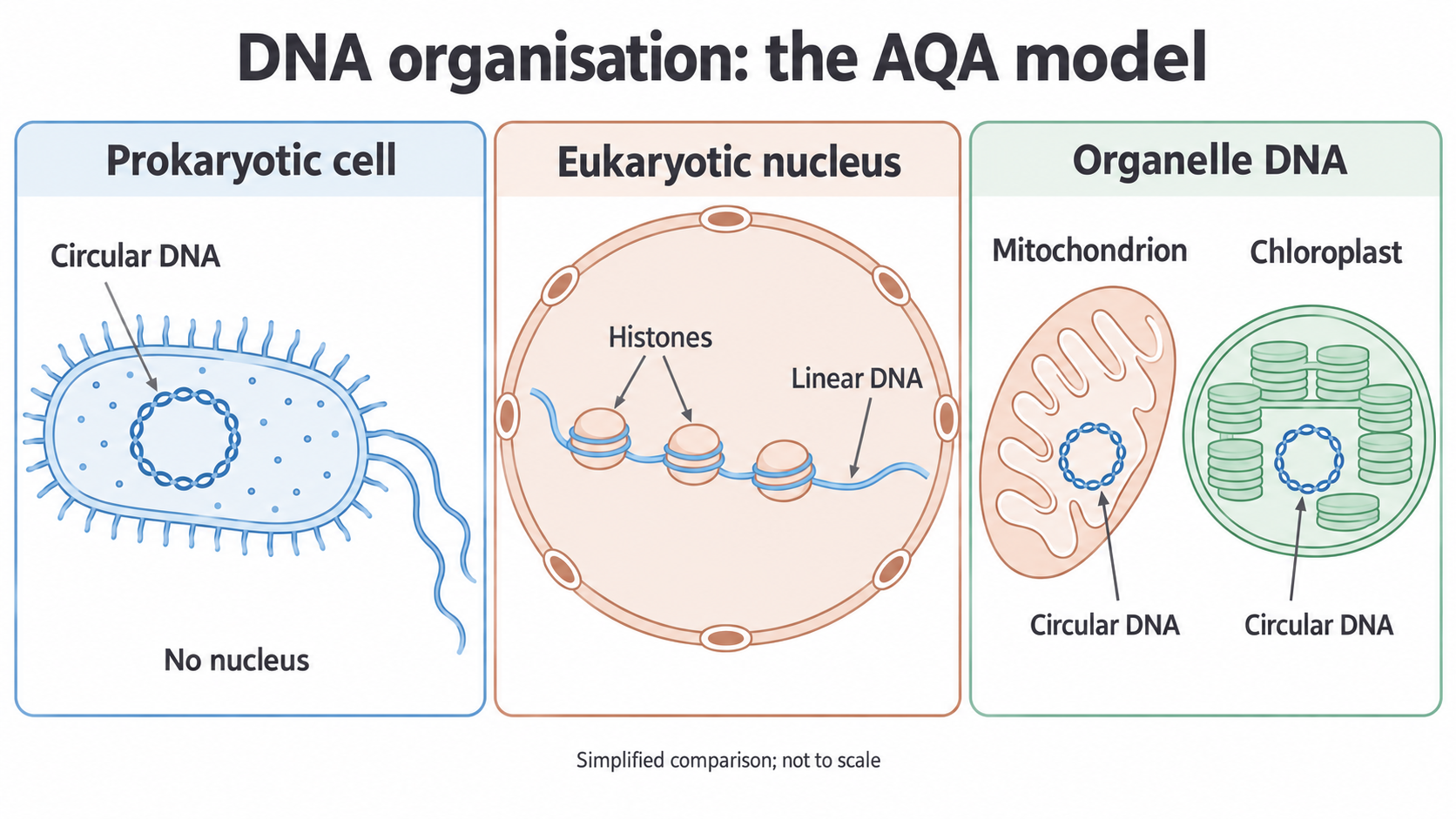
Prokaryotic DNA has no nucleus around it, so it lies in the cytoplasm. In the AQA model, it is short, circular and not associated with proteins.
Eukaryotic nuclear DNA is very long and linear, and associated with histone proteins.
Chromosome
Together, a DNA molecule and its associated proteins form a chromosome.
Mitochondrial and chloroplast DNA resembles prokaryotic DNA: short, circular and not associated with proteins.
Watch out
“All eukaryotic DNA is linear” is incorrect, because mitochondrial and chloroplast DNA is circular. Specify nuclear DNA.
“Short” is relative, as a bacterial DNA molecule can reach millions of base pairs. Bacterial and organelle DNA interact with some proteins, and many archaea have histones. Use the AQA model in answers.
| DNA | Location | Shape and relative length | Packaging in the AQA model |
|---|---|---|---|
| Prokaryotic | Cytoplasm | Short, circular | Not associated with proteins |
| Eukaryotic nuclear | Nucleus | Very long, linear | Associated with histones |
| Mitochondrial and chloroplast | Inside the organelle | Short, circular | Not associated with proteins |
Cover the table, then state the differences from memory.
Genes and loci
A chromosome is not one long instruction: it is a row of separate genes, each at its own fixed address.
Take haemoglobin from 3.3.4.1. The DNA specifying its β-globin polypeptide is one gene, at one fixed place on human chromosome 11.
Gene and locus
A gene is a base sequence of DNA that codes for the amino acid sequence of a polypeptide or for a functional RNA.
A locus is the fixed position of a gene on a particular DNA molecule.
Functional RNAs include ribosomal RNA (rRNA) and transfer RNA (tRNA), which act as RNA and are not translated.
A chromosome carries many genes at different loci, plus sequences between genes, so a gene is part of its DNA, not a miniature chromosome or a histone.
Watch out
When defining a gene, don't write “codes for a protein”. Some proteins contain several polypeptides, and some genes code for a functional RNA. Write the amino acid sequence of a polypeptide or a functional RNA.
Same locus, different alleles
In a diploid cell (one with two sets of chromosomes), a homologous pair is two corresponding chromosomes, normally one from each parent. They carry the same genes at corresponding loci, but may carry different alleles: versions of a gene with different base sequences.
You have a β-globin gene at the same locus on each chromosome 11. The two can be different alleles: the sickle-cell allele differs from the usual one by a single base. The locus says where the gene is; the base sequence says which allele is present.
The triplet code
DNA has four bases and polypeptides use 20 amino acids, so reading bases singly or in pairs gives too few combinations.
A sequence of three DNA bases, called a triplet, codes for a specific amino acid.
A one-base code permits 4 combinations and a two-base code permits , both too few. Three bases permit . Of those, 61 code for amino acids and 3 are stop signals, which end the polypeptide. So most amino acids have more than one triplet.
Transcription copies DNA into mRNA, where the matching three bases form a codon. Translation at a ribosome reads the codons to build a polypeptide. 3.4.2 covers both.
Reading the code
In the diagram, each arrow means “specifies through transcription and translation”.
[DIAGRAM: asset_name: 4.1 - DNA, genes and chromosomes - Diagram 2; asset_slug: 4.1 - DNA, genes and chromosomes - Diagram 2; recommended_method: local_png; caption: Six consecutive, non-overlapping triplets in a coding DNA sequence, corresponding to six amino acids via mRNA.; description: Six consecutive, non-overlapping triplets in a coding DNA sequence, corresponding to six amino acids via mRNA.]
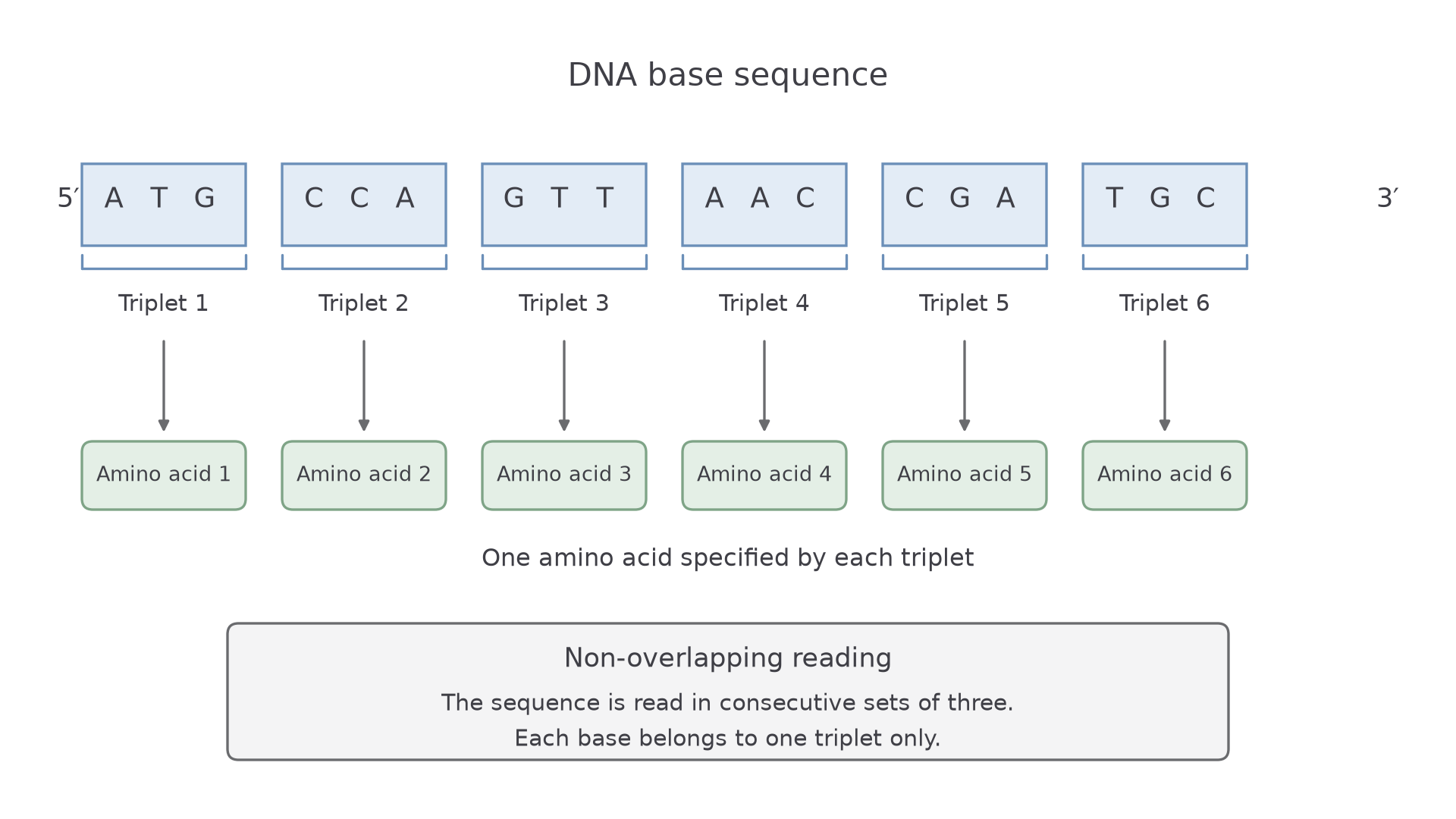
Read from the first base: ATG, then CCA, then GTT. GCC is never read, because its G belongs to ATG and its CC to CCA, so the code is non-overlapping. It is also degenerate and universal. This division into consecutive triplets from a starting point is the reading frame.
| Property | Meaning | Consequence |
|---|---|---|
| Degenerate | Most amino acids are specified by more than one triplet/codon | A substitution can leave the amino acid unchanged |
| Non-overlapping | Within a reading frame, each base belongs to one triplet | A substitution changes one triplet, not three |
| Universal | The same codon specifies the same amino acid in almost all organisms | Genetic information can often be expressed across species |
Watch out
Degenerate does not mean one codon specifies several amino acids. In the standard code, each amino-acid codon has one meaning; several codons can share an amino acid.
Continue this lesson.
You’re previewing NovaLearn without an account. Create a free account to read the rest.
Create free account