3.5.3 - Energy and ecosystems
Follow the chemical energy in plant and animal biomass to calculate production, explain losses between trophic levels and judge how farming changes energy transfer. Measurements only become comparable when their area, time and units are clear.
Energy enters ecosystems through producers
The energy in a fox began as sunlight: follow it through grass and rabbit to see where it goes.
Producers synthesise organic compounds from inorganic carbon. Land plants take in atmospheric carbon dioxide; aquatic plants and algae use carbon dioxide dissolved in water. Photosynthesis transfers light energy into chemical energy in sugars.
Most of the sugars synthesised are used as respiratory substrates. The remainder can be converted into cellulose, lipids, amino acids and other biological molecules, which also requires mineral nutrients, for example nitrogen for amino acids. Together, these molecules form the plant's biomass.
Biomass
Biomass is biological material, commonly quantified as dry mass or mass of carbon per unit area.
Biomass contains chemical energy; it is not itself a type of energy.
Energy flows, atoms cycle
Herbivores acquire this energy by eating plants; carnivores eat other consumers. Each feeding position is a trophic level: producer, primary consumer, secondary consumer and so on. An arrow in a food chain points from food to feeder, the direction of energy transfer.
In the diagram, the straight downward arrows carry chemical energy in dead material and waste to the decomposers. The wavy arrows are heat.
[DIAGRAM: asset_name: 5.3 - Energy and ecosystems - Diagram 1; asset_slug: 5.3 - Energy and ecosystems - Diagram 1; recommended_method: retained_png; caption: Energy enters grass as sunlight, passes through rabbit to fox, and enters decomposer pathways from every trophic level.; description: Energy enters grass as sunlight, passes through rabbit to fox, and enters decomposer pathways from every trophic level.]
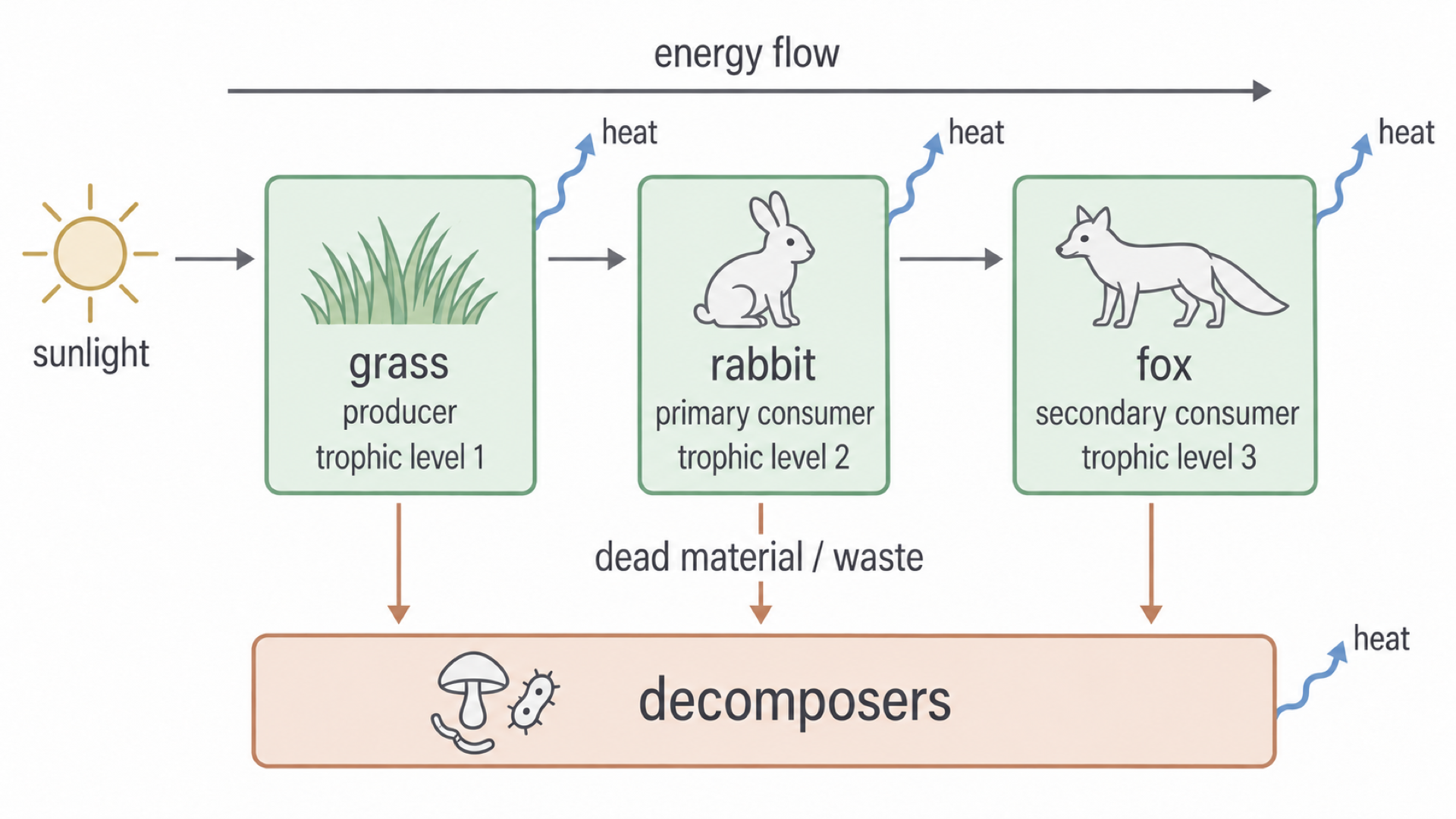
Every box has a heat arrow, because producers, consumers and decomposers all respire. Energy transferred to heat becomes dispersed in the surroundings and cannot be recycled into biomass by the ecosystem. A continuing input of light energy is therefore needed, even though atoms of nutrients can be reused.
Measuring biomass and stored energy
To compare plants fairly, remove the water first, then burn the dry tissue to find the energy it stores.
Finding dry mass
Fresh mass includes a variable quantity of water, so a wetter sample need not contain more organic material. To measure dry mass:
- Heat a representative sample in a weighed container, in an oven hot enough to evaporate water but not to burn the tissue.
- Cool it in dry conditions, so it does not take up water from the air, and weigh it.
- Repeat until successive readings give a constant mass. Mass stops falling only when all the water has gone.
- Subtract the empty container's mass.
Compare samples dried by the same procedure, and use replicates because living material varies.
Exam tip
“Heat until the sample stays the same mass” earned both marks on AQA's June 2025 Paper 2. “Burn” was rejected, because burning destroys the organic sample. Subtracting final from initial mass gives the water lost, not the dry mass.
A dry mass of 12 g from 0.25 m² gives g m⁻². A carbon analysis could instead report g C m⁻². Neither includes time, so they describe a standing quantity, not productivity.
Estimating energy by calorimetry
Calorimetry estimates the chemical energy store in a known dry mass by burning it and measuring the heat transferred. In a bomb calorimeter, complete combustion in oxygen inside a sealed chamber warms surrounding water, and the instrument can account for heat absorbed by the apparatus.
Energy from a temperature rise
is energy in joules, is water mass in grams, is the specific heat capacity of water in J g⁻¹ °C⁻¹ and is temperature rise.
For water, 1 cm³ has mass approximately 1 g. A question may give in words, such as “4.18 J raises 1 cm³ of water by 1 °C”: multiply the volume, 4.18 and the temperature rise.
Worked example: energy per gram of dry tissue
Burning 0.80 g of dry tissue warms 100 g of water by 12.0 °C, with . Find the energy per gram in kJ g⁻¹.
Plan: find joules, convert to kilojoules, then divide by the tissue mass.
- J
- kJ
- kJ g⁻¹
Answer: 6.27 kJ g⁻¹.
Check: kJ.
On AQA's 2025 calorimetry question, common slips were not dividing by sample mass and converting joules to kilojoules wrongly.
In a simple uninsulated apparatus, heat escapes and combustion may be incomplete, so the temperature rise is smaller and the estimate too low. Use a shield or insulation, tongs for hot equipment and eye protection.
Gross and net primary production
A plant can fix a lot of energy and still grow slowly, because its own respiration takes a share first.
Gross and net primary production
Gross primary production (GPP) is the total chemical energy fixed into plant organic material in a specified area or volume during the period being considered.
Net primary production (NPP) is what remains after respiratory losses, available for growth, reproduction and transfer to herbivores or decomposers.
Plants respire some of the material they fix, and the energy released is lost to the environment.
Primary production
All terms must describe the same area, period and units. If GPP is 280,000,000 and is 115,000,000 kJ ha⁻¹ year⁻¹, NPP is 165,000,000 kJ ha⁻¹ year⁻¹. Rearranging gives , so NPP alone cannot give you gross fixation.
Productivity is a rate
Productivity is a rate of production. Primary productivity is the rate of primary production: how fast producers add chemical energy to biomass. Energy per area, in kJ m⁻², is a quantity; productivity adds time, as in kJ m⁻² year⁻¹ or kJ ha⁻¹ year⁻¹. A biomass rate could use g m⁻² year⁻¹.
Dividing by area lets you compare sites of different sizes, and a whole year includes every season. A slow-growing forest may hold far more biomass than a harvested crop, yet the crop may have the higher annual rate, so standing biomass is not productivity.
Worked example: GPP and its units
A 2.5 ha crop stores 600,000,000 kJ in new biomass over 2 years, with a respiratory loss of 900,000,000 kJ. Calculate GPP and derive its units.
Plan: add NPP and , then divide by area and by time. Each division adds that unit with a power of −1.
- Total: kJ
- Per area: kJ ha⁻¹
- Per time: kJ ha⁻¹ year⁻¹
Answer: 300,000,000 kJ ha⁻¹ year⁻¹.
Check: kJ.
Since 1 ha = 10,000 m², 165,000,000 kJ ha⁻¹ year⁻¹ is 16,500 kJ m⁻² year⁻¹. Divide by 10,000, not multiply, because each square metre is only one ten-thousandth of a hectare.
How temperature changes NPP
NPP is the difference between the two rates, so explain any change using both. A moderate temperature rise might increase respiration more than photosynthesis, reducing NPP. Above a plant's photosynthetic optimum, GPP may decline while respiratory loss stays high or rises.
Continue this lesson.
You’re previewing NovaLearn without an account. Create a free account to read the rest.
Create free account