RP04 - Membrane permeability
Beetroot stores a purple pigment behind two membranes, so a solution that turns purple shows they have become more permeable. In this practical, you change one named variable, such as ethanol concentration, and turn that colour into an indirect measure of permeability.
Why pigment leakage shows permeability
Beetroot turns a membrane change you cannot see into a colour change you can measure.
Beetroot cells store a purple pigment called betalain in their vacuoles. Betalain is a large, water-soluble molecule, so very little of it crosses the hydrophobic core of an intact phospholipid bilayer. If membrane permeability increases, more pigment leaks into the surrounding solution.
Betalain
A purple water-soluble pigment found in beetroot vacuoles. It is used as an indicator of membrane permeability because it leaks out when membranes are damaged.
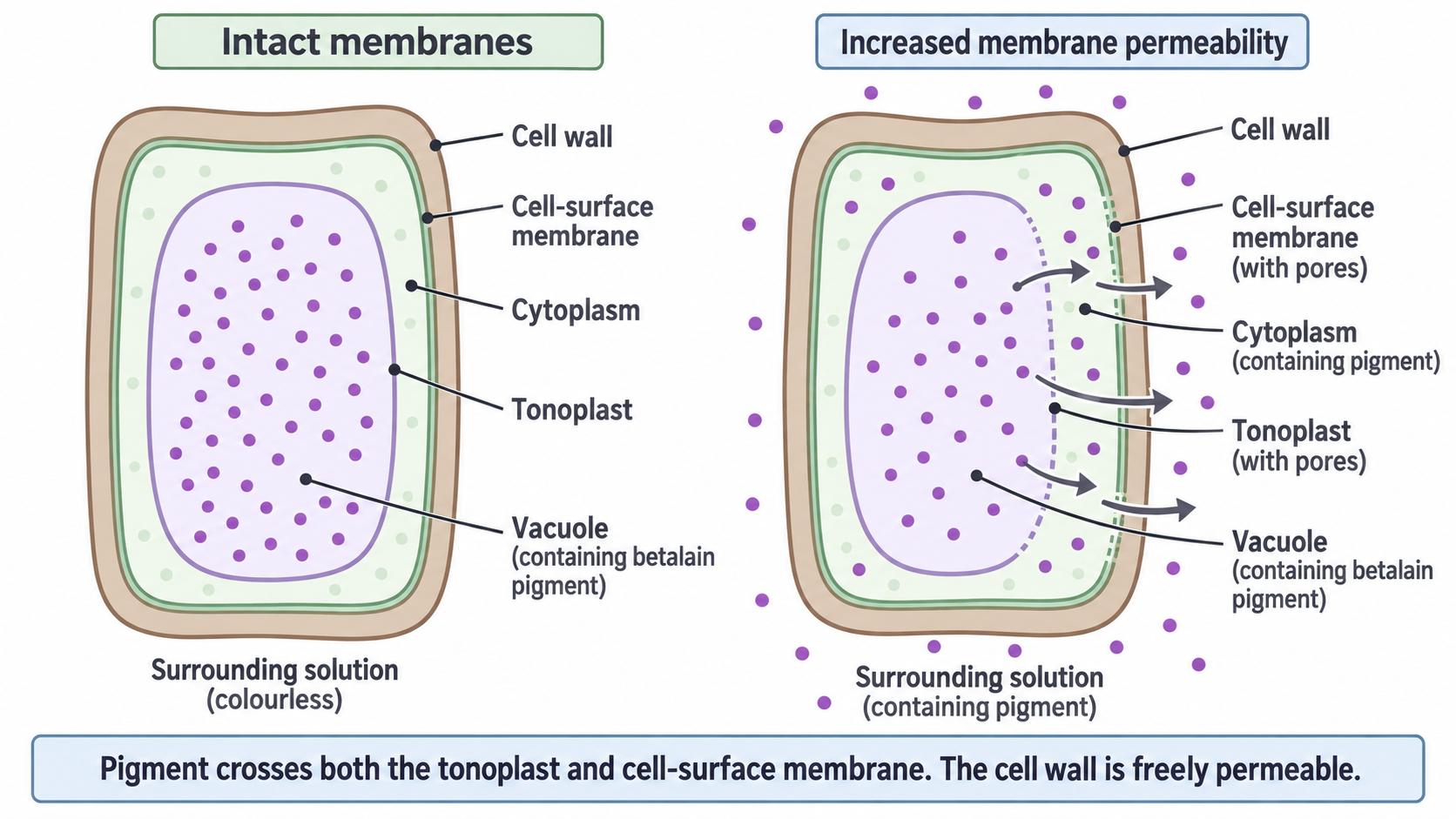
Pigment must cross two membranes: the tonoplast around the vacuole, then the cell-surface membrane around the cytoplasm. In the left panel below, both are intact, so the solution stays colourless. In the right panel, both have gaps, so pigment escapes. The cell wall stays in place, but it is freely permeable.
[DIAGRAM: asset_name: beetroot-membrane-permeability; asset_slug: beetroot-membrane-permeability; recommended_method: retained_png; caption: Pigment held inside an intact vacuole compared with net leakage across the tonoplast and cell-surface membrane into surrounding solution.; description: Pigment held inside an intact vacuole compared with net leakage across the tonoplast and cell-surface membrane into surrounding solution.]
Ethanol or temperature as the variable
The named variable is often ethanol concentration: ethanol disrupts phospholipids and membrane proteins, so higher concentrations usually cause more pigment leakage. Temperature can be used instead. Either way, you compare how much pigment leaves the tissue, using colour standards and, where available, a colorimeter.
Pigment leakage is an indirect measure: it also depends on tissue quantity and exposure time, and it does not isolate the cell-surface membrane from the tonoplast.
Method and calibration curve
A colour needs a scale before it means anything, so you build one from known standards, then measure your samples.
A colorimeter shines light of a chosen wavelength through a solution and measures how much is absorbed. More pigment absorbs more light, so a darker solution gives a higher absorbance, which has no units.
Calibration Curve
A graph made from known standards that allows you to use an absorbance reading to estimate the concentration of an unknown sample.
Making the colour standards
Stock beetroot extract is a concentrated pigment solution, treated as 100%.
- With a graduated pipette or syringe, mix stock extract and water into six standards covering 0% to 100% extract in equal steps, each with a total volume of 5 .
- Zero the colorimeter with the solvent blank (water for these aqueous standards), so that readings show only the light absorbed by the pigment.
- Measure each standard's absorbance, usually at 520 nm, a green wavelength that the purple pigment absorbs strongly. Keep the wavelength, cuvette path length and reading procedure the same throughout.
- Plot extract concentration on the x-axis and absorbance on the y-axis.
For example, a 5.0 40% standard contains of stock extract and of water. These percentages are fractions of the chosen stock, not of all the pigment in a beetroot.
Measuring leakage at each ethanol concentration
- Set up a water bath at 30 °C, checked with a thermometer, because temperature also changes permeability.
- Dilute stock ethanol with water, as for the standards, to make each concentration. Put 2 of each into a labelled tube, including a 0% tube of water as the control.
- Allow the tubes to reach 30 °C, so that discs start at test temperature.
- Cut uniform discs on a tile with one cork borer, a scalpel and a ruler. Rinse them in several changes of water, because cutting damages surface cells and the pigment released would otherwise enter the solution and make readings too high.
- Put two discs into each tube, add bungs to limit ethanol evaporation, and leave for 5 minutes.
- Remove the discs, so that exposure time is equal. Zero the colorimeter with a matching ethanol solution without pigment, which checks any solvent background.
- Measure each solution at a fixed wavelength such as 520 nm. Fill clean cuvettes to a consistent level, wipe the clear faces, remove bubbles and keep the same orientation, because these change how much light gets through.
- Repeat independently at each concentration and calculate a mean.
Read each mean from the curve to give an extract-equivalent concentration (or stock-equivalent): the percentage of stock extract with the same colour intensity.
Without a colorimeter, compare the solutions by eye with the standards, though instrumental readings are more precise.
Variables and controls
A trend in absorbance points to ethanol only if everything else that alters the reading is held constant.
| Type of variable | What it is in the ethanol investigation |
|---|---|
| Independent variable | Ethanol concentration |
| Dependent variable | Absorbance of the solution or the extract-equivalent concentration read from the calibration curve |
Each variable below changes how much pigment is measured, so each must be controlled.
| Control variable | How to control it | Why it matters |
|---|---|---|
| Size of beetroot discs | Use one cork borer and keep thickness the same | Different sizes have different amounts of tissue and exposed surface area, so they release different amounts of pigment |
| Number of discs | Put the same number in each tube | More discs would release more pigment |
| Temperature | Use the same water bath for all tubes | Temperature also changes membrane permeability |
| Time in solution | Leave every tube for the same time | Longer exposure allows more pigment to leak out |
| Volume of solution | Add the same volume to every tube | Different volumes would dilute the pigment differently |
| Source of beetroot | Use discs from the same beetroot if possible | Different beetroot may contain different amounts of pigment |
The 0% ethanol tube is a negative control. It shows how much pigment appears when ethanol is absent, so extra leakage in the other tubes can be linked to ethanol.
Continue this lesson.
You’re previewing NovaLearn without an account. Create a free account to read the rest.
Create free account