3.5.4 - Nutrient cycles
Organisms cannot make nitrogen or phosphorus atoms, so life depends on reusing them. Follow both elements through soil, microbes, plants and animals, then see how harvesting removes them and how fertilisers can damage rivers and lakes.
Why nutrients are recycled
Organisms cannot make new nitrogen or phosphorus atoms, so life depends on reusing the ones already there.
Organisms need nitrogen for amino acids and nucleotides, and phosphorus for nucleic acids, ATP and phospholipids. A nutrient cycle transfers these elements between inorganic stores in the environment and organic molecules in organisms.
Start at the top left of the diagram. Plants absorb inorganic ions and assimilate them into organic molecules, and feeding passes these to animals. Dead tissue and waste hold the nutrients in large molecules that roots cannot absorb, so the cycle depends on microorganisms.
[DIAGRAM: asset_name: 5.4 - Nutrient cycles - Diagram 1; asset_slug: 5.4 - Nutrient cycles - Diagram 1; recommended_method: retained_png; caption: General nutrient cycle: inorganic ions are assimilated by plants, passed through feeding, and returned during microbial decomposition of dead material and waste.; description: General nutrient cycle: inorganic ions are assimilated by plants, passed through feeding, and returned during microbial decomposition of dead material and waste.]
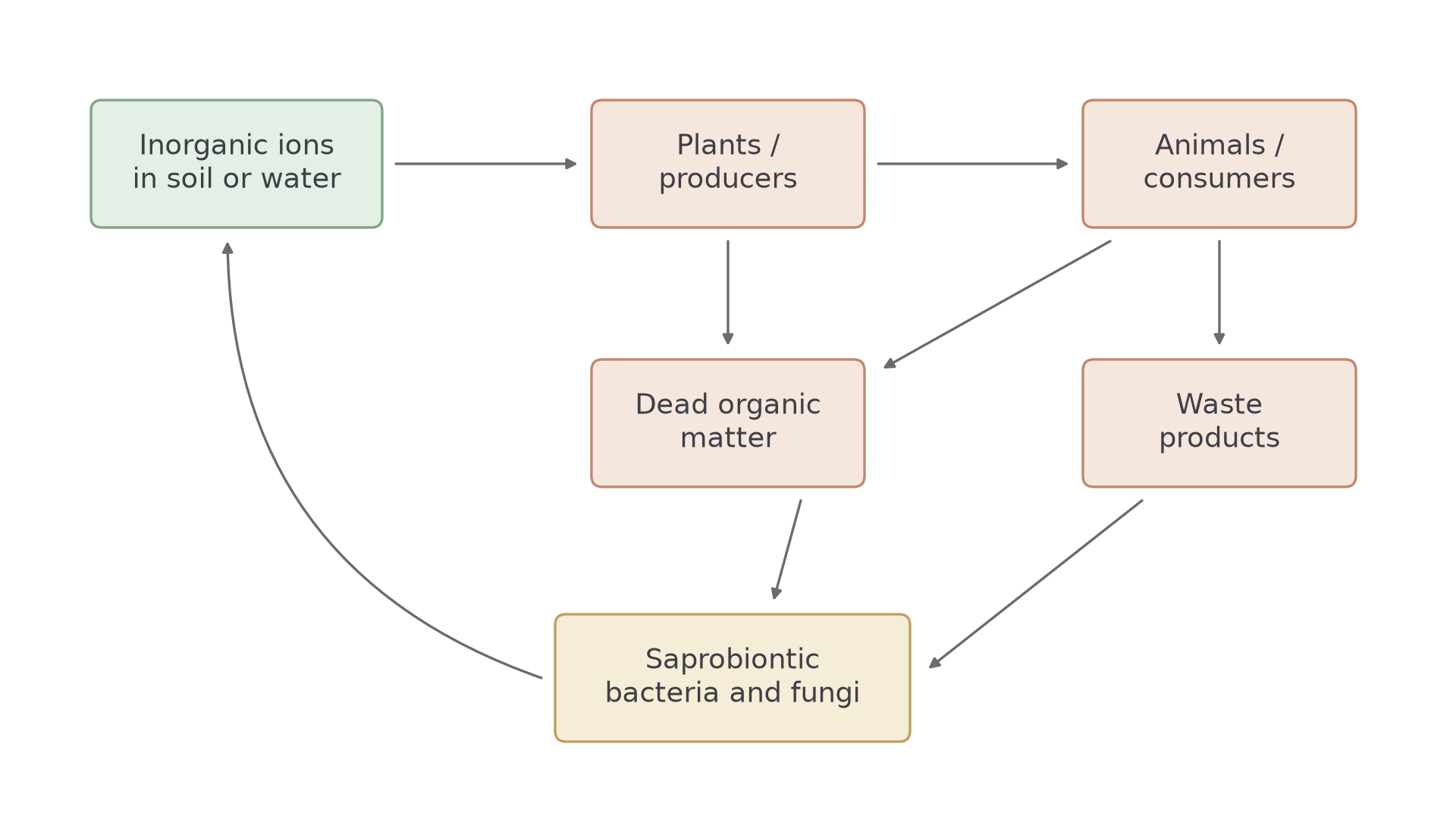
This is the main route, not every transfer: some excreted ions return directly to the environment. Only matter goes round the loop, because respiration disperses energy as heat.
How saprobionts release nutrients
Saprobionts, including many bacteria and fungi, feed by saprobiotic nutrition:
- They secrete extracellular enzymes onto dead organic matter.
- The enzymes digest large molecules by hydrolysis into small soluble ones, such as proteins into amino acids.
- The saprobionts absorb these products and use them in metabolism and growth.
- Their metabolism can then release inorganic forms, such as ammonium and phosphate ions, which plants absorb.
What controls decomposition rate
Saprobionts rely on enzymes and respiration, so decomposition depends on conditions:
- Temperature: warmth increases enzyme activity up to an optimum; excessive heat can denature enzymes.
- Moisture: water is used in hydrolysis and other metabolic reactions.
- pH: a suitable pH supports enzyme function.
- Oxygen: oxygen supports aerobic respiration.
Exam tip
Link each condition to enzymes or a named process. AQA credited water for hydrolysis in 2025; “warm, so decomposition is faster” can lose the mark.
Waterlogging fills air spaces and restricts oxygen, so “warm and wet” does not mean that flooded soil decomposes fastest.
The nitrogen cycle
Air is about 78% nitrogen gas, yet crops can still run short of nitrogen.
Plants and animals have no enzyme that breaks the triple bond in nitrogen gas, , so they depend on bacteria. For each arrow in the diagram, name the starting and finishing substances.
[DIAGRAM: asset_name: nitrogen-cycle-corrected; asset_slug: nitrogen-cycle-corrected; recommended_method: retained_png; caption: Nitrogen transformations: fixation from atmospheric nitrogen to ammonium, ammonification from organic waste, aerobic nitrification through nitrite to nitrate, uptake, feeding and anaerobic denitrification from nitrate to nitrogen gas.; description: Nitrogen transformations: fixation from atmospheric nitrogen to ammonium; ammonification from organic waste; aerobic nitrification through nitrite to nitrate; uptake, feeding and anaerobic denitrification from nitrate to nitrogen gas.]
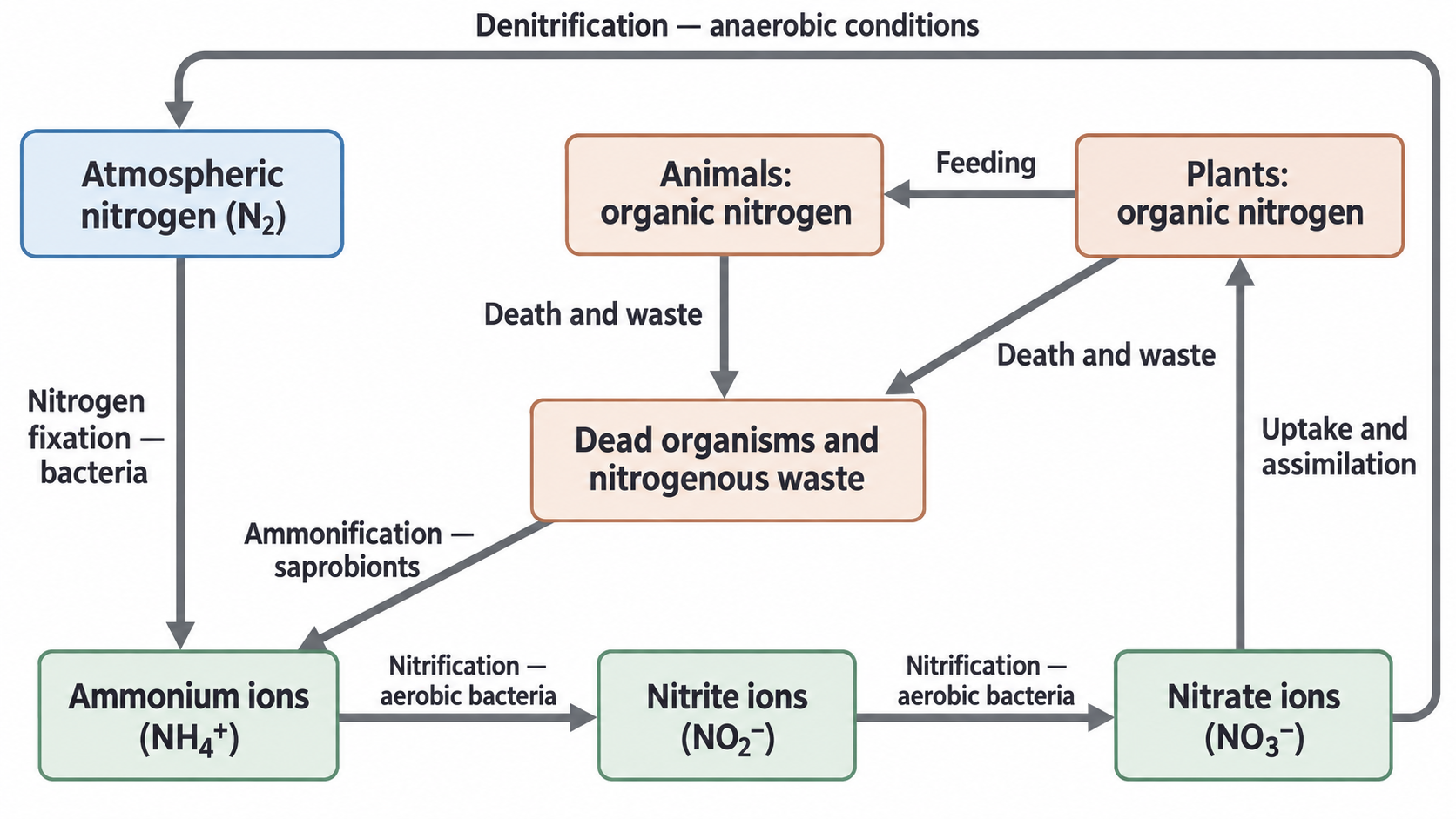
Start at the central box and follow a protein’s nitrogen along the bottom row:
- Saprobiotic nutrition: saprobionts digest proteins and absorb products such as amino acids.
- Ammonification: their metabolism releases ammonia, forming ammonium ions, , in soil.
- Nitrification, first stage: aerobic nitrifying bacteria oxidise ammonium to nitrite, .
- Nitrification, second stage: aerobic nitrifying bacteria oxidise nitrite to nitrate, .
- Uptake: plants absorb nitrate, and also some ammonium, and use the nitrogen to synthesise amino acids, proteins and nucleotides.
Feeding passes organic nitrogen to animals, and death and nitrogenous waste return it to step 1.
Exam tip
Name the starting compound, then keep the order ammonia, nitrite, nitrate. On AQA’s 2025 question, most answers missed the first mark because they named no nitrogen-containing compound, such as protein.
Adding and removing nitrogen
- Nitrogen fixation: nitrogen-fixing bacteria, free-living or in legume root nodules, convert nitrogen gas to ammonia. This adds fixed nitrogen, meaning nitrogen already combined into a usable compound.
- Denitrification: when oxygen is scarce, denitrifying bacteria use nitrate in place of oxygen as the final electron acceptor in respiration (3.5.2), reducing it to nitrogen gas. This removes nitrate from soil.
Root-nodule bacteria and legumes have a mutualistic association: both benefit. The bacteria obtain organic compounds and the plant obtains fixed nitrogen.
Watch out
The bacteria fix nitrogen, not the legume. Nitrifying bacteria are a different group: they oxidise nitrogen that is already fixed, not atmospheric nitrogen.
Species names are not required:
| Process | Nitrogen transformation | Organisms and conditions |
|---|---|---|
| Ammonification | Organic nitrogen in proteins, amino acids or urea → ammonia/ammonium | Saprobionts |
| Nitrification | Ammonium → nitrite → nitrate | Nitrifying bacteria, aerobic |
| Nitrogen fixation | Nitrogen gas → ammonia/ammonium | Nitrogen-fixing bacteria, free-living or in root nodules |
| Denitrification | Nitrate → nitrogen gas | Denitrifying bacteria, anaerobic |
Why waterlogging lowers soil nitrate
In waterlogged soil, water replaces much of the air between soil particles, so oxygen falls. This lowers nitrate in two ways:
- Limited oxygen reduces nitrification, so less nitrate forms.
- Anaerobic denitrification removes nitrate as nitrogen gas.
Less nitrate can limit synthesis of nitrogen-containing molecules and reduce plant growth. Nitrogen is never “destroyed”: it changes form or leaves the local soil.
The phosphorus cycle
Phosphorus has no major gas in its cycle, so its slowest route runs through rock rather than the air.
Phosphorus cycles mainly as phosphate ions and phosphorus-containing organic compounds. Start at the rock on the left of the diagram.
[DIAGRAM: asset_name: 5.4 - Nutrient cycles - Diagram 2; asset_slug: 5.4 - Nutrient cycles - Diagram 2; recommended_method: retained_png; caption: Phosphorus cycle linking weathering of rock, phosphate in soil or water, plant uptake, feeding, decomposition and sediment formation, no major gaseous phase.; description: Phosphorus cycle linking weathering of rock, phosphate in soil or water, plant uptake, feeding, decomposition and sediment formation; no major gaseous phase.]
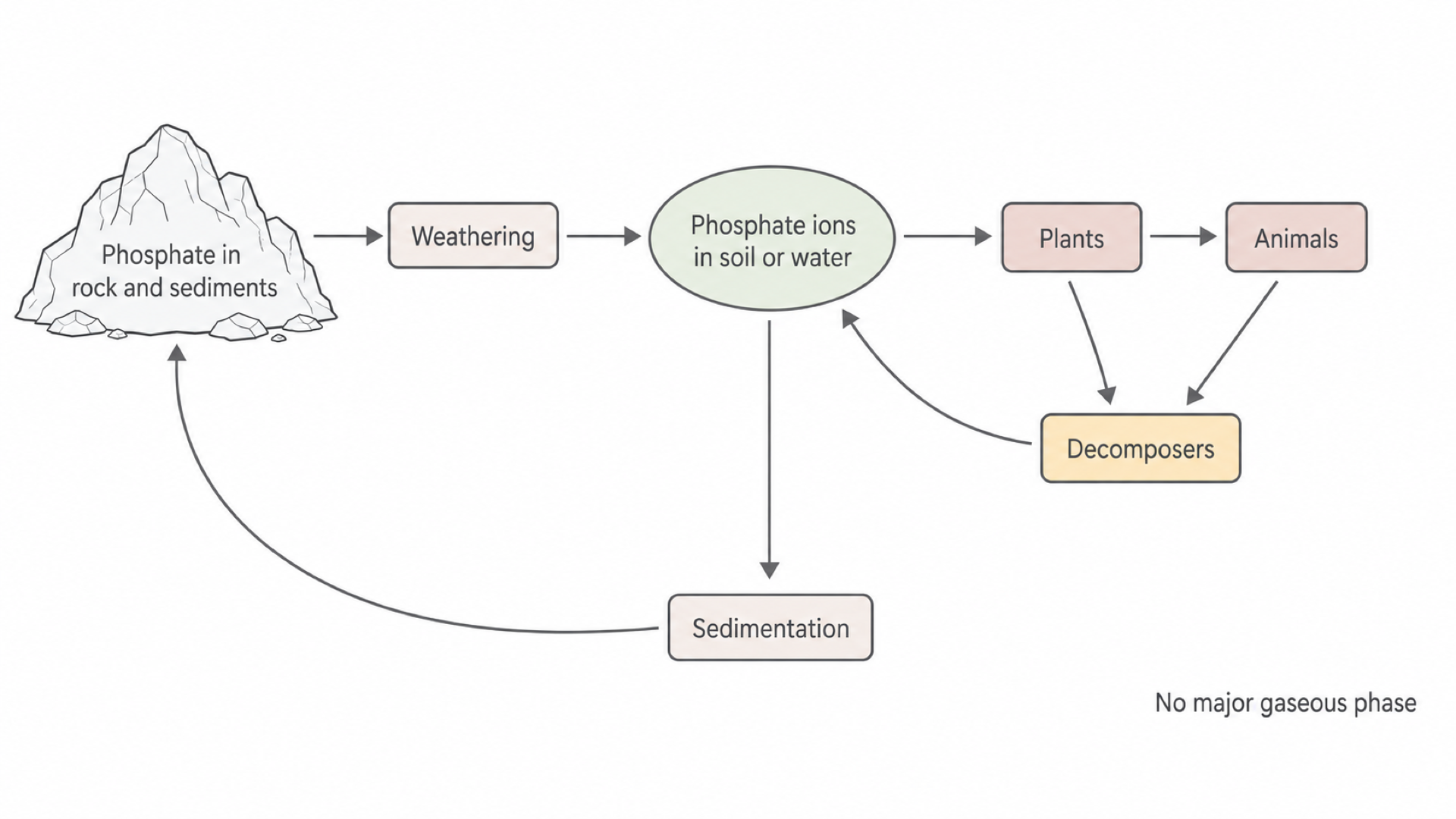
- Weathering releases phosphate from rocks into soil and water.
- Plants absorb phosphate through their roots and incorporate phosphorus into molecules such as ATP, DNA and phospholipids.
- Animals obtain it by feeding.
- Dead material and waste pass to decomposers, the saprobionts: these are the arrows down from plants and animals.
- Decomposition and mineralisation (converting organic compounds to inorganic ions) release phosphate ions for reuse.
The slow route through rock
Some phosphorus is carried into rivers and seas, where it is incorporated into organisms or deposited in sediments. Over geological timescales, sediments form rock, and uplift can expose it to weathering again. These transfers are far slower than uptake and decomposition within a soil.
How this differs from the nitrogen cycle
The phosphorus cycle has no major gaseous phase, so it has no equivalent of fixation or denitrification, although both cycles include uptake, feeding and decomposition. New phosphate enters soil and water mainly by weathering, which is slow, so phosphate locked in rock is not immediately available to plants.
Continue this lesson.
You’re previewing NovaLearn without an account. Create a free account to read the rest.
Create free account