3.6.1.1 - Survival and response
A woodlouse has no plan, a seedling has no nerves, and your hand leaves a hot pan before you decide to move it. Each is a simple response that raises the chance of survival. This lesson covers taxes and kineses, IAA-controlled plant growth, the three-neurone reflex and how to investigate IAA.
Why response improves survival
Responses share one basic pattern, which links the change an organism detects to what it does next.
Organisms increase their chance of survival by responding to changes in their environment: drying air, light from one side, a hot pan.
A stimulus is a detectable change in the internal or external environment. Receptors detect that stimulus, a coordinator processes the information, and an effector produces the response.
Stimulus → receptor → coordinator → effector → response
In animals, coordination may involve the nervous system, which can produce very rapid responses. In flowering plants, growth factors such as indoleacetic acid (IAA) move from growing regions to other tissues and change growth.
A response helps because of what it leads to. Growing towards light can increase light absorption for photosynthesis; growing roots downwards improves anchorage and access to water and mineral ions; withdrawing a limb reduces the time its tissues are exposed to a damaging stimulus.
These responses are not conscious plans to survive: natural selection (3.4.4) favoured individuals whose alleles produced them.
Exam tip
Name the specific benefit of a response. In the 2025 paper, shrimps moving into darkness earned the mark for being less visible to predators; a general phrase such as “to ensure survival” can lose marks.
Taxes and kineses
A mobile organism can reach better conditions by steering, or simply by moving differently where conditions differ.
Bacteria moving up a nutrient concentration gradient and woodlice moving away from light share one feature: their direction depends on where the stimulus is.
Taxis
A taxis is movement of the whole organism in a direction relative to a stimulus. A positive taxis is towards it; a negative taxis is away.
So the bacteria show positive chemotaxis and the woodlice negative phototaxis. Name both the direction and the stimulus when the evidence allows it.
A taxis can keep an organism in a favourable environment because its direction takes it there: bacteria reach more nutrients, and woodlice tend to reach dark, damp places where they lose less water.
Kinesis: movement without a direction
Woodlice may also move faster in dry air and more slowly in humid air, with no steering at all.
Kinesis
A kinesis is a non-directional change in movement: the speed of movement, the rate of turning, or both change with stimulus intensity.
With no orientation towards humid air, this can still gather woodlice there, which reduces water loss:
- Moving fast in dry air covers more ground, so random movement carries some into humid conditions.
- Moving slowly there increases residence time, the time spent in that area.
- More woodlice are therefore counted in humid air later.
Do not learn a universal rule that more turning always helps an animal leave an area. Turning more just after crossing into dry air can bring an animal back to humid air, but turning more once deep in dry air keeps it there for longer.
Speed and turning can vary separately, so describe the measured behaviour in a supplied experiment.
Telling taxis from kinesis
An endpoint count tells you where animals accumulated, not how each got there, because both mechanisms can maintain animals in favourable environments. Observations of individual tracks distinguish them:
| Taxis | Kinesis | |
|---|---|---|
| What changes with the stimulus | Direction of movement | Speed, rate of turning or both |
| Video tracks | Consistent orientation; the path reverses when the light’s position is reversed | No preferred heading; speed or turning differs between conditions |
| Example | Woodlice moving away from light | Woodlice slowing in humid air |
Tropisms and IAA in flowering plants
A plant bends by growing more on one side, and the concentration of IAA decides which side that is.
Tropism
A tropism is the growth of part of a plant in response to a directional stimulus.
Phototropism responds to light and gravitropism to gravity. Towards the stimulus is positive; away is negative.
How IAA makes cells elongate
Specific growth factors move from growing regions to other tissues, where they regulate growth. Here that is indoleacetic acid (IAA), an auxin produced in the tips of shoots and roots, which moves to the elongation zone. In a shoot:
- An appropriate IAA concentration activates enzymes that loosen the cell wall.
- This increases the wall’s plasticity: its ability to stretch permanently.
- The cell takes up water by osmosis, which extends the wall, so the cell elongates.
Bending comes from differential elongation, not the shaded side producing extra cells by mitosis: the organ curves towards the side that elongates less.
Watch out
Plasticity is not elasticity: an elastic wall springs back, but a plastic wall stays stretched. “Elasticity” can lose marks, and so can “IAA causes elongation” with no mention of plasticity.
Why the same IAA has opposite effects
Shoots and roots respond differently to IAA concentration. On the graph, the dashed line means no effect on elongation. Above it IAA stimulates elongation; below it IAA inhibits elongation, so cells elongate less than they would without IAA.
[DIAGRAM: asset_name: iaa-concentration-effect; asset_slug: iaa-concentration-effect; recommended_method: retained_png; caption: Effect of IAA concentration on elongation in roots and shoots, with a dashed no-effect line. The root curve peaks at a low concentration and falls below the line while the shoot curve is rising.; description: Effect of IAA concentration on elongation in roots and shoots, with a dashed no-effect line. The root curve peaks at a low concentration and falls below the line while the shoot curve is rising.]
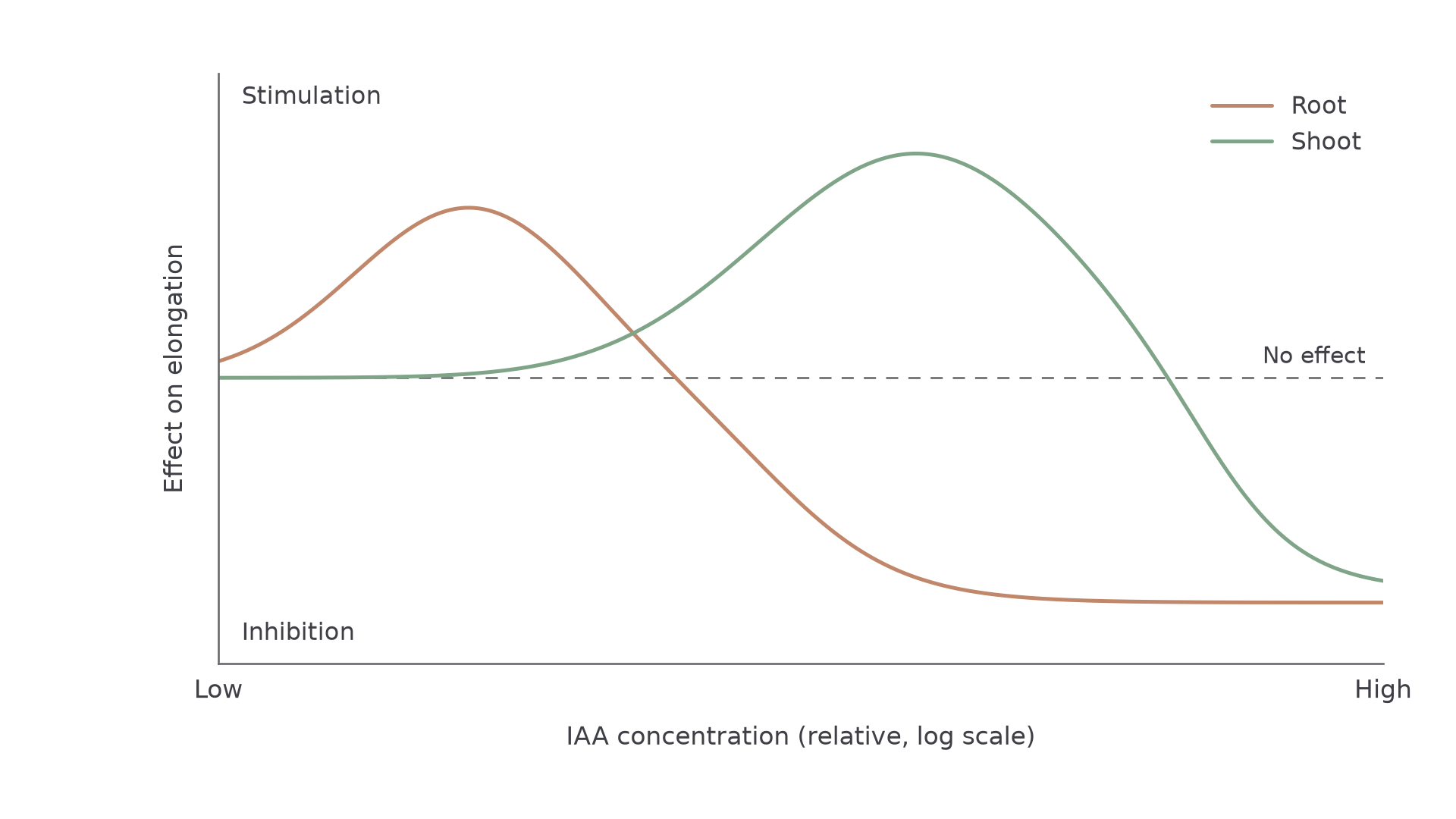
Read each curve from left to right:
- Root: very low IAA concentrations can stimulate root elongation, but a rise above the root optimum, the peak, inhibits it.
- Shoot: IAA stimulates cell elongation over a higher concentration range, and very high concentrations inhibit it too.
Roots are more sensitive to IAA than shoots, so a concentration that stimulates a shoot can inhibit a root: find the stretch of axis where the curves lie on opposite sides of the line. The standard answers below assume this range; actual sensitivity varies with species.
Phototropism and gravitropism
In a responsive seedling exposed to unilateral light (light from one side only), more IAA moves to the shaded side of both shoot and root.
- Shoot: the extra IAA stimulates elongation on the shaded side, so the shoot bends towards the light.
- Root: the higher concentration inhibits elongation on the shaded side, so the light side elongates more and the root bends away from the light.
If a root or shoot is horizontal, gravity causes more IAA to collect on the lower side. In the diagram, purple dots show IAA crowded along the lower side of both organs; compare the curvature.
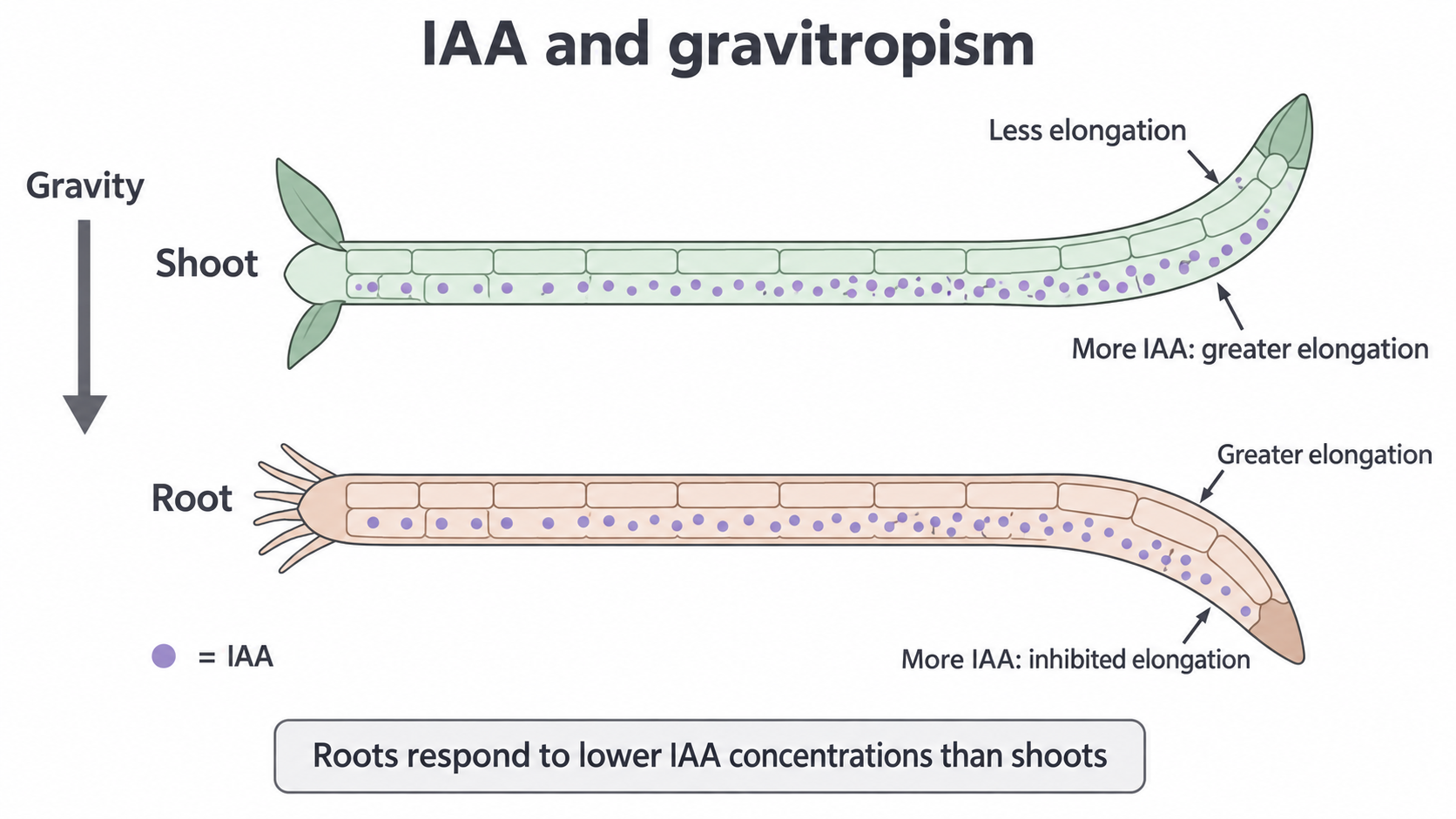
- Shoot: the extra IAA stimulates elongation on the lower side, so the shoot bends upwards, away from gravity.
- Root: elongation is inhibited on the lower side, so the upper side elongates more and the root bends downwards, towards gravity.
Continue this lesson.
You’re previewing NovaLearn without an account. Create a free account to read the rest.
Create free account